
Most conversations about fleet management systems start with features: GPS dots on a map, dashcams, engine diagnostics. But the real value shows up somewhere else: in fewer accidents, lower repair bills, and dispatchers who stop playing phone tag with drivers.
This article looks past the feature list. Here's what a fleet management system actually changes about day-to-day operations.
TL;DR
- A fleet management system centralizes vehicle tracking, driver behavior, and maintenance data into one platform
- Top advantages include up to 30% lower costs, 38% fewer accidents, and real-time visibility
- Skipping fleet management usually means rising fuel costs, more accidents, and safety incidents that compound over time
- Full value comes from consistent use and acting on the data, not just collecting it
What Is a Fleet Management System
A fleet management system is software connected to GPS and OBD-II devices plugged into each vehicle. It shows you where vehicles are, how drivers behave behind the wheel, and when a truck needs maintenance before it breaks down on a job site.
You'll typically find these systems in
- Construction and utility fleets managing mixed vehicle and equipment assets
- service businesses like HVAC, plumbing, and electrical contractors juggling multiple daily stops
- Trucking and logistics operations tracking long-haul compliance
- Small businesses running as few as four or five vehicles
| Capability | GPS tracking alone | Full fleet management system |
|---|---|---|
| Vehicle location | Yes | Yes |
| Driver behavior scoring | No | Yes |
| Maintenance alerts | No | Yes |
| Compliance & reporting | No | Yes |
This visibility drives lower costs, safer driving, and data-backed decisions instead of guesswork.
Key Advantages of a Fleet Management System
The advantages below aren't theoretical. Each one ties to numbers businesses already track: cost per mile, accident frequency, on-time delivery rates, and compliance turnaround.
Reduced Operational Costs and Improved ROI
Lower fuel spend. Less idle time. Fewer surprise repair bills. That's what cost control looks like once a fleet management system replaces manual tracking with data.
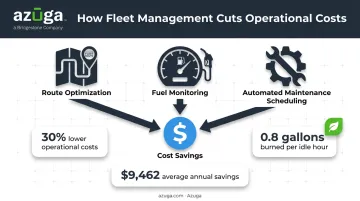
The mechanism breaks down into three levers
- Route optimization cuts wasted miles
- Fuel monitoring flags waste as it happens
- Automated maintenance scheduling catches small issues before they turn expensive
Idle time deserves close attention on its own. The Department of Energy estimates heavy-duty trucks burn about 0.8 gallons per idle hour, and long-haul fleets waste more than 1 billion gallons of fuel annually just sitting still (Department of Energy data).
Azuga customers report an average 30% reduction in operational costs and $9,462 in annual savings, driven by combined improvements in fuel use, maintenance timing, and accident-related expense.
Pest control fleets using the platform saw idling drop 29% and breakdowns fall by half. Diamond Engineering, a construction firm, brought driver behavior and asset location data to its insurer and walked away with a 10% premium discount.
Why it works: Visibility into cost drivers replaces guesswork with a paper trail. Once you know which vehicle idles longest or missed its last service interval, budgeting stops being reactive.
KPIs impacted:
- Cost per mile
- Fuel consumption
- Maintenance spend
- Vehicle utilization rate
When this matters most: Larger fleets and thin-margin operations feel it fastest. With non-fuel costs at a record high, every controllable dollar counts more than it used to.
Improved Driver Safety and Reduced Accident Risk
Fewer accidents. Safer habits. Less liability hanging over every dispatch. This is where fleet management systems earn their keep for many operators.
Real-time alerts catch risky behavior, such as speeding, harsh braking, and hard acceleration, before it becomes an incident report. Dashcam footage and driver scorecards turn that data into coaching conversations instead of after-the-fact blame sessions.
Federal research backs the mechanism, with a caveat. FMCSA's field test of a telematics system found that pairing event detection with driver feedback and coaching, not passive monitoring alone, produced the safety improvement (FMCSA's telematics field study). The data only helps if someone acts on it.
Azuga customers average a 38% decrease in accidents and a 57% reduction in speeding citations. The platform's SafetyCam AI Collision Reconstruction feature adds another layer: dual-facing HD cameras capture footage automatically when a risky event triggers, and an AI engine tags the likely cause.
Azuga reports that 70% of accidents involving its customers' drivers weren't actually the driver's fault. That footage can settle a disputed claim in days instead of months.
KPIs impacted:
- Accident frequency
- Speeding events
- Harsh braking and acceleration incidents
- Insurance premium trends
When this matters most: Fleets with new or high-mileage drivers see the biggest swing, along with industries carrying heavy liability exposure, like trucking, towing, and utility work, where one bad incident can mean a lawsuit rather than just a repair bill.
Real-Time Visibility and Data-Driven Decision Making
Knowing where every vehicle is right now changes how a business runs. No more calling drivers to check job status. No more guessing which truck sits closest to the next stop.
A centralized dashboard pulling GPS location, engine diagnostics, and driver data into one screen, refreshing as often as every 30 seconds on higher tiers, eliminates most manual check-in calls. Geofencing alerts flag when a vehicle enters or leaves a job site. Breadcrumb history lets managers reconstruct a route after the fact, useful for proving what actually happened after an accident dispute.
Why it works: Real-time data replaces reactive firefighting with faster dispatch decisions. Instead of reshuffling a schedule after a problem surfaces, managers see it coming.
KPIs impacted:
- Asset utilization rate
- On-time delivery and service rate
- Compliance audit turnaround time
When this matters most: Multi-vehicle dispatch operations feel this immediately, along with compliance-heavy industries and any fleet that's outgrown what one person can track by memory.
What Happens When Fleet Management Is Missing or Ignored
Skip fleet management, or install it and ignore the data, and the consequences show up gradually, then all at once.
- Inconsistent results across drivers and routes, since there's no baseline to tell if a bad week is an anomaly or a pattern
- Higher error rates in maintenance timing, leading to breakdowns that could've been scheduled around instead of towed in
- Reactive firefighting replaces proactive planning for repairs and compliance deadlines
- Rising costs that add up unnoticed: unmonitored fuel waste and idle time alone can inflate operating costs by up to 30% a year
- Difficulty scaling once a fleet outgrows what one manager can track by spreadsheet
None of these show up as a single dramatic failure. They show up as a fleet that costs more to run every year, without an obvious reason why.
How to Get the Most Value from a Fleet Management System
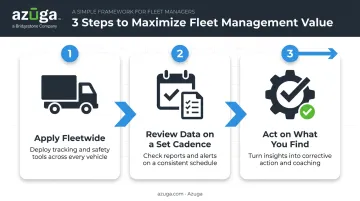
A fleet management system only pays off under three conditions.
- Apply it fleetwide, not selectively. Tracking half your vehicles gives you half a baseline, and drivers on unmonitored vehicles have no incentive to change behavior.
- Review the data on a set cadence. Weekly or monthly check-ins on cost, safety, and utilization metrics catch problems while they're still small.
- Act on what you find. Coach the driver with repeated hard-braking events. Reroute the truck burning excess idle time. Move up the maintenance date flagged by engine diagnostics.
Adoption is often the real barrier, not the technology. Azuga's self-install OBD-II tracker plugs into a vehicle's diagnostic port and takes just minutes to set up, with no technician, wiring, or scheduled downtime required.
That plug-and-play setup makes it realistic to get an entire fleet online in days instead of months. Speed matters here: the goal is a fleetwide baseline, not a partial one.
Conclusion
The real value of a fleet management system lies in the clarity and control it brings to decisions that used to run on guesswork. That means knowing what a truck costs to operate, how a driver handled a near-miss, and where a vehicle sat at 2 p.m. on a Tuesday.
These advantages compound. Lower fuel waste this month becomes a better maintenance budget next quarter. Fewer accidents this year become a lower insurance premium at the next renewal. Treat fleet management as an ongoing practice rather than a single purchase, and platforms like Azuga help those returns keep building.
Frequently Asked Questions
What are the advantages of a fleet management system?
Lower operational costs, safer drivers, and real-time visibility into vehicle and driver performance are the three core benefits. Together, they cut day-to-day expenses and long-term liability risk.
What is the primary purpose of a fleet management system?
It gives businesses centralized visibility and control over vehicles, drivers, and costs, driving better efficiency and lower operational risk.
How much does a fleet management system cost?
Packaging scales per vehicle. Azuga matches packaging to fleet size and the features you select, with premium tiers adding AI dashcams and high-frequency tracking.
How quickly can a business see ROI from fleet management software?
Many businesses see measurable savings within the first few months through reduced fuel waste and fewer accidents. Full ROI typically builds over 6 to 12 months as maintenance and safety data compound.
Is fleet management software worth it for small business fleets?
Yes. Even fleets with four or five vehicles benefit from reduced fuel costs and safer driving, especially with affordable, self-install solutions built for businesses of any size.
What's the difference between GPS tracking and a full fleet management system?
GPS tracking shows only vehicle location. A full fleet management system adds maintenance alerts, driver safety scoring, compliance tools, and reporting on top of that location data.