
Unplanned downtime still drains budgets. Maintenance costs keep climbing. And as fleets and equipment portfolios grow, keeping eyes on every vehicle, machine, and asset by spreadsheet just doesn't scale anymore. Many operations teams struggle with exactly this: too much equipment, too little visibility, and maintenance decisions based on guesswork instead of data.
Artificial intelligence changes that equation. It shifts asset management from reactive firefighting to predictive, data-driven oversight, catching problems before they become five-figure repair bills or safety incidents.
This guide breaks down what AI in asset management actually means, where it delivers real value, the challenges worth planning for, and a practical, step-by-step path to implementation.
Key Takeaways
- AI shifts maintenance from calendar-based schedules to condition-based servicing, cutting costs and downtime
- IoT data, machine learning, and generative AI combine to predict failures early
- AI dashcams help exonerate drivers, proving 70% of accidents aren't their fault
- Data quality and legacy equipment gaps are the biggest barriers to a smooth rollout
- Self-installable platforms now bring AI-driven tracking to small fleets, not just enterprises
What Is AI in Asset Management?
AI in asset management means layering machine learning, automation, and real-time data analysis on top of traditional maintenance and tracking processes. Instead of servicing equipment on a fixed schedule or waiting for it to break, organizations use continuous data streams to understand exactly what condition an asset is in, right now.
One important clarification: this guide focuses on physical assets, meaning vehicles, machinery, equipment, and infrastructure. That's distinct from financial or investment "asset management," a term that gets used constantly in banking and wealth management contexts. If you're managing trucks, HVAC systems, or construction equipment, you're in the right place.
The shift is already reshaping executive priorities. In an IBM survey, 71% of executives say generative AI changes how they'll manage physical assets, and 72% say it increases the strategic value those assets hold for the business (IBM Institute for Business Value). That's a notable shift from viewing maintenance as a cost center to treating it as a competitive lever.
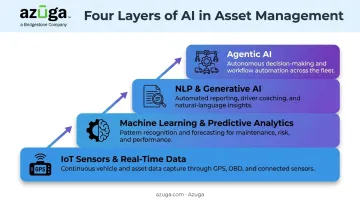
IoT Sensors and Real-Time Data Collection
IoT devices and telematics hardware are the data foundation everything else depends on. Sensors mounted on vehicles and equipment continuously capture
- GPS location and route history
- Engine diagnostics and fault codes
- Vibration, temperature, and pressure readings
- Fuel consumption and idle time
Without this steady stream of real-world data, AI models have nothing to learn from. This is the layer that makes prediction possible in the first place.
Machine Learning and Predictive Analytics
Machine learning models study historical sensor data to learn what "normal" looks like for a given asset. Once that baseline exists, the model flags deviations early, such as a bearing running hotter than usual or a battery draining faster than its typical curve.
Predictive analytics takes this further by estimating the remaining useful life of a component or vehicle part. Rather than a hard failure date, most models produce a probability window, giving maintenance teams a realistic runway to plan repairs before something actually breaks down on the road.
Natural Language Processing and Generative AI
Maintenance data isn't just numbers. Technician notes, inspection reports, and driver comments are messy, unstructured text, and most of it never gets analyzed. NLP changes that by scanning maintenance logs and reports to surface recurring issues that would otherwise stay buried in a filing cabinet.
Generative AI adds another layer of value by handling the paperwork. It can draft
- Work orders from a technician's shorthand notes
- Maintenance and inspection reports
- Compliance documentation for audits
That's real time back in a maintenance team's day, without sacrificing accuracy.
Agentic AI: The Next Frontier
Agentic AI refers to systems that can monitor conditions, triage issues, and take action with minimal human input, closing the loop between detection and response. It's an exciting direction, but it's still early. These systems need defined guardrails and human oversight before they're handed the keys to autonomous decision-making across a full asset portfolio.
Key Benefits of AI in Asset Management
The case for AI isn't theoretical. It shows up directly in downtime hours, maintenance budgets, and staff productivity.
Fewer Surprise Breakdowns
Unplanned downtime is expensive at every scale. Siemens estimates it costs the world's 500 largest companies $1.4 trillion annually, equal to 11% of their revenue (Siemens, The True Cost of Downtime 2024).
AI catches the early warning signs before they escalate: an unusual vibration pattern, a fault code trending in the wrong direction. Spotting these signals early stops a roadside breakdown or a stalled production line before it starts.
Lower Maintenance Costs, Longer Asset Life
Catching problems early is only half the savings story. Condition-based servicing beats fixed schedules because it services equipment when it actually needs attention, not on an arbitrary calendar. The U.S. Department of Energy estimates predictive maintenance delivers 8% to 12% in cost savings compared to preventive maintenance (DOE Operations & Maintenance Best Practices Guide).
Azuga's own fleet customers see this play out in practice, with an average of $9,462 in annual savings from tighter maintenance and cost management, alongside a 38% reduction in accidents.
Freeing Up Your Team for Higher-Value Work
Beyond maintenance savings, AI reclaims something harder to quantify: your team's time. Automated monitoring and reporting eliminate hours of manual inspection logging and status checks. That's time redirected toward:
- Focusing on strategic planning instead of routine data entry
- Responding faster to genuine anomalies
- Coaching drivers or technicians instead of chasing paperwork
Key Use Cases for AI in Asset Management
Here's where the theory turns into daily operations.
Predictive maintenance scheduling. AI combines sensor readings with maintenance history to service equipment based on actual condition, not a generic 5,000-mile or 90-day rule. This alone tends to be the fastest ROI use case for most fleets.
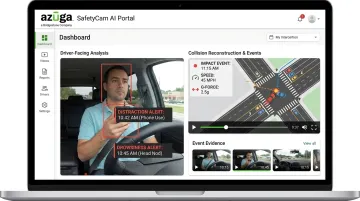
Fleet tracking and safety monitoring. Real-time GPS and driver behavior data cut accidents and improve compliance. Azuga's GPS tracking, paired with SafetyCam AI and Collision Reconstruction, uses a neural learning network to analyze driver-facing video and flag risky events like distraction.
Since 70% of accidents aren't actually the fault of fleet drivers, that AI-analyzed footage becomes powerful evidence. It helps exonerate drivers and cut litigation costs when a claim gets filed.
Asset lifecycle management. AI analyzes total cost of ownership signals such as repair frequency, fuel costs, and downtime hours to help guide repair-vs-replace decisions. Diagnostic trouble code alerts and expense tracking give fleet managers the raw data needed to spot when an aging vehicle is costing more to keep than to replace.
Energy and facilities optimization. For fleets running depot or warehouse facilities, AI-driven building controls identify waste across HVAC, lighting, and equipment usage. Lawrence Berkeley National Laboratory modeling estimates AI could reduce commercial building energy use by roughly 8% to 19% by 2050, a meaningful dent in operating costs at scale.
Compliance and safety automation. AI tools help regulated industries like trucking, utilities, and waste management stay ahead of requirements such as FMCSA's Electronic Logging Device rule. This means automating hours-of-service tracking and inspection documentation instead of relying on manual logs.
Challenges to Consider Before Implementation
AI asset management isn't plug-and-play. Three obstacles come up again and again.
Data quality gaps. AI models are only as good as the data feeding them. Incomplete sensor readings, inconsistent maintenance logs, or missing inspection records will undermine even the best model.
Integration hurdles. A Rockwell Automation survey of more than 1,500 manufacturers found organizations use only 44% of the data they collect effectively. Disconnected systems are usually to blame: CMMS, EAM, and legacy fleet software that were never built to talk to each other.
Legacy equipment gaps. Older vehicles and machinery often lack the sensors or connectivity needed for AI monitoring altogether. That means investing in retrofits such as battery-powered, hardwired, or Bluetooth beacon trackers and telematics hardware before AI can even get started on those assets.
How to Implement AI in Asset Management: A Step-by-Step Strategy
Rolling out AI across an entire asset portfolio at once is a recipe for stalled projects. Here's a more realistic path.
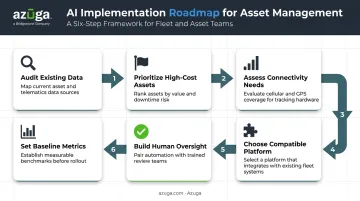
Audit your existing data. Review maintenance logs, sensor feeds, and vehicle diagnostics to identify quality gaps and blind spots in coverage before you build anything on top of it.
Prioritize high-cost, high-risk assets first. Start with the equipment or vehicles causing the most downtime or the biggest maintenance bills, not a company-wide rollout.
Assess connectivity needs. Determine which assets already have sensors or telematics installed, and which will need retrofitting before AI can generate useful insights.
Choose a platform that fits your operation. Look for AI-powered tools that integrate with what you already run. Azuga's battery-powered, hardwired, and Bluetooth beacon trackers mount to the asset and start transmitting data without a complex install or dedicated IT team, with plans scaled from a handful of vehicles to large enterprise fleets.
Build in human oversight. Define where AI recommendations require a manager's sign-off and where automated actions can run independently. This matters even more once agentic AI enters the picture.
Set baseline metrics before you deploy. Track downtime hours, maintenance cost per asset, and accident rates ahead of rollout so you can measure real ROI and adjust course over time.
The Future of AI in Asset Management
AI's role in asset management keeps expanding beyond today's predictive models. Three developments show where the technology is headed next
- Agentic AI is moving toward managing broad portfolios with minimal human input, monitoring and acting across dozens of assets at once. Gartner cautions many projects will stall over unclear value or governance gaps, so expect steady progress, not overnight change.
- Digital twins, virtual replicas of physical assets, simulate maintenance scenarios and lifecycle outcomes before anything happens in the real world. Industrial leaders use them for asset-health monitoring, throughput optimization, and scenario planning.
- Prescriptive maintenance goes beyond prediction, recommending the specific action to take instead of flagging a likely failure. Paired with sustainability tracking, it helps organizations hit efficiency and ESG targets while cutting downtime.
Frequently Asked Questions
How is AI used in asset management?
AI powers predictive maintenance and real-time condition monitoring by analyzing sensor and maintenance data to flag problems early, cutting the manual work of tracking asset health.
What is the difference between AI asset management and traditional asset management?
Traditional approaches rely on fixed schedules or reactive repairs after something breaks. AI asset management uses continuous, data-driven monitoring to service assets based on actual condition, not the calendar.
What industries benefit most from AI-powered asset management?
Industries with heavy physical asset and vehicle dependence see the biggest gains, including construction, trucking, utilities, and waste management. These sectors face high downtime costs and strict compliance requirements.
Can AI predict vehicle or equipment failure before it happens?
Yes. Sensor data combined with machine learning models can forecast a component's remaining useful life, giving teams a window to schedule repairs before an actual failure occurs.
What are the biggest challenges in implementing AI asset management?
The top three are inconsistent data quality, integration difficulties with existing CMMS or fleet systems, and retrofitting older equipment that lacks the sensors needed for connectivity.
Is AI asset management only for large enterprises, or can small businesses use it too?
Small businesses can absolutely use it. Affordable platforms with battery-powered, hardwired, and Bluetooth beacon trackers like Azuga make AI-driven tracking accessible without a dedicated IT team or enterprise-level budget.