
Introduction
Picture a fleet manager juggling spreadsheets, driver phone calls, and paper mileage logs to figure out where 30 trucks are right now. It doesn't scale.
One missed call means a late delivery. One lost fuel receipt means a compliance headache come tax season.
As fleets grow past a handful of vehicles, manual tracking becomes a full-time guessing game.
Fleet telematics fixes this by automating data collection across every vehicle and driver, delivering real-time visibility instead of after-the-fact reports.
The market reflects how urgently businesses need this: the commercial vehicle telematics sector was valued at $61.5 billion in 2024 and is projected to grow at a 13.8% CAGR through 2030, according to a 2024 report by Grand View Research.
This article breaks down exactly what telematics is, how it works, and what it costs.
Key Takeaways
- GPS tracking plus onboard diagnostics deliver real-time vehicle and driver monitoring.
- A telematics device collects data; software then converts it into dashboards and alerts.
- Safe-driving data collected through telematics can qualify fleets for insurance discounts.
What Is a Fleet Telematics System?
Telematics blends "telecommunications" and "informatics." In practice, it means using GPS technology alongside onboard diagnostics to collect, analyze, and transmit data about a vehicle's location, performance, and usage.
A fleet telematics system has two parts
- Hardware device: installed in the vehicle, this collects raw data.
- Cloud-based software platform: this visualizes that data as dashboards, alerts, and reports.
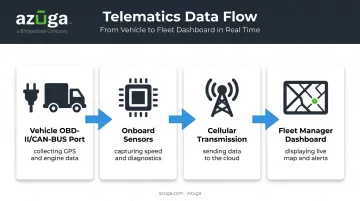
The device connects to a vehicle's OBD-II or CAN-BUS port, pulling data like GPS coordinates, speed, and engine diagnostics. It then transmits that information over cellular networks to the cloud, where fleet managers can view it almost instantly.
Here's what that looks like in the field: a fleet manager opens a live map showing every vehicle's current location, speed relative to posted limits, and idle time. If a driver has been sitting still for 20 minutes on a route with no scheduled stop, that shows up immediately, not in next week's report.
How Is Fleet Telematics Different from Fleet Management Software?
These terms get used interchangeably, but they aren't the same thing.
| Term | What It Covers |
|---|---|
| Telematics | The hardware and raw data it generates, including location, speed, and diagnostic codes |
| Fleet management software | The platform that interprets that data into dashboards, reports, and alerts fleet managers use |
Telematics generates the raw data. The software turns that data into decisions fleet managers can act on.
Most modern providers, including Azuga, bundle both pieces into a single integrated platform. That means fleets don't need to source GPS hardware from one vendor and reporting software from another, then hope the two play nicely together.
Key Components of a Fleet Telematics System
A telematics system relies on several data streams working together, not a single device performing one job.
GPS Tracking
Satellite-based location tracking forms the backbone of any telematics system. It enables
- Real-time vehicle location on a live map
- Geofencing that triggers alerts when a vehicle enters or exits a defined zone
- ETA notifications that keep customers informed without a phone call
Onboard Diagnostics (OBD-II)
The OBD-II connection captures engine performance data, fault codes, fuel levels, and mileage. This lets fleet managers flag maintenance needs before they become breakdowns, rather than discovering a problem when a truck stalls on the highway.
Telematics Device Hardware
Devices generally come in two forms: plug-and-play, self-install units that connect directly to the OBD-II port in seconds, and professionally hardwired devices, often used for heavy-duty or specialty vehicles.
Core hardware components typically include a GPS receiver, an accelerometer for detecting harsh driving events, and a cellular SIM card for data transmission.
Driver Behavior & Safety Analytics
Sensors track harsh braking, speeding, rapid acceleration, and cornering. Many platforms now add AI dashcams that detect distracted driving, such as phone use, by analyzing driver-facing video in real time.
Wireless Communication & Cloud Software
Data travels over cellular networks to a central dashboard, where fleet managers get real-time reporting and instant alerts rather than waiting for end-of-day summaries.
Common Integrations
Telematics systems rarely operate alone. They often connect with
- Fuel cards for automated expense tracking
- ELDs for Hours of Service compliance
- Dispatch and routing tools for job assignment
Key Benefits of Fleet Telematics Systems
Fleet telematics systems deliver measurable improvements across cost, safety, and compliance. Key benefits include
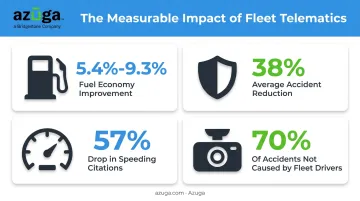
- Reduced operational costs: Route optimization, idle-time reduction, and fuel monitoring lower expenses directly. An FMCSA field trial measured fuel economy gains of 5.4% for sleeper cabs and 9.3% for day cabs after telematics-supported driver coaching.
- Improved driver safety: Behavior monitoring paired with in-cab coaching reduces risky driving patterns. Azuga customers have seen accidents decrease by 38% on average, with speeding citations dropping 57%.
- Preventive maintenance: Real-time diagnostic trouble codes catch mechanical issues before a vehicle breaks down on the job, letting managers schedule repairs on their own terms.
- Simplified regulatory compliance: Automated Hours of Service logging, IFTA mileage reporting, and DVIR workflows cut paperwork and help fleets avoid costly fines.
- Increased customer satisfaction: Accurate ETAs, proof of delivery, and real-time status updates mean customers stop calling to ask "where's my technician?"
- Liability protection: Collision reconstruction technology, like Azuga SafetyCam AI, helps prove fault after an accident, which matters since 70% of accidents aren't the fault of the fleet driver.
How Much Does Fleet Telematics Cost?
Most providers package fleet telematics by feature level, plus either a one-time or bundled hardware fee.
| Feature Level | Typical package focus |
|---|---|
| Basic GPS tracking | Location, alerts, standard reporting |
| Mid-tier | Driver scorecards, maintenance alerts |
| Advanced | AI dashcams, predictive maintenance |
Azuga packages match fleet needs and include a self-installable OBD-II device that removes the need for costly professional installation. That's a meaningful difference when you're outfitting dozens of vehicles and don't want to pay a technician for each one.
Which Industries Use Fleet Telematics Systems?
Telematics adoption spans nearly every industry that operates vehicles for work, including
- Construction
- HVAC and plumbing
- Electrical and utilities
- Landscaping and pest control
- Trucking and logistics
- Waste management
- Towing and roadside assistance
Needs differ by sector
- Trucking fleets prioritize HOS compliance and IFTA reporting.
- Service trades (HVAC, plumbing, electrical) lean on dispatch and routing tools, often integrated with platforms like ServiceTitan, to reach the nearest available technician.
- Construction fleets focus on asset and equipment tracking across job sites, not just vehicle location, often relying on tools like Procore for jobsite coordination.
Telematics scales from a landscaping company with four trucks to an enterprise fleet running hundreds of vehicles across multiple states.
How to Choose the Right Fleet Telematics System
Not every telematics platform fits every fleet. A few criteria matter more than others
- Ease of installation: Look for plug-and-play OBD-II devices that don't require a professional installer or vehicle downtime.
- Feature fit: Match tracking frequency, driver safety cameras, maintenance alerts, and integrations to your actual operational needs, not just a feature checklist.
- Support and total cost of ownership: Confirm what's included before signing a contract.
Azuga, for example, offers 24/7 unlimited support and scalable, customizable plans backed by Bridgestone, so fleets aren't locked into a rigid package that doesn't match their size or industry.
Frequently Asked Questions
What is telematics in fleet management?
Fleet telematics combines GPS tracking with onboard diagnostics to monitor a vehicle's location, engine performance, and driver behavior in real time. It's the technology behind live fleet dashboards.
How much does fleet telematics cost per vehicle?
Most fleets choose a package that depends on features and hardware. Azuga matches packaging to fleet size and the features you select, with a self-install device included.
Is fleet telematics the same as GPS tracking?
No. GPS tracking is one piece of telematics. A full telematics system also captures engine diagnostics, driver behavior, and safety data alongside location.
What data can a fleet telematics device collect?
Common data points include location, speed, idling time, harsh braking events, fuel usage, and engine diagnostic trouble codes.
Do I need a professional installer for a telematics device?
Not usually. Many devices, including Azuga's OBD-II plug-in, install in seconds without tools. Some hardwired devices for specialty vehicles may still require a technician.
Can fleet telematics help lower insurance premiums?
Yes. Insurers increasingly offer usage-based insurance discounts tied to safe-driving telematics data. Progressive Commercial's Snapshot ProView, for instance, reports new participants saving an average of 9% on premiums.