
Introduction
Picture a delivery driver waiting outside a client's office, engine running, AC blasting, for fifteen minutes while nobody's behind the wheel. Multiply that across a fleet of 30 trucks, five days a week, and you've got a fuel bill that's quietly bleeding money.
Idling simply means the engine is running while the vehicle isn't moving anywhere. It sounds harmless. It isn't.
A single vehicle idling for even a few minutes per stop adds up fast across a workday, a week, a fiscal year.
The U.S. Department of Energy estimates idling burns roughly a gallon of fuel per hour for every vehicle left running. For fleet managers tracking fuel, maintenance, and driver productivity, that waste is one of the most overlooked line items on the budget.
This article breaks down what idling actually means, why drivers do it, what it costs, where it's illegal, and how fleets are using data to cut it out entirely.
Key Takeaways
- Idling means the engine runs while the vehicle stays stationary and out of gear
- Passenger vehicles burn 0.2 to 0.5 gallons per hour at idle; trucks burn about 0.8 gallons per hour
- Many U.S. cities cap idling at 3 to 5 minutes per hour, with exemptions for traffic and extreme weather
- Stops longer than 10 seconds typically waste more fuel idling than restarting the engine
- GPS telematics and idle-reporting tools give fleets the visibility needed to actually fix the problem
What Is Idling in a Vehicle?
Technically, idling occurs when the engine runs while the transmission isn't engaged in drive or propulsion. No wheels turning, no forward motion, just the engine ticking over.
That definition matters because it excludes something drivers experience every single day: getting stuck at a red light or crawling through rush-hour traffic. Most anti-idling ordinances specifically carve out traffic-related stops from their rules. Drivers aren't "idling illegally" when stuck behind a jackknifed trailer on the interstate — they're just stuck.
Two Types of Idling
Idling generally falls into two buckets
- Voluntary idling: running the engine for comfort, waiting on a passenger, or convenience
- Necessary idling: powering a refrigeration unit, lift gate, diagnostic equipment, or other job-critical systems
How It Differs Across Vehicle Types
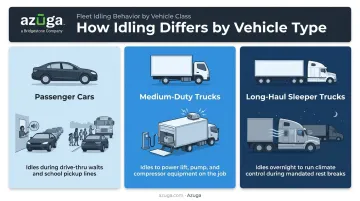
Idling looks different depending on what's behind the wheel
- Passenger cars idle mostly in drive-throughs, school pickup lines, and while warming up
- Medium-duty trucks idle to run PTO-driven equipment like lifts, pumps, or compressors
- Long-haul sleeper trucks idle for hours during mandated rest breaks to keep the cab heated or cooled
This is exactly why idling matters more for commercial fleets than for individual drivers. One car idling for ten minutes is a rounding error. Twenty trucks idling for ten minutes at every stop, every day, becomes a real operating expense.
Modern OBD-II and telematics systems solve the visibility problem here. They detect and log idle events automatically, turning what used to be an invisible cost into a measurable, trackable metric fleet managers can actually act on.
Why Do Drivers and Fleets Idle?
The Warm-Up Myth
A lot of drivers still believe engines need several minutes to warm up before driving. That was true decades ago with carbureted engines. It's not true anymore.
Modern fuel-injected engines need about 30 seconds before you can drive off, even in cold weather, according to the U.S. Department of Energy. Driving the car gently actually warms the engine and cabin faster than sitting still, and it gets the catalytic converter working sooner, too.
Comfort, Convenience, and Operational Needs
Plenty of idling has nothing to do with mechanics. Drivers leave engines running to
- Keep the AC or heat on while waiting for a passenger
- Stay comfortable in a drive-thru line
- Avoid restarting the engine during short breaks
Commercial fleets idle for similar comfort reasons, but often out of necessity rather than convenience
- Powering refrigeration units on reefer trucks
- Running lift gates or hydraulic equipment
- Maintaining cab temperature during federally mandated rest periods
That last point matters for long-haul drivers. FMCSA hours-of-service rules require a 30-minute break after 8 hours of driving and at least 10 hours off duty. The regulation requires rest, not engine idling, but sleeper cabs still need climate control, making it a major driver of long-haul fuel use.
The Hidden Costs of Idling
Fuel Waste, By the Numbers
Idling costs vary by vehicle class, but they're never zero
- Passenger vehicles: 0.2 to 0.5 gallons per hour at idle
- Heavy-duty trucks: approximately 0.8 gallons of diesel per idling hour, according to the EPA
- Long-haul trucks: idle 1,600 to 2,400 hours per year, burning roughly 900 to 1,400 gallons annually just sitting still
At today's diesel prices, that adds up to a serious line item on any fleet budget.
Engine and Transmission Wear
Idling for extended periods increases engine wear and drives up maintenance costs, per EPA fleet guidance. The mechanism isn't fully settled in research, but the outcome is consistent: engines that idle a lot need more attention, sooner.
Transmission wear is a related concern. Leaving a vehicle in Drive while idling for long stretches puts continuous strain on the transmission and torque converter, which can accelerate fluid breakdown over time. Idling in Park or Neutral carries less risk since there's no load on the drivetrain.
Emissions and Health Impact
Idling isn't just a fuel problem. A gasoline passenger car produces roughly 71 grams of carbon monoxide per hour at idle, based on EPA fleet modeling.
Over a year, EPA's SmartWay program estimates that idle reduction on a single long-haul truck avoids 9.7 to 14.6 metric tons of CO2, equivalent to roughly two to three years' worth of emissions from a typical passenger car.
The Fleet-Wide Multiplier
Here's where it gets serious. Take a mid-size fleet of 30 vehicles, each idling just 30 minutes a day. That's 15 vehicle-hours of wasted fuel daily, translating into thousands of dollars a year before maintenance costs even enter the picture.
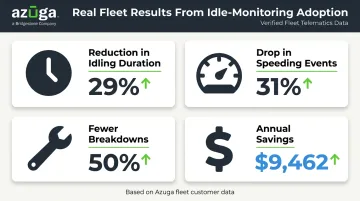
Azuga's own fleet data backs this up in practice. Pest control fleets using idle-monitoring tools saw an average 29% reduction in idling duration, alongside a 31% drop in speeding events and 50% fewer breakdowns. Kitsap Garage Door Company, another Azuga customer, reported $9,462 in annual savings by managing fleet costs (idling included) more effectively.
Beyond dollars, idle-heavy routes wear on drivers too. Sitting in a running vehicle for long stretches contributes to fatigue and eats into productive hours that could be spent on the next job.
Is Idling Illegal? Understanding Idling Laws
Idling laws exist in dozens of U.S. cities and states, and most follow a similar pattern: limit idling to a few minutes per hour, with exemptions for legitimate needs.
| Jurisdiction | Idling Limit | Key Exemptions |
|---|---|---|
| Cleveland, OH | 5 min/hour; 10 min in loading zones | Traffic, emergencies, PTO equipment, extreme temperatures |
| New York City | 3 min (1 min near schools) | Emergency vehicles, loading equipment |
| Austin, TX | 5 consecutive minutes | Traffic, military/emergency use, PTO work |
| Pennsylvania | 5 min/hour (trucks over 10,000 lb) | Emergencies, work-related PTO, bus climate control |
| New York State | 5 min (heavy-duty over 8,500 lb) | Traffic, maintenance, refrigeration, agricultural use |
Cleveland's ordinance is a good real-world example: 5 minutes in any 60-minute period, with extended allowances during extreme heat or cold.
Common Exemptions
Nearly every ordinance excludes
- Vehicles stuck in traffic or stopped by law enforcement
- Emergency vehicles performing their duties
- Equipment requiring engine power (PTO, refrigeration, lifts)
- Extreme weather conditions
Idling Laws vs. Unattended Vehicle Laws
Don't confuse anti-idling ordinances with unattended vehicle laws — they address different concerns. Ohio, for instance, requires drivers to stop the engine, lock the ignition, remove the key, and set the parking brake before leaving a vehicle unattended.
This is a theft-prevention and safety rule, aimed at goals separate from fuel conservation. A truck could be perfectly legal under an idling ordinance and still violate the unattended vehicle statute if the driver walks away without setting the brake.
How to Reduce Vehicle Idling and Cut Fleet Costs
Driver-Level Habits
Small behavior changes add up quickly
- Turn off the engine for any stop longer than 30 to 60 seconds
- Use seat and steering wheel heaters instead of running the engine for warmth
- Avoid drive-thru idling when a quick park-and-walk-in is realistic
- Skip the warm-up ritual: 30 seconds is plenty before driving off
Fleet-Level Policies
Fleet managers get further with structure than with reminders. Effective programs include
- Written anti-idling guidelines distributed to every driver
- Idle-time performance goals tied to driver scorecards
- Regular training refreshers on fuel-efficient habits
Technology That Reduces the Need to Idle
Two technologies remove the need to idle altogether. Automatic engine shutdown timers cut power after a set idle duration, while auxiliary power units (APUs) run climate control without the main engine, cutting fuel use during mandated rest periods.
Where Telematics Fits In
This is where GPS tracking earns its keep. Azuga's platform polls vehicle location and status every 30 seconds, the highest frequency available on the platform, precise enough to catch the exact moment a vehicle shifts from moving to stationary-but-running. That granularity is what makes idle logging accurate instead of a rough estimate.
A few features that make this practical for fleets of any size
- Trip Tags capture idle time alongside every stop, location, and route detail
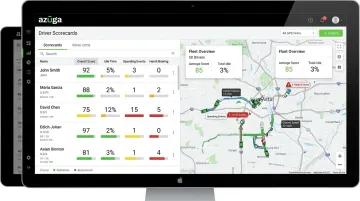
- Driver scorecards flag idling alongside speeding and harsh braking, turning data into coaching conversations rather than punishment
- Quarterly Fleet Reviews with a Customer Success Manager walk through idling trends as a standing metric
- Plug-and-play OBD-II devices install without a mechanic, so even a five-vehicle operation can start capturing idle data the same day
Fleets that use scorecard data to have direct conversations with drivers about inefficient habits see measurable results. Idling is often part of that broader efficiency conversation, and the payoff shows up in the numbers: Azuga customers who act on this data report cutting operational costs by up to 30%. The pattern holds across Azuga's customer base — fleets that can see idle time are the ones that manage to reduce it.
Frequently Asked Questions
How long is it okay to idle a car?
Most engines only need about 30 seconds to circulate oil and warm up before driving. For parked vehicles, most local ordinances cap allowable idling at 3 to 5 minutes per hour.
Is it illegal to keep a car running while parked?
Many cities enforce idling time limits, and separate "unattended vehicle" laws often require keys removed and the parking brake set. Rules and enforcement vary by jurisdiction, so check local ordinances.
Can idling damage your transmission?
Prolonged idling while the vehicle is in Drive can strain the transmission and contribute to fluid breakdown over time. Idling in Park or Neutral carries less risk since there's no load on the drivetrain.
What does it mean when a car is idling?
It means the engine is running while the vehicle remains stationary and isn't actively being driven. The transmission isn't engaged in propulsion.
Does idling waste more fuel than restarting the engine?
For stops longer than about 10 seconds, restarting the engine typically uses less fuel than continued idling, according to Department of Energy testing. Shorter stops are more of a toss-up depending on vehicle type.