
Introduction
Picture a landscaping crew showing up to a job site missing a trencher that's sitting in a different truck across town. Or an HVAC technician who spends 40 minutes searching for a diagnostic tool left at yesterday's job.
These scenarios play out daily across construction, utilities, and service businesses. Field asset management is the practice of tracking, monitoring, and maintaining the vehicles, tools, and equipment your crews rely on across scattered job sites.
As fleets grow and crews multiply, keeping tabs on who has what, where it is, and whether it's working becomes a real operational challenge.
This article breaks down what field asset management actually means, why it matters for your bottom line, the types of assets worth tracking, and how to build a system that works.
Key Takeaways
- Field asset management tracks location, condition, and lifecycle data for every asset your crews rely on daily.
- It differs from fleet and enterprise asset management by delivering real-time, mobile-first visibility across job sites.
- Companies that adopt it typically cut equipment loss, schedule delays, and administrative overhead.
- GPS tracking, mobile access, and automated maintenance alerts form the backbone of a modern system.
What Is Field Asset Management?
Field asset management is the process of tracking, monitoring, and maintaining physical assets, meaning vehicles, tools, and equipment, that field teams use across dispersed job sites. It combines three data layers: location (where is it right now), condition (is it working and when was it serviced), and lifecycle (age, warranty status, service history).
The value shows up before a job starts, when dispatchers and technicians already know what's available, working, and where. That real-time picture stops a crew from driving 45 minutes only to discover the generator they needed is broken or already checked out to another job.
Field Asset Management vs. Fleet management vs. Enterprise Asset Management
These three terms get used interchangeably, but they're not the same thing.
Fleet management centers on vehicles specifically, covering routing, driver behavior, and fuel use. The U.S. Department of Energy defines it narrowly around owned or leased motor vehicles like cars, vans, trucks, and buses.
Enterprise asset management (EAM) takes a broader, financial view. IBM describes EAM as software and systems that control operational assets and equipment across their full lifecycle, often with an emphasis on depreciation, compliance, and long-term capital planning for large fixed assets.
Field asset management sits between the two. It extends beyond vehicles to include tools, portable equipment, and even customer-owned assets serviced on-site, all while prioritizing real-time, mobile-first visibility over accounting-driven reporting.
Here's the practical difference
| Focus | Fleet Management | Field Asset Management | EAM |
|---|---|---|---|
| Primary scope | Vehicles, drivers | Vehicles, tools, equipment, customer assets | Enterprise-wide fixed assets |
| Update frequency | Real-time | Real-time, mobile-first | Periodic, often batch-based |
| Key concern | Routing, fuel, safety | Availability, condition, location | Depreciation, compliance |
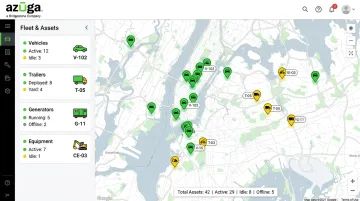
Modern platforms are blurring these lines. Azuga, for example, built its foundation on GPS fleet tracking and has expanded into broader asset visibility, letting operators see trailers, generators, and high-value equipment alongside their vehicles in one dashboard.
Why Field Asset Management Matters
Field-intensive industries run on thin margins, which makes small inefficiencies expensive. The Construction Financial Management Association's 2024 benchmark study, based on 1,290 companies' fiscal 2023 statements, found an average net income before tax of just 6.3% across the industry. At that margin, every hour of lost productivity or every misplaced piece of equipment cuts directly into what's left over.
Unplanned equipment downtime compounds the problem. Caterpillar's own cost model illustrates the stakes: if 20 workers earning $30 an hour sit idle because equipment isn't ready, that single hour of downtime costs $600 in wasted labor alone. Multiply that across a season of delayed starts, and the math gets ugly fast.
What Drives These Losses in Practice?
- Crews arriving on-site without confirmation that equipment is available or functional
- Tools and machinery sitting idle in one location while another crew searches for a substitute
- Maintenance issues going unnoticed until a breakdown stops work entirely
- No clear record of who last used an asset or where it ended up
Asset theft adds another layer of risk on job sites, particularly for equipment left overnight or in remote locations. While industry-wide dollar figures on theft losses vary in quality and freshness, the operational reality is consistent: unsecured, untracked equipment is a target.
Automated tracking changes this equation. When managers get real-time alerts on location, condition, and usage, problems surface before they escalate into missed deadlines or costly emergency repairs.
Types of Field Assets Businesses Track
"Field assets" covers more than trucks. Full visibility across every category is what separates a mature asset management program from ad hoc spreadsheets and sticky notes.
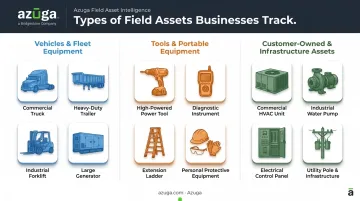
Vehicles and Fleet Equipment
This category includes anything with a motor that moves your business forward
- Service trucks and vans
- Trailers
- Forklifts
- Generators and other powered equipment
Fleet managers typically track these assets via GPS and telematics platforms like Azuga, which pair hardwired and battery-powered asset trackers with 30-second location updates for continuous visibility into location and usage.
Tools and Portable Equipment
Smaller, but often just as critical to a job's success
- Power tools
- Diagnostic instruments
- Ladders
- PPE and safety gear
- Test equipment
Technicians commonly tag these items with barcodes or RFID for check-in and check-out tracking, since GPS isn't practical for a cordless drill.
Customer-Owned and Infrastructure Assets
Field teams don't just manage their own equipment. They also service assets that belong to customers or utilities
- HVAC units
- Pumps
- Control panels
- Utility poles and pipelines
Technicians link these fixed assets to service history records, so they know exactly what was done, when, and by whom on the last visit.
Key Components of a Field Asset Management System
A working system rests on a handful of connected components. Miss one, and visibility gaps start creeping back in.
Asset information. Every tracked asset needs a structured data profile: make, model, serial number, install date, warranty terms, and maintenance history. Without this baseline, location data alone doesn't tell you much.
GPS and telematics tracking. This is the foundation for real-time location visibility. Hardwired trackers, battery-powered asset units, and Bluetooth beacons, like the ones Azuga offers, let fleets get equipment and field assets online without complex professional installation.
Mobile access. Field techs need to view and update asset records from the job site, not just from a desktop back at the office. This closes the gap between what dispatch knows and what's actually happening in the field.
Automated maintenance scheduling. Alerts triggered by mileage, engine hours, or condition data help catch problems before they become breakdowns. Azuga's platform, for instance, surfaces live asset health and utilization data and lets managers set maintenance reminders tied to usage.
Reporting and analytics dashboards. Managers need a real-time view of
- Utilization rates (is this asset earning its keep, or gathering dust?)
- Current location and geofence status
- Engine diagnostics and service history
- Idle time and fuel consumption trends
Integration capabilities. Asset data becomes far more useful when it feeds directly into dispatch and scheduling systems, letting job assignments account for what equipment is actually available and where.
Best Practices for Implementing Field Asset Management
Rolling out a system without a plan usually leads to partial adoption and gaps in coverage. A few practices make the difference.
Asset audit: Before you can track anything, you need a baseline. Document every vehicle, tool, and piece of equipment, along with its condition and current owner or job site assignment.
Tagging standards: Whether you use QR codes, RFID, or barcodes, consistency matters more than the specific technology.
GS1's Global Individual Asset Identifier standard offers one useful framework. It assigns a persistent, unique ID to an individual asset that can be encoded into a barcode or an RFID tag, so the identity stays consistent even if you switch tag technology later.
Scheduling integration: Don't let dispatch assign a job without confirming the equipment needed is actually available and in working condition. This single change eliminates a huge share of the "we showed up without the right tool" problem.
Choosing the Right Field Asset Management Solution
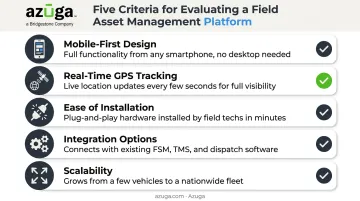
When evaluating platforms, focus on criteria that actually affect day-to-day operations
- Mobile-first design so field crews can check status from anywhere
- Real-time GPS tracking with update intervals that match your use case
- Ease of installation, ideally plug-and-play rather than requiring a technician visit
- Integration options with your existing dispatch or scheduling tools
- Scalability that works whether you run 5 vehicles or 500
Cost and support also matter, especially for small and mid-sized teams. Azuga, for example, matches packages to fleet needs and 24/7 customer support, which lowers the barrier for teams that don't have a dedicated IT department to manage a rollout.
Frequently Asked Questions
What are 20 examples of assets?
Field assets span vehicles such as trucks, vans, and trailers; tools like power tools, ladders, and diagnostic instruments; machinery including forklifts and generators; technology such as tablets and GPS devices; and customer equipment like HVAC units, pumps, and control panels.
What is asset information?
Asset information is the structured data profile tied to each tracked item, including identification details like make and serial number, current location, condition, and maintenance history.
What is the difference between field asset management and fleet management?
Fleet management focuses on vehicles and drivers, covering routing, fuel, and safety. Field asset management extends further, covering tools, equipment, and customer-owned assets used across job sites.
What is the difference between asset management and fleet management?
Asset management tracks equipment lifecycle, location, and condition. Fleet management coordinates technician schedules, dispatch, and work orders, often relying on asset data to make those decisions.
How does GPS tracking support field asset management?
GPS and telematics devices provide real-time location and usage data. That data feeds directly into maintenance alerts, utilization reports, and dispatch decisions, giving managers a clear operational picture.
What industries benefit most from field asset management?
Construction, HVAC, electrical, utilities, and landscaping businesses see the greatest gains, since they rely on distributed crews and shared equipment across multiple job sites daily.