
Manual routing can't account for everything that affects a delivery, including traffic, driver hours, vehicle weight limits, and shifting customer windows. Route optimization software can, because it factors in fuel costs, delivery windows, vehicle capacity, and driver hours simultaneously, adjusting in real time as conditions change.
This guide covers what truck route optimization actually means, the variables that make or break a route, the returns fleets can expect, where AI fits in, and how to pick software that works for your operation.
Key Takeaways
- Route optimization weighs vehicle limits, HOS rules, and traffic, not just distance
- Optimized routes cut fuel spend, mileage, and missed deliveries together
- AI now adjusts routes mid-shift, not a single static morning plan
- Software choice should match fleet size and existing GPS and safety tools
What Is Truck Route Optimization?
Truck route optimization uses algorithms and real-time data to calculate the most cost-effective sequence of stops for an entire fleet, not just the fastest way from point A to point B.
Gartner classifies this as "vehicle routing and scheduling" software: solutions that build routes and schedules while weighing constraints like delivery time windows, vehicle capacities, and driver working hours all at once [26]. That's a different problem than mapping a single trip.
Consumer navigation apps aren't built for it. Google Maps and Waze can get a car from one address to another, but they don't know a truck's height, weight, or hazmat load, and they can't efficiently sequence more than a handful of stops.
The FMCSA has warned that following car-based navigation has led to bridge strikes, and it instructs commercial drivers to use truck-specific systems that account for vehicle dimensions before they hit the road.
A Real-World Example of Route Optimization in Logistics
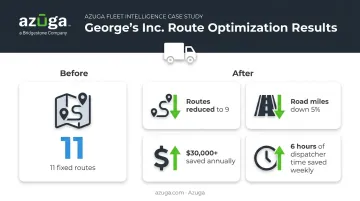
Take George's Inc., a poultry distributor running up to 35 stops per truck across its direct-store-delivery network. Before adopting route optimization software, the company managed 11 fixed routes.
After implementation, George's Inc. saw measurable gains across its fleet:
- Cut routes from 11 to 9
- Reduced road miles by 5%
- Saved more than $30,000 a year in fuel costs
- Trimmed six hours of dispatcher work each week
That's the pattern optimization software follows at scale: sequence stops by time window and vehicle capacity, respect road restrictions, and only then calculate the shortest workable path.
Azuga customers see a similar dynamic through native routing tools that pull in real-time traffic and driver availability. Ko Olina Transportation, for instance, uses Azuga's live tracking data to reroute drivers around traffic and reassign the nearest available vehicle to service calls as conditions shift.
Key Factors That Determine an Effective Truck Route
A route can look efficient on a map and still fail on the road. Several variables separate a workable plan from a costly one.
Vehicle and legal constraints that only commercial-grade routing engines account for include
- Weight limits, bridge and height clearances, and lane restrictions
- Hazmat routing that weighs vehicle size, underpass clearances, congestion, and accident history
- Permit requirements and designated routes for oversized or overweight loads
Hours-of-Service Rules Are Routing Constraints Too
Federal Hours-of-Service rules set a hard limit on what any route can ask of a driver. Current FMCSA guidance sets out three core limits:
- An 11-hour driving limit after 10 consecutive hours off duty
- A 14-hour on-duty window that doesn't pause for traffic or breaks
- A mandatory 30-minute break after 8 cumulative hours of driving
Routing software checks these before a route is ever assigned, flagging trips that would push a driver past legal limits.
Timing, Service Time, and True Cost
- Customer delivery windows have to be balanced against driver availability, not scheduled in isolation
- Real-time traffic, weather, and construction data catch problems a static route plan simply can't see
- Service time varies by stop. A quick drop-off and a delivery requiring installation aren't equal, and treating them the same throws off every ETA downstream
- Cost-per-route and cost-per-stop math, covering fuel, driver wages, and vehicle wear, should be calculated before a route is finalized
Benefits of Truck Route Optimization for Fleets of All Sizes
Route optimization pays off in ways you can measure within the first billing cycle, not just in the abstract.
Fuel and operational costs drop first. According to a Tech.co analysis reported by Food Logistics, fleets using route optimization software save an average of 19.3% on fuel costs, or roughly $640 per vehicle. Other industry estimates put annual savings closer to 2-5% once optimization is isolated from related tactics like idle reduction, but the direction holds: fewer miles and less idling mean lower fuel bills.
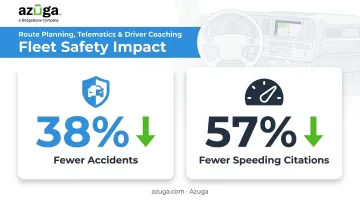
Safety improves alongside the routes. Optimized routing removes unnecessary turns, backtracking, and rushed schedules that push drivers to speed. Fleets pairing route planning with telematics and driver coaching, like those using Azuga's platform, have seen accidents drop by an average of 38% and speeding citations fall by 57%.
Visibility, Data, and Emissions Benefits
- Real-time GPS tracking at 30-second intervals gives dispatchers a live view of every truck, so delays get caught and rerouted before they cascade
- Automated ETA updates and delivery notifications cut down on "where's my driver" calls
- Fewer failed or late deliveries protect customer relationships built over years, not weeks
That same visibility extends into long-term planning. Planned-vs-actual performance reports let fleets refine routes continuously instead of guessing at what's working. There's also an environmental upside: fewer unnecessary miles mean lower emissions, which helps fleets hit sustainability targets without adding cost or complexity to daily operations.
How AI Is Powering the Next Generation of Route Optimization
Yes, AI does route optimization work today, and it's shifting the model from a static morning plan to a system that keeps adjusting throughout the shift.
Dynamic Route Adjustments
AI models continuously process live traffic, weather, and historical delivery data to reroute trucks as conditions change, rather than locking in one plan at 6 a.m. and hoping it holds. This real-time handling of delivery and LTL routing variables catches disruptions before they turn into a missed window.
Smarter ETAs Over Time
Machine learning models get more accurate the longer they run, learning individual driver patterns, stop-level service times, and route-specific quirks a static map can't capture. The result: dispatchers spend less time manually adjusting arrival windows for customers.
AI and Driver Safety Data
Keeping routes on schedule also means keeping drivers safe behind the wheel. Azuga's SafetyCam AI uses a neural learning network to analyze driver-facing video for distraction events, tagging the underlying cause whenever a risky driving event triggers a recording.
When a collision does happen, the same system's Collision Reconstruction feature settles disputes fast. It has helped show that 70% of accidents involving fleet drivers weren't actually the driver's fault, replacing costly disputes with objective video evidence.
Predictive Maintenance Keeps Routes on Track
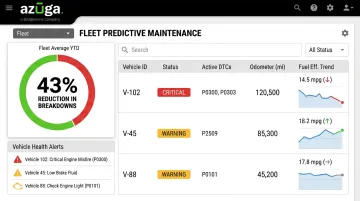
None of this matters if a truck breaks down mid-route. Predictive maintenance tools monitor diagnostic trouble codes, odometer data, and fuel efficiency trends to flag problems before they strand a driver.
Azuga's platform tracks these signals continuously and has been tied to a 43% reduction in vehicle breakdowns across customer fleets, keeping optimized routes from unraveling over a bad alternator.
One caution: AI routing models can behave like black boxes and occasionally get things wrong, so dispatchers should still review flagged exceptions rather than trust every automated reroute blindly.
How to Choose the Best Truck Route Planning Software
Not every fleet needs the same routing tool. A five-truck HVAC company and a 200-vehicle waste management fleet are solving different problems, even if both call it "route optimization."
Work through these steps before signing a contract
- Match the software to your fleet and industry. A service fleet needs fast rescheduling for same-day calls; a long-haul trucking operation needs hazmat and HOS compliance built in.
- Insist on truck-specific routing. Look for weight and height restriction handling, beyond a consumer-grade map with extra stops tacked on. Standalone route planners that don't talk to your GPS and safety tools create data gaps dispatchers have to fill manually.
- Calculate total cost of ownership, not just the listed rate. Solutions like Azuga pair a plug-and-play OBD-II device that installs in about 20 seconds with packages matched to fleet needs, making solid routing tools affordable for smaller fleets.
- Check support and integrations. Confirm around-the-clock phone and email support, plus connections to fuel cards, TMS, and ELD systems, so routing data doesn't sit in a silo.
- Request a demo and check independent reviews. Platforms recognized as G2 category leaders, like Azuga, have a track record validated by actual users, rather than relying on vendor claims alone.
Frequently Asked Questions
What is the best route planner for truckers?
There's no single best option; it depends on fleet size and needs. Effective truck route planners must support weight limits, HOS compliance, and multi-stop optimization—capabilities consumer mapping apps don't offer.
Can AI do route optimization?
Yes. AI increasingly powers route optimization by analyzing real-time traffic, weather, and historical delivery data to dynamically adjust routes and improve ETA accuracy as conditions change.
What is an example of route optimization in logistics?
A distribution fleet uses software to sequence 30-50 daily stops by balancing delivery time windows against vehicle capacity and local road restrictions, cutting both miles driven and fuel used compared to manual planning.
How much can route optimization save my fleet?
Fleets have reported fuel savings anywhere from roughly 2% to nearly 20%, depending on baseline routing efficiency, with additional gains in reduced mileage and lighter vehicle wear. Results vary by fleet size and route complexity.
Is route optimization only useful for large fleets?
No. Small and mid-size fleets in construction, HVAC, and service fleets benefit just as much, especially with affordable, scalable platforms packaged by fleet needs rather than by enterprise contract.
What's the difference between route planning and route optimization?
Route planning is manually sequencing stops. Route optimization uses algorithms to balance traffic, cost, time windows, and vehicle constraints to calculate the most efficient path automatically.