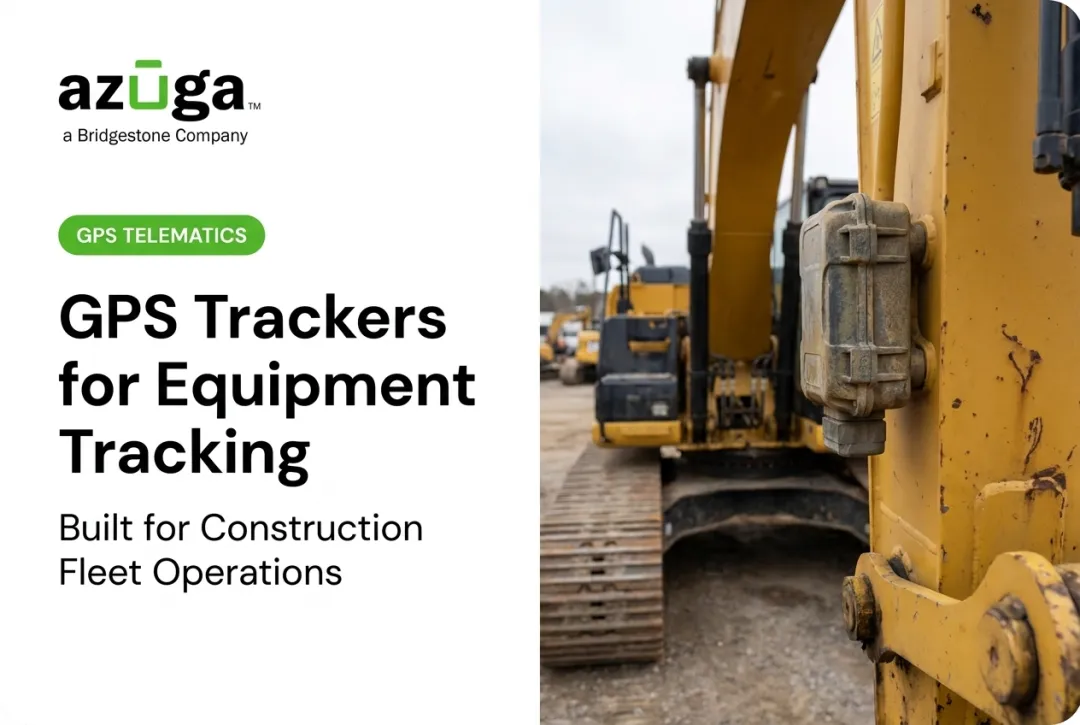

Equipment GPS tracking has moved from "nice to have" to standard operating procedure for construction, HVAC, landscaping, waste management, and towing companies. Beyond theft prevention, the right tracker improves equipment utilization, catches maintenance issues before they become breakdowns, and gives dispatchers real visibility into where every asset sits at any moment.
This guide compares the top GPS trackers for equipment in 2026, evaluated on hardware flexibility, total cost of ownership, feature depth, and how well each platform fits different fleet sizes.
Key Takeaways
- Equipment theft costs North American businesses up to $1 billion annually, making theft deterrents essential.
- Fleets with both powered and unpowered assets need hardwired and battery-powered tracker options.
- Azuga matches packages to fleet needs tailored to fleet size and features; most competitors also require a sales conversation.
- Telematics adoption can lift asset availability by 10-30%, per McKinsey, beyond theft prevention alone.
- Contract terms vary: Azuga requires no long-term contract, while Verizon Connect locks in multi-year deals.
Overview of GPS Equipment Tracking in 2026
Equipment GPS tracking means attaching a location device to a machine, either wired into its power system or running on its own battery. The device monitors where the asset is, how it's being used, and whether it's moving when it shouldn't be.
Industries rely on this visibility in different ways
- Construction crews track excavators and generators across job sites
- HVAC and plumbing contractors monitor service vehicles and trailers
- Towing companies keep tabs on tow trucks and recovered vehicles across a service area
The market backing this shift is expanding fast. Mordor Intelligence values the commercial-vehicle telematics market at $21.19 billion in 2026, with projections reaching $42.08 billion by 2031 — a 14.71% compound annual growth rate.
That growth reflects a simple reality: businesses that can't see their equipment can't protect, maintain, or bill for it accurately.
The section below ranks the best GPS tracker providers for equipment based on reliability, feature depth, and pricing value.
Top GPS Trackers for Equipment in 2026
Rankings below weigh four factors: total cost of ownership, hardware versatility across powered and unpowered assets, ease of installation, and quality of ongoing customer support.
Azuga
Azuga positions itself as a GPS fleet management platform built for simplicity and affordability, backed by Bridgestone. It serves fleets of all sizes across construction, HVAC, landscaping, and towing, with a hardware lineup that covers vehicles, trailers, and small tools alike.
What sets it apart
- Hardwired and battery-powered trackers: mount to powered equipment or run on long-life batteries for trailers, generators, and tools, with no complex install required
- SafetyCam AI with collision reconstruction: dual-facing HD dashcam footage combined with telematics data helps exonerate drivers, since Azuga's own data shows 70% of accidents aren't the driver's fault
- High-frequency tracking at 30-second intervals for tighter location accuracy
- Battery-powered asset trackers and equipment beacons for trailers, generators, and tools that need independent power
| Category | Details |
|---|---|
| Pricing | packages matched to fleet needs, no long-term contract required |
| Key Features | Hardwired and battery-powered trackers, AI dashcams, 24/7 support, third-party fuel card integrations |
| Best For | Small to mid-size fleets across service industries needing affordable, easy-to-deploy tracking |
Real-world results back the pitch. Diamond Engineering used Azuga's asset location and driver behavior data to negotiate a 10%+ discount on their insurance premium, while Hobart Service cut emergency response times by dispatching the closest available technician using live map tracking.
Samsara
Samsara built its reputation on enterprise-scale fleet visibility, with a heavy emphasis on compliance and driver safety. Its dashcam technology and ELD tools are strong, but the platform leans vehicle-centric rather than equipment-first.
It stands out for large fleets that need airtight compliance and hundreds of software integrations. That said, rates are quote-only rather than listed publicly, and contracts tend to run long-term with premium costs attached.
| Category | Details |
|---|---|
| Pricing | Not publicly listed; typically premium-tier; contact for details |
| Key Features | AI dashcams, ELD compliance, 350+ integrations |
| Best For | Large enterprise fleets with heavy compliance and driver safety needs |
Motive
Motive combines GPS tracking, AI dashcams, and dedicated asset gateways into one operations platform. Its Asset Gateway Mini monitors location, engine hours, and battery status independently of a vehicle's power source.
Motive's OEM integrations with Caterpillar, Komatsu, and John Deere give it a genuine edge for mixed fleets running both trucks and heavy machinery. Contract terms are available on request, though Motive's Order Form structure allows more flexibility than some competitors' multi-year lock-ins.
| Category | Details |
|---|---|
| Pricing | Contact for details; monthly options available |
| Key Features | Asset Gateway devices, AI Omnicam, 240+ integrations |
| Best For | Safety-focused fleets needing driver monitoring alongside equipment tracking |
Verizon Connect
Verizon Connect leans on Verizon's cellular network for reliable coverage in remote job sites and rural service areas where weaker carriers drop signal. It supplements location data with sensor add-ons for temperature change, vibration, and door movement.
The trade-off: multi-year contract terms are common, and the platform's roots remain firmly vehicle-first rather than built around heavy equipment.
| Category | Details |
|---|---|
| Pricing | Contact for details; typically multi-year contracts |
| Key Features | Geofencing, condition sensors, dedicated account support |
| Best For | Companies already using Verizon's network needing broad coverage |
Geotab
Geotab operates one of the largest global telematics ecosystems, with a Marketplace offering 350+ solutions from 250+ partners. Engine diagnostics and fuel management are genuine strengths.
Two caveats stand out. Geotab doesn't sell direct: every purchase runs through an authorized reseller, which means pricing and support quality vary by who you buy from. It also lacks dedicated heavy-equipment hardware, favoring vehicle diagnostics over unpowered asset tracking.
| Category | Details |
|---|---|
| Pricing | Contact for details; through authorized resellers |
| Key Features | Geotab Marketplace, engine diagnostics, fuel management |
| Best For | Vehicle-heavy fleets needing deep data and third-party app integrations |
Tenna
Tenna grew up inside the construction industry, and it shows. Its hardware range spans cellular GPS units, Bluetooth beacons, and QR tags, letting companies tier tracking investment by asset value, from a $500,000 excavator down to a shovel.
Maintenance scheduling is where Tenna shines, tying inspections and DVIRs directly into automated work orders. The trade-off is cost: pricing sits at a premium tier that can feel like overkill for smaller operations with just a handful of assets.
| Category | Details |
|---|---|
| Pricing | Contact for details; premium tier |
| Key Features | Maintenance workflows, tiered hardware (GPS/Bluetooth/QR), utilization reporting |
| Best For | Construction companies needing unified equipment and maintenance management |
How We Chose the Best GPS Trackers for Equipment
Buyers commonly make two mistakes: picking a provider based on brand recognition alone, or assuming any GPS device works for every asset type. Neither holds up. A tracker built for over-the-road trucks often can't handle the vibration, moisture, and power gaps found on a construction site.
We weighed five factors, each tied to a measurable business outcome
- Hardware versatility: Does the platform support both hardwired (powered) and battery-powered (unpowered) assets? This determines whether a company needs one vendor or three.
- Total cost of ownership: Published rates let buyers budget accurately; quote-only pricing often signals higher costs buried in the sales process.
- Contract flexibility: Month-to-month terms reduce risk versus multi-year lock-ins that penalize switching providers.
- Integration capability: Open APIs connect tracking data to job-costing, ERP, or maintenance software, closing margin gaps that spreadsheets miss.
- Customer support quality: 24/7 availability matters when equipment goes missing at 2 a.m. on a Saturday.
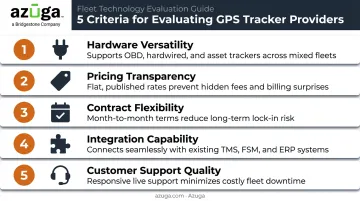
Providers that scored well across all five categories reduce downtime and lower total cost of ownership, not just the listed rate on a device.
Key Features to Look for in an Equipment GPS Tracker
Hardwired vs. Battery-Powered Trackers
Powered equipment, think excavators, loaders, and generators with running engines, works best with hardwired trackers that draw power from the machine. Unpowered assets like trailers, portable generators, and storage containers need battery-powered trackers instead, since there's no engine to draw power from.
Most fleets need both. A construction company running trucks alongside towed equipment trailers can't rely on a single hardware type to cover its whole yard.
Engine Hour Tracking and Maintenance Timing
Engine hour tracking enables usage-based maintenance scheduling instead of calendar-based guessing. Deloitte reports predictive maintenance approaches can reduce total downtime by 20-50% compared to routine, time-based service schedules. Equipment that sits idle for weeks shouldn't get serviced on the same calendar as equipment running 60 hours a week.
Geofencing and Theft Alerts
Geofencing draws a virtual boundary around a job site, yard, or employee's home. After-hours movement outside that boundary triggers an immediate alert, giving fleet managers a head start on recovery before equipment crosses state lines. Fleet managers using after-hours visibility report catching unauthorized equipment use before it becomes a pattern, turning theft prevention from reactive to proactive.
Ruggedization Standards
Equipment sitting in mud, rain, and constant vibration needs devices rated IP67 or IP68 for dust and water resistance. Keep in mind: IP ratings only cover dust and moisture ingress. They say nothing about vibration or shock tolerance, so ask vendors for separate specs on both before mounting a tracker to a jackhammer or skid steer.
Integration Capability
An open API turns raw location data into something accounting and operations teams can actually use. Look for
- Connects to ERP and job-costing software
- Syncs with maintenance management platforms
- Integrates fuel card and expense tracking data
- Links to fleet management software like ServiceTitan or Procore
Plans Models and Red Flags
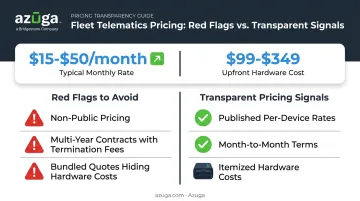
Per-device monthly pricing is the most transparent model for fleet-grade platforms, per Geotab's published pricing guide, with equipment-specific hardware often adding an upfront component. Watch for these red flags before signing anything
- Non-public pricing that only appears after a sales call
- Multi-year contracts with steep early termination fees
- Bundled quotes that hide hardware and activation costs
Conclusion
The right GPS tracker for equipment depends on your fleet mix, not brand reputation. A landscaping company running mostly trailers needs different hardware than a trucking outfit running compliance-heavy vehicles. Match features to what you actually operate before comparing price tags.
Before committing to any provider, evaluate three factors
- Platform scalability as your fleet grows
- Contract flexibility, so you're not locked into long-term terms
- Total cost of ownership, including hardware, activation, and support fees
For businesses wanting an affordable, easy-to-install platform without a long-term contract, Azuga is worth a look. Fleets using the platform have seen accidents drop by 38% on average and annual savings of $9,462 through more effective fleet cost management.
Frequently Asked Questions
What is the best GPS tracker for equipment?
The best choice depends on your fleet mix. Affordable all-in-one platforms like Azuga suit most small-to-mid-size fleets needing easy installation and broad feature coverage across vehicles, trailers, and tools.
Is there a GPS tracker with no monthly fee?
Cellular GPS trackers require a data plan to transmit live location data. Some providers, including Azuga, offer flexible monthly packaging that can fit fleets without long-term lock-in.
How much does a GPS tracker for equipment cost?
Fleet-grade tracking typically runs, with equipment-specific hardware costing upfront. Hardware type, activation fees, and contract terms all affect the final total.
Do I need a hardwired or battery-powered tracker for my equipment?
Hardwired trackers work best for powered equipment like trucks and generators with running engines. Battery-powered options serve unpowered assets such as trailers, storage containers, and portable equipment lacking a power source.
Can GPS trackers help prevent equipment theft?
Yes. Geofencing and after-hours movement alerts notify managers the moment equipment leaves an authorized zone, supporting faster recovery. This matters given up to $1 billion in equipment theft losses across North America each year.
How accurate are GPS trackers for equipment?
Quality GPS receivers typically deliver better than 2.2 meters of accuracy in 95% of cases. Signal obstruction from buildings, dense trees, or metal structures on job sites can reduce that accuracy somewhat.