
That number hasn't gotten friendlier since. Customers now expect two-day, next-day, or same-day delivery as the default, not the exception. Meanwhile, driver shortages and city traffic congestion squeeze capacity from every direction. This isn't just an Amazon or FedEx problem, either. HVAC companies, plumbers, waste haulers, and towing operators all face the same math: more stops, tighter windows, thinner margins per truck.
This guide breaks down what last mile delivery optimization means, ten strategies to implement it, the trends reshaping the space, and how fleet visibility technology like Azuga ties it all together.
Key Takeaways
- Last mile delivery can consume up to 41% of supply chain costs, driven by low-density stops and failed deliveries
- Route optimization, tracking, and driver monitoring form the last mile's technology backbone
- Service fleets like HVAC and waste management face the same last mile economics as parcel carriers
- Azuga customers using connected routing, tracking, and safety tools save an average of $9,462 annually
What is Last Mile Delivery Optimization?
Last mile delivery optimization is the process of making the final leg of a delivery (from a hub, warehouse, or depot to the customer's door) as fast and reliable as possible while keeping costs down. It's the last few miles of the journey, but often the most expensive and the most visible to the customer.
Done well, it addresses a specific set of recurring problems
- Traffic congestion that eats into delivery windows
- Failed delivery attempts when no one's home
- Driver and staff shortages that limit capacity
- Safety risks tied to tight schedules and unfamiliar routes
- High per-stop costs from low-density, single-drop deliveries
There's no single fix for any of this. Optimization usually blends route planning software with real-time data feeds and fleet visibility tools, each covering gaps the others miss. A dispatcher using GPS tracking alongside route optimization software, for example, can reroute a driver around a backed-up highway in real time. Neither tool accomplishes this well on its own.
Why Last Mile Delivery Is the Most Costly Supply Chain Leg
That 41% figure isn't an accident of bad planning. It's baked into the structure of last mile delivery itself.
Consider what a long-haul truck does versus what a delivery van does. The truck drops a full trailer at one dock.
The van might make 80 stops in an afternoon, each requiring a parking spot, a walk to the door, and a signature, regardless of whether that stop generates $500 or $15 in profit.
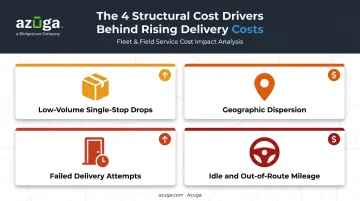
Four structural factors drive the cost up
- Low-volume, single-stop drops: No economies of scale like a full-truckload shipment
- Geographic dispersion: Suburban and rural stops mean more miles per delivery
- Failed delivery attempts: A driver returning to a stop wastes fuel, time, and a slot on tomorrow's route
- Idle and out-of-route mileage: Traffic, poor routing, or last-minute changes add unproductive miles
Here's the part often missed: this isn't only a parcel-carrier problem. For service-based fleets, including HVAC, plumbing, electrical, and waste management, every job site visit is its own last mile delivery.
A technician stuck 20 extra minutes in traffic isn't just late. That's 20 minutes of billable time gone, multiplied across every truck in the fleet, every day. For these operators, route and time efficiency directly determines revenue per truck.
10 Proven Strategies to Optimize Last Mile Delivery
Most of what separates an efficient last mile operation from an expensive one comes down to these ten strategies. Nearly all of them depend on some form of software or connected technology to work at scale. Manual dispatching and paper routes can't keep pace with modern delivery volumes.
Strategy 1: Advanced Route Optimization
Route optimization software factors in live traffic, delivery time windows, order priority, and road complexity to build the most efficient sequence of stops. Instead of a fixed route regardless of conditions, the system recalculates on the fly.
The payoff: fewer out-of-route miles, which directly lowers cost per stop. Azuga's route optimization tools build in real-time traffic and hazard avoidance, guiding drivers around construction or congestion before it becomes a delay. For high-volume, multi-stop operations, Azuga's partnership with NextBillion.ai adds specialized routing algorithms suited to dense delivery scenarios.
Strategy 2: Predictive Analytics & Demand Forecasting
Historical delivery data holds patterns most dispatchers never get time to study — which zip codes spike around holidays, which routes slow down every Friday, which vehicles need maintenance around 60,000 miles.
Predictive analytics turns that history into a forecast. Fleets can staff up ahead of seasonal demand, reroute around recurring traffic patterns, and schedule maintenance before a breakdown pulls a truck out of rotation. It's the difference between reacting to a bad day and seeing it coming a week out.
Strategy 3: Real-Time Tracking & Live ETAs
Live GPS tracking gives dispatchers, and customers, visibility into exactly where a vehicle is. That transparency cuts "where's my delivery" calls and lets dispatchers spot delays early enough to actually act.
Update frequency matters more than most people realize. Azuga's platform refreshes vehicle location every 30 seconds under its High Frequency Tracking feature. That tight interval means ETAs reflect current position, not data that's five minutes stale, so a dispatcher relaying an arrival window to a customer can do so with real confidence.
Strategy 4: Driver Behavior Monitoring for Safety and Efficiency
Speeding, harsh braking, rapid acceleration, and excessive idling don't just burn fuel; they raise accident risk and insurance costs. Monitoring these behaviors gives fleet managers the data to coach drivers before a bad habit turns into a collision.
Azuga's GPS fleet tracking, paired with SafetyCam AI and Collision Reconstruction, adds a video layer to that data. When a risky event triggers the system, dual-facing dashcam footage runs through an AI engine that flags distraction or other contributing factors.
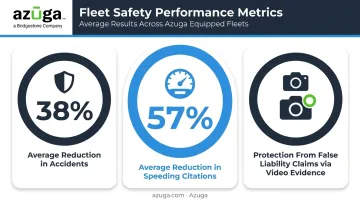
That evidence matters. Azuga reports that 70% of accidents involving fleet drivers are not actually the driver's fault. Fleets using Azuga's safety tools see
- 38% average reduction in accidents
- 57% average reduction in speeding citations
- Protection from false liability claims through video evidence
Strategy 5: Crowdsourced and Flexible Delivery Labor
Peak seasons don't require permanent headcount increases. Tapping gig-economy drivers or third-party delivery networks during holiday surges adds capacity without the overhead of full-time hires, benefits, or year-round vehicle costs.
This works best as a supplement, not a replacement, for a core fleet. Flexible labor absorbs the peaks; a stable, trained fleet handles the baseline volume where consistency and reputation matter most.
Strategy 6: Micro-Fulfillment Centers & Localized Storage
Positioning smaller, strategically located hubs closer to dense customer areas shortens the distance every delivery has to travel. Instead of one central warehouse covering a whole metro area, several micro-fulfillment centers each handle a smaller radius.
Shorter distances mean faster delivery windows, fewer miles per stop, and more delivery attempts possible per driver shift, a model quickly becoming standard for retailers competing on same-day promises.
Strategy 7: Smart Lockers and Alternative Delivery Points
Self-service lockers and designated pickup points solve one of last mile delivery's most persistent headaches: the failed attempt. No one has to be home, no package gets left on a porch, and customers pick up on their own schedule, including outside standard business hours.
For carriers dealing with dense residential routes, lockers give delivery operations a predictable, repeatable drop point instead of a different doorstep every time.
Strategy 8: Contactless and Paperless Proof of Delivery
Electronic proof of delivery tools (photo confirmation, e-signature capture, GPS geostamping) replace paper delivery slips with a digital record tied to the exact time and location of drop-off.
That record does double duty: it speeds up delivery confirmation for billing and payroll, and it gives fleets hard evidence when a customer disputes whether a delivery happened. Contactless confirmation has also become an expectation, not just a preference, since the pandemic reshaped comfort with in-person handoffs.
Strategy 9: Sustainable Delivery Practices
Route consolidation, electric and hybrid vehicles, and reduced idling all cut emissions and cost, since less idling and fewer wasted miles mean less fuel burned per stop.
The stakes reach beyond any single fleet. Transportation accounts for 29% of total US greenhouse gas emissions, more than any other sector in the economy. Last mile delivery, with its stop-start pattern and high idle time, is a disproportionate contributor to that number.
Azuga's idle time monitoring and fuel consumption reporting give fleets direct visibility into wasted fuel, whether that's a truck idling at a job site or an inefficient route. That visibility helps fleets cut cost and emissions in the same move.
Strategy 10: Driver Recruitment, Training & Retention
An optimized route doesn't matter much if there's no driver to run it. Competitive pay and structured onboarding get drivers in the door; what keeps them is a culture that doesn't treat every mistake as a firing offense.
Real-time coaching through telematics feedback helps here. Azuga Coach delivers personalized safety training based on each driver's actual telematics data, and drivers see their own performance scores through the FleetMobile app, the same data managers see. Programs like Azuga's Safe Driver Rewards turn safety into friendly competition with real incentives, rather than a surveillance tool drivers resent.
Last Mile Delivery Trends to Watch
AI-Driven Dynamic Routing
AI-driven routing has moved well past the pilot stage for large enterprise fleets, with logistics leaders increasingly using systems that adjust routes in real time based on traffic, weather, and customer behavior. Platforms like Azuga already fold these variables into live route calculations for last mile fleets. The days of a fixed morning route that never changes are numbered.
Autonomous Vehicles and Delivery Drones
Self-driving vehicles and delivery drones remain more promise than practice for most fleets. Federal regulators still require special certification for drone deliveries beyond visual line of sight, and safety oversight for autonomous vehicles continues to evolve. The long-term appeal, bypassing gridlock entirely, is obvious. For now, these remain pilot programs rather than mainstream last mile tools.
The Shift to Out-of-Home Delivery
Parcel lockers and designated pickup points keep gaining ground across delivery networks. Customers get to pick up packages on their own schedule. Carriers benefit too, especially amid tight labor markets: fewer delivery attempts get wasted on empty doorsteps.
How Fleet Visibility Technology Powers Last Mile Optimization
Every strategy above shares one dependency: data. Route optimization runs on real-time location feeds, driver coaching depends on behavior data, and live ETAs require constant position updates. GPS fleet management software is the connective layer that lets these strategies work together instead of running as disconnected tools that don't talk to each other.
Getting Started Without an IT Project
Fleets often delay adopting visibility tools, assuming it means a lengthy IT rollout. It doesn't have to. Azuga's OBD-II device plugs directly into a vehicle's OBD port and is self-installable — no technician, no wiring, ready in about 20 seconds per vehicle. A ten-truck fleet can be tracking by the end of an afternoon, with location data populating the dashboard as soon as the last unit is plugged in.
Why Update Frequency Matters
Not all GPS tracking is equal. Azuga's platform refreshes vehicle location every 30 seconds under its High Frequency Tracking feature. Widely spaced updates, say every five minutes, mean an ETA is built on stale data. Tighter intervals mean dispatchers and customers get arrival windows based on where a vehicle actually is right now, not where it was several stops ago.
The Cost Case
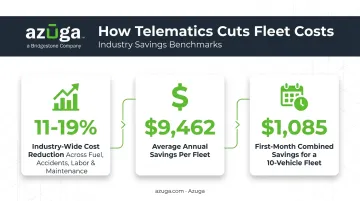
Telematics adoption pays for itself. Verizon Connect's 2026 fleet survey found GPS users saw average cost reductions of 11% to 19% across fuel, accidents, labor, and maintenance combined. Azuga's own customer data lines up with that pattern: fleets report average annual savings of $9,462, with a typical ten-vehicle fleet seeing roughly $1,085 in combined safety, fuel, and maintenance savings in the first month alone.
The platform scales with fleet size, which is why construction crews, pest control operators, and towing companies use the same platform as national carriers to manage their own version of the last mile: the job site visit.
Bug-N-A Rug Exterminators, a pest control operator, reported 50% cost savings after implementing Azuga's platform. Diamond Engineering, a construction fleet, secured a 10%+ discount on its insurance premiums by sharing Azuga's driver behavior data with its insurer.
Key KPIs to Measure Last Mile Delivery Performance
Optimization only works if you're measuring the right things.
Core delivery metrics:
- On-time delivery rate — percentage of deliveries arriving within the promised window
- Cost per delivery/stop — total delivery cost divided by completed stops
- Delivery success rate — first-attempt completions versus reattempts or failures
Service-quality indicators:
- Customer satisfaction score or NPS: direct feedback on the delivery experience
- Average delivery time: from dispatch to completed drop-off
- Order accuracy rate: percentage of deliveries with correct items and quantities
Idling time, speeding events, and vehicle utilization don't sound like delivery metrics at first glance, but they directly control cost per stop. A truck idling 15 extra minutes per stop across a full route adds up to real fuel cost by week's end. Azuga's dashboard tracks these fleet-level numbers alongside trip data, geofence entry and exit times, and site duration. That data gives managers the raw inputs to calculate their own on-time and cost-per-stop benchmarks rather than guessing.
Frequently Asked Questions
What is last mile delivery optimization?
Last mile delivery optimization is the process of maximizing speed and cost-efficiency during the final delivery leg. It relies on smarter routing, real-time tracking, and data-driven decisions to boost reliability.
How to improve last mile delivery?
Start with route optimization software to cut out-of-route miles. From there, add real-time tracking with proactive customer notifications, and explore delivery lockers to reduce failed attempts.
What are the current trends in last mile delivery?
AI-driven dynamic routing is reshaping how fleets handle the final mile, alongside early-stage autonomous vehicles, drones, and growing use of out-of-home options like parcel lockers.
Why is last mile delivery so expensive?
Low consolidation per stop, geographic dispersion, and failed delivery attempts all drive per-stop costs up. Unlike a full-truckload shipment, each last mile stop carries fixed costs regardless of order size.
What KPIs should I track for last mile delivery?
On-time delivery rate and cost per delivery form the foundation, along with delivery success rate. Customer satisfaction scores and fleet-level data, such as idling and vehicle utilization, round out the full picture.
How does GPS fleet tracking improve last mile delivery?
Real-time location data and driver behavior monitoring give dispatchers accurate ETAs and the visibility to act fast. This data cuts costs, resolves delays before customers notice, and keeps them informed without constant phone calls.