
This shift matters because the stakes are real. Poor visibility into driver behavior leads to accidents, higher insurance premiums, and wasted fuel. Fleet management software closes that gap by combining GPS tracking, safety monitoring, and maintenance alerts into one system.
Adoption reflects this urgency. Berg Insight found approximately 19.2 million active fleet-management systems in North America at the end of 2024, covering 56.8% of the roughly 34 million commercial vehicles on the road. This guide breaks down the top platforms worth considering this year.
TL;DR
- Fleet management software centralizes GPS tracking, safety, and maintenance data to cut accidents and downtime.
- The best fit depends on fleet size, budget, and priority features like ELD compliance or maintenance automation.
- Azuga, Samsara, Geotab, Motive, and Fleetio lead in 2026 for affordability, safety, and ease of use.
- Choose based on total cost of ownership, safety features, and scalability, not brand recognition alone.
Overview of Fleet Management Software in 2026
Fleet management software has moved well past dot-on-a-map GPS tracking. Today's platforms layer in AI dashcams that flag distracted driving, predictive maintenance alerts, and automated compliance workflows that didn't exist a decade ago.
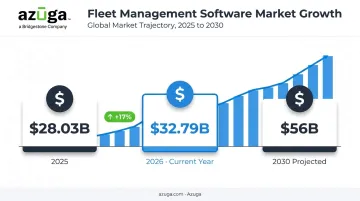
The market reflects that growth. The global fleet management software market is projected to hit $32.79 billion in 2026, up 17% from $28.03 billion in 2025, according to ResearchAndMarkets' 2026 forecast. That trajectory continues through 2030, when the market is expected to reach nearly $56 billion.
With so many providers competing for fleet budgets, picking the right one gets confusing fast. The list below ranks the top-rated platforms based on
- Packages matched to fleet needs
- Proven safety technology
- Simple installation
- Responsive customer support
- Scalability across fleet sizes
Top Fleet Management Software Providers of 2026
Every provider on this list was evaluated against the same criteria: clear pricing, proven safety outcomes, simple deployment, responsive support, and the ability to grow with a fleet from five vehicles to five hundred.
Azuga
Azuga is a GPS fleet management provider backed by Bridgestone, built for fleets ranging from small crews to enterprise operations. It's a common fit for construction, HVAC, plumbing, trucking, and utility businesses that want a platform that's simple to deploy without sacrificing depth.
What makes it stand out:
- Self-install OBD-II device: no technician visit required; most fleets are running in minutes.
- SafetyCam AI with Collision Reconstruction: helps exonerate drivers by reconstructing accident scenes, reducing liability exposure and frivolous litigation.
- Gamified driver rewards program: drivers earn gift cards based on daily safety scores, turning safe driving into friendly competition rather than punitive monitoring.
The results back up the approach. Azuga customers have seen an average 38% reduction in accidents, a 57% drop in speeding citations, and average annual savings of $9,462 per customer.
Construction firm Diamond Engineering used Azuga's data on driver behavior and asset location to negotiate a more than 10% reduction in insurance premiums with its carrier, a concrete example of telematics data translating directly into lower operating costs.
| Category | Details |
|---|---|
| Pricing | packages matched to fleet needs, flat-rate plans, no long-term contract required |
| Key Features | GPS tracking at 30-second intervals, AI dashcams with collision reconstruction, driver rewards program, fuel card integrations, sustainability program |
| Support & Installation | Self-install OBD-II device in minutes; 24/7 unlimited phone, email, and web-based support |
Samsara
Samsara built its reputation as an all-in-one fleet platform with an interface that's genuinely intuitive, which explains its strong footing with large and mid-size fleets managing complex operations.
Its AI-powered dashcams, driver safety scorecards, and fully customizable dashboards give operations teams the flexibility to build reporting around their specific workflows rather than a fixed template. Customer sentiment backs this up: Samsara holds a 4.5 out of 5 rating across 1,018 reviews on Capterra.
The tradeoff is packaging structure. Samsara doesn't publish flat rates. Instead, buyers work with packages matched to fleet needs, and its small-business segment (fewer than 11 vehicles) typically requires upfront payment on 3-year contracts.
| Category | Details |
|---|---|
| Pricing | flexible; smaller fleets often see multi-year contract requirements |
| Key Features | AI dashcams, driver safety scorecards, incident reporting, customizable dashboards |
| Best For | Large fleets needing a fully customizable, all-in-one solution |
Geotab
Geotab operates as an open-platform data leader. Rather than locking customers into a closed ecosystem, it built its business around an open API and a marketplace that now includes nearly 530 third-party solutions.
Scale is where Geotab separates itself. The company reports connecting approximately 6 million vehicles and assets and processing 100 billion data points daily. For fleets with specialized needs (custom dashboards, unusual integrations, or evolving compliance requirements), that flexibility matters more than a slick interface.
Geotab also carries strong ELD and IFTA compliance tools, supporting more than 100 HOS rulesets across the US and Canada. This makes it a natural fit for fleets that need deep customization alongside regulatory automation.
| Category | Details |
|---|---|
| Pricing | packages matched to fleet needs depending on add-ons |
| Key Features | Open API, ELD/IFTA compliance, vehicle diagnostics, marketplace integrations |
| Best For | Fleets needing deep data customization and compliance automation |
Motive
Formerly known as KeepTruckin, Motive built its platform around safety and compliance, which explains its popularity with trucking and logistics fleets running tight regulatory margins.
Its AI dashcam detects 20+ safety events, including distracted driving behaviors like phone use, eating, and drowsiness, with in-cab alerts designed to correct the behavior in real time. Motive's ELD is FMCSA-registered, and its HOS compliance tools automate violation alerts before they become costly citations.
Packaging works differently here than with Azuga or Fleetio. Motive requires a package matched to fleet size, sorted into bands from 1-9 vehicles up to 1,000+. there is no published flat rate for small fleets, so expect a sales conversation before you see plan details.
| Category | Details |
|---|---|
| Pricing | package matched to fleet size; contact for details |
| Key Features | AI dashcams, HOS/ELD compliance, live GPS tracking, driver coaching tools |
| Best For | Fleets prioritizing automated safety coaching and compliance |
Fleetio
Fleetio takes a maintenance-first approach, and it's the rare provider in this category that publishes plan details openly instead of hiding behind a "request a quote" form.
Its strength lies in preventive maintenance scheduling, inspection workflows, and cost-per-vehicle reporting that gives small-to-mid-size fleets a real handle on total cost of ownership. Fuel card integrations flag consumption anomalies and potential theft, adding another layer of financial control.
For budget-conscious fleets that care more about maintenance visibility than AI dashcams or advanced compliance automation, Fleetio's transparency is a genuine differentiator.
| Category | Details |
|---|---|
| Pricing | Published Essential through Premium tiers, billed annually |
| Key Features | Preventive maintenance scheduling, fuel card integrations, inspection workflows, cost-per-vehicle reporting |
| Best For | Small-to-mid-size fleets prioritizing maintenance automation and budget predictability |
How We Chose the Best Fleet Management Software
Most businesses default to two shortcuts when picking fleet software: brand recognition or the lowest listed rate. Both lead to regret. A cheap platform that lacks safety features can cost far more in accidents and insurance premiums than it saves in monthly fees.
Our evaluation weighted five factors against real business outcomes
- Total cost of ownership — real numbers without a sales call, with no hidden contract terms
- Safety technology — active accident prevention, not just after-the-fact reporting
- Installation ease — self-install versus scheduled technician visits
- Integration options — compatibility with existing TMS, fleet management, or fuel card systems
- Support responsiveness — availability and quality of ongoing customer service
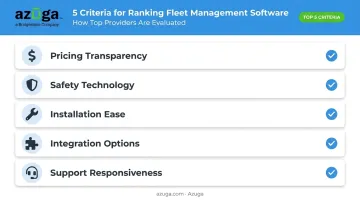
Providers that scored well delivered measurable results: fewer accidents, lower fuel spend, and reduced administrative overhead.
Conclusion
Choosing the right fleet management platform comes down to your fleet size, budget, and operational priorities, not a single universal "best" pick. A 15-vehicle HVAC company and a 500-truck logistics operation need very different tools.
Before committing, evaluate contract flexibility, scalability, and total cost of ownership, not just the monthly rate on a sales page. Hidden fees and multi-year lock-ins tend to surface after the ink dries.
If you're weighing your options, Azuga's self-install simplicity and AI-backed safety technology, paired with packages matched to fleet needs, make it a strong starting point for fleets of nearly any size. You can request a demo or quote directly through Azuga's site, or call (888) 790-0715 to speak with a fleet specialist.
Frequently Asked Questions
What is fleet management software and why do businesses need it?
It centralizes vehicle tracking, driver safety, maintenance, and cost data into one platform. This gives fleet managers real-time visibility to reduce risk and cut operational waste.
How much does fleet management software cost in 2026?
Options depend on features and fleet size. Azuga matches packages to fleet needs, Fleetio publishes flat rates, and Samsara and Motive require a conversation for plan details.
What features should I look for in fleet management software?
Prioritize accurate GPS tracking, driver safety scorecards, maintenance alerts, ELD compliance, and integration options with your existing service fleets or TMS software.
Is fleet management software worth it for small businesses?
Yes. Even small fleets see ROI through reduced fuel waste, fewer accidents, and lower insurance and maintenance costs, often within the first year of adoption.
How does fleet management software improve driver safety?
AI dashcams flag risky behavior in real time, while scorecards and rewards programs build accountability. Together, they reduce speeding, harsh braking, and distracted driving.
What's the difference between basic GPS tracking and full fleet management software?
GPS tracking only shows vehicle location, movement, and speed. Full fleet management software adds maintenance scheduling, safety monitoring, compliance, and cost reporting on top of that data.