
43% of online shoppers say real-time tracking would improve their delivery experience, according to DHL's 2024 survey of 12,000 shoppers across 24 countries. For businesses still relying on phone calls and spreadsheets to manage deliveries, that expectation gap is a real problem.
A delivery management system (DMS) is the technology that closes it. It's the connective tissue between the moment an order is placed and the moment a customer signs for it, handling routing, dispatch, tracking, and proof of delivery along the way.
This guide breaks down what a DMS actually does, the features that separate good platforms from bad ones, the benefits and challenges you'll encounter, and how to choose the right system. We'll also cover where fleet visibility tools fit into the equation, since a DMS alone doesn't tell you everything happening on the road.
Key Takeaways
- A DMS unifies delivery from order intake to proof of delivery in one platform
- Route optimization and real-time tracking cut fuel costs, labor hours, and complaints
- Integration with CRM, ERP, and telematics systems eliminates data silos and errors
- Scalability and ease of use matter more than feature count when evaluating vendors
- Pairing a DMS with GPS tracking closes blind spots order data alone can't reveal
What Is a Delivery Management System?
A delivery management system is software that plans, executes, and monitors the movement of goods from order placement to final delivery. It's built to keep deliveries accurate, on time, and cost-efficient.
According to Capterra's delivery management software category, these platforms connect vehicles and couriers on the road with back-office operations, digitizing tasks that used to run on paper or phone calls.
Not every DMS looks the same. Some are lightweight route-optimization tools built for small delivery teams. Others are full platforms that integrate CRM, inventory, and analytics into a single dashboard for enterprise-level operations.
How a Delivery Management System Works
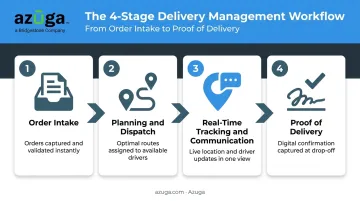
Most systems follow a similar four-stage workflow
- Order intake - Delivery instructions flow in automatically from sales or order management systems, eliminating manual re-entry.
- Planning and dispatch - The system assigns routes and drivers based on location, delivery time windows, and vehicle capacity.
- Real-time tracking and communication - GPS data and automated alerts keep dispatchers, drivers, and customers informed as the delivery progresses.
- Proof of delivery - Digital signatures, photos, or barcode scans confirm the job is complete and accountable.
Delivery Management vs. Fleet management vs. TMS: Clearing Up the Confusion
These three categories get lumped together constantly, but they solve different problems.
| System | Primary Focus | Example Use |
|---|---|---|
| Delivery Management System | Order and shipment-level tracking, customer experience | Route planning, ETAs, POD |
| Fleet Management Software | Vehicle and driver-level data | GPS location, safety scores, maintenance alerts |
| Transportation Management System (TMS) | Broader freight and carrier logistics | Multimodal shipping, carrier selection, freight documentation |
G2's last-mile delivery category defines DMS platforms around route optimization and customer-facing tracking. IBM's TMS breakdown, by contrast, covers company-wide inbound and outbound freight movement.
In practice, these systems overlap. A service business might run a DMS for daily dispatch. Meanwhile, it could rely on fleet telematics, like Azuga's GPS tracking platform, to see exactly where vehicles are and how drivers are behaving behind the wheel.
Key Features Every Delivery Management System Should Have
Not all DMS platforms are built equally. Here's what actually separates a functional system from a frustrating one.
- Real-time tracking and visibility - GPS-based live location updates that both dispatchers and customers can access, not just an estimated window
- Route optimization and automated dispatch - Factors in traffic, delivery windows, and vehicle capacity to cut delays before they happen
- Proof of delivery (POD) - Captures signatures, photos, or barcode scans so there's no dispute about whether a delivery happened
- Automated customer notifications - SMS or email alerts covering dispatch confirmation, ETA updates, and delivery completion
- Data analytics and reporting - Tracks metrics like on-time delivery rate, cost per delivery, and customer satisfaction scores
- Integration capabilities - Connects with CRM, ERP, inventory, and fleet/telematics platforms so data doesn't need to be entered twice
Of these, integration deserves extra attention. A DMS that can't talk to your existing systems just creates a new silo instead of eliminating one. Platforms like Azuga's integration marketplace connect to 75+ telematics and field-service tools such as ServiceTitan and TowBook, eliminating manual re-entry. If your dispatch software doesn't sync with your inventory system, you're one order mismatch away from an angry customer.
Real-time tracking is the feature customers notice first, but it's also the hardest to get right without accurate GPS data feeding the platform. That's where the line between "route on a map" and "actual live vehicle location" starts to matter.
The difference in practice
| Tracking Type | What It Shows |
|---|---|
| Route on a map | Planned path, not real-time |
| Live GPS tracking | Actual position, updated every 30 seconds |
Benefits & Challenges of Delivery Management Systems
A DMS pays for itself when it's used well, but it's not without friction. Here's the honest breakdown.
The Benefits Are Measurable
Cost savings show up fast when routing improves. Poultry supplier George's implemented route-planning software and reported 5% fewer road miles, a 10% smaller fleet, and more than $30,000 in annual fuel savings, according to an Inbound Logistics case study. Dispatchers also saved six hours per week once routes stopped requiring manual adjustment.
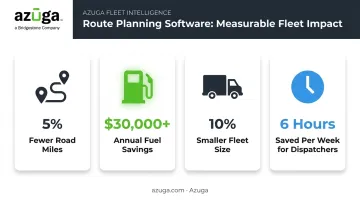
That's one company's result, not a universal guarantee, but it shows what's possible when routing decisions stop being guesswork.
Customer loyalty is the other side of the equation. Capgemini's research on last-mile delivery found that 48% of dissatisfied consumers intended to stop buying from a retailer after a poor delivery experience, while 74% of satisfied consumers planned to increase their purchases. Delivery experience isn't a back-office detail anymore. It's a retention lever.
The Challenges Are Real Too
- Last-mile complexity - Dense urban areas and remote locations both complicate timely delivery, and customers increasingly expect same-day or hour-specific windows regardless of geography
- Data overload - Dispatchers can drown in metrics without proper training, and drivers often resist switching from manual processes they've used for years
- Blind spots - Order-level data doesn't tell you if a driver is speeding, idling excessively, or taking risky routes that put the delivery at risk
That last point matters more than most DMS vendors admit. Order data can tell you a delivery is late. It can't tell you why, and it definitely can't tell you if the reason involves a safety risk. Pairing a DMS with GPS tracking and AI dashcams closes that gap, giving dispatchers the speeding events, harsh-braking alerts, and camera footage that order data alone can't capture.
Best Practices for Choosing and Implementing a Delivery Management System
Picking the wrong DMS is expensive. Here's how to avoid that.
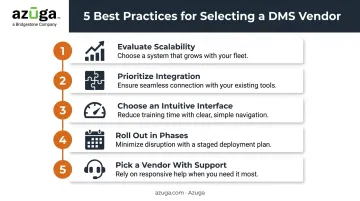
- Evaluate scalability first. Make sure the platform can handle seasonal spikes, not just your current delivery volume. A system that works fine at 200 daily deliveries can buckle at 2,000.
- Prioritize integration capability. Confirm the DMS connects cleanly with your existing CRM, ERP, and fleet/telematics systems before you sign anything. For reference, Azuga's marketplace links 75+ systems, including ServiceTitan and Procore. Data silos are the number one complaint from teams that skip this step.
- Choose an intuitive interface. Dispatchers and drivers need to be productive on day one, not week three. Complicated software slows adoption and frustrates the people who use it daily.
- Roll out in phases. Set clear KPIs, on-time delivery rate, cost per delivery, and customer satisfaction score, and test with a small group before full deployment.
- Pick a vendor with real support. Delivery downtime costs revenue immediately, so a vendor's reliability track record and support responsiveness matter as much as the feature list.
Even the right vendor can't guarantee success without proper rollout support.
Gartner predicts 60% of supply-chain digital adoption efforts will fail to deliver promised value by 2028, largely due to insufficient training investment.
Budget for onboarding time. It's not optional overhead.
How Fleet Visibility Strengthens Your Delivery Management Strategy
A DMS manages orders and stops. It doesn't tell you what's happening inside the vehicle. That's the gap fleet visibility tools fill.
Azuga's GPS fleet tracking updates vehicle location every 30 seconds on its CompleteFleet plan, giving dispatchers a near-continuous view of where every vehicle is. For delivery-heavy trades like HVAC, plumbing, electrical, and waste management, that granularity turns reactive dispatching into proactive routing.
Beyond location, Azuga's platform captures driver behavior data a DMS never sees
- Speeding, harsh braking, and sudden acceleration events
- Excessive idling and dwell time at job sites
- Hours of service compliance for smarter load assignment
- Distracted driving indicators via connected mobile apps
This matters for liability, too. Azuga's SafetyCam AI with Collision Reconstruction captures dual-facing video and uses AI analysis to help exonerate drivers wrongly blamed for accidents, a critical protection given how much time delivery drivers spend on the road daily.
The financial case holds up on its own. Azuga customers have reported:
- Decreased accidents by 38% on average
- Reduced speeding citations by 57%
- $9,462 in annual savings from better fleet cost management
Construction fleet operator Diamond Engineering used Azuga's driver behavior data to negotiate directly with its insurer
"We brought data from the Azuga system to our insurance company. When they saw what we had in terms of the ability to locate our assets and monitor our driver behaviors, they were happy to work with us on our premium, and we got more than a 10% discount."
With a plug-and-play OBD-II device that's operational in about 20 seconds and packages matched to fleet needs, layering fleet intelligence onto an existing DMS workflow is a small investment. It's minor compared to what a single at-fault accident dispute can cost.
Frequently Asked Questions
What is a delivery management system?
A delivery management system is software that automates order processing, route planning, tracking, and delivery confirmation. It connects every stage of the delivery process to improve efficiency and customer experience.
What is the best shipping management software?
There's no single "best" option since it depends on your business size and delivery volume. Compare vendors on scalability, integration capability, and real-time tracking quality rather than looking for a universal winner.
How does a delivery management system work?
It follows a four-step workflow: order intake, route planning and dispatch, real-time tracking with customer communication, and proof of delivery. Each stage feeds data into the next for full visibility.
Is delivery management the same as fleet management?
No. Delivery management focuses on order-level, customer-facing tracking, while fleet management (like Azuga) focuses on vehicle, driver, and safety data. Many businesses run both together for complete operational visibility.
How much does a delivery management system cost?
Evaluate any quote against expected labor and fuel savings before committing.
What industries benefit most from delivery management systems?
E-commerce, retail, food service, service fleets trades like HVAC and plumbing, waste management, and trucking and logistics see the strongest returns. Each industry depends on accurate, timely delivery to keep customers satisfied.