
That's where a Motor Vehicle Record, or MVR, comes in. This guide covers what an MVR includes, who needs to run them, the DOT and FMCSA rules attached to them, and how to actually pull one.
An MVR shows where a driver has been. It won't tell you what they're doing right now — and that gap matters more than most employers realize.
Key Takeaways
- An MVR is a state-maintained driving history record used for hiring, compliance, and insurance decisions.
- Federal law requires a 3-year MVR pull at hire and annual reviews under 49 CFR 391.23 and 391.25.
- Fees and lookback periods vary by state — expect anywhere from + per record.
- Written consent under the FCRA and DPPA is required before pulling an employment MVR.
- Continuous telematics monitoring closes the visibility gap between annual MVR reviews.
What Is a Motor Vehicle Record (MVR)?
MVR stands for Motor Vehicle Record. It's a document maintained by a state's motor vehicle or driver-licensing agency (called a DMV, DPS, MVD, or something similar depending on the state) that summarizes a person's complete driving history.
An MVR functions as a driving-specific background check. It's separate from a criminal history report or an employment background check, and it covers one thing only: what happens behind the wheel.
One catch: MVRs aren't standardized nationwide. AAMVA requires each state to map its own violation codes and statutes to a shared national system, but states are still free to store and format their records differently. That inconsistency creates real complexity for employers managing drivers licensed across multiple states.
One more limitation worth flagging: an MVR only shows what's officially reported to the state. Dismissed charges, unreported fender-benders, or incidents still working through the court system won't show up.
What Does an MVR Typically Include?
A standard MVR generally covers
- License number and status: valid, suspended, revoked, or expired
- License class and endorsements, including CDL and Hazmat designations
- Traffic violations and points accumulated over a defined lookback period
- DUI/DWI and other serious offenses
- Accident history as reported to the state
- Medical certification status for CDL holders, pulled through the Commercial Driver's License Information System
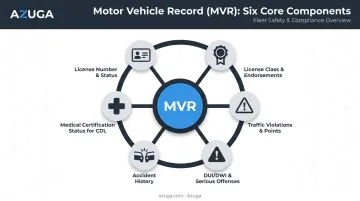
The level of detail varies a lot by state. Some list exact violation dates and point values; others summarize more broadly. That inconsistency is exactly why employers need a consistent internal review process rather than treating every MVR as apples-to-apples.
Who Needs to Run MVR Checks?
Any business whose employees drive a company vehicle (or use a personal vehicle for work) carries liability exposure. That's a wider net than most people assume. Industries with routine driving exposure include
- Construction and electrical contracting
- HVAC and plumbing services
- Landscaping and pest control
- Trucking and logistics
- Utilities and waste management
- Delivery and last-mile fulfillment
MVR checks aren't limited to DOT-regulated carriers. If a technician drives their own truck to a job site and causes an accident, the business can still face liability through hired and non-owned auto (HNOA) exposure. As Travelers explains, a company can be held legally responsible after an employee's accident, and that employee's personal auto policy often won't cover the business.
Insurance carriers are paying attention, too. Nationwide, for example, recommends employers pull an MVR at hiring and continue reviewing it throughout employment. Many commercial auto insurers now expect this practice as a baseline for coverage eligibility, not just a nice-to-have.
What Are the DOT and FMCSA Requirements for MVRs?
For DOT-regulated motor carriers, MVR requirements aren't optional. They're written into federal law.
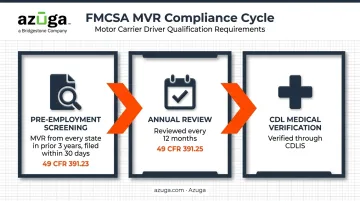
Pre-employment screening: Under 49 CFR 391.23, carriers must request an MVR from every state where a driver held a license in the preceding 3 years. That record needs to land in the Driver Qualification (DQ) file within 30 days of the employee's start date.
Annual review: Under 49 CFR 391.25, carriers must pull and review each driver's MVR at least once every 12 months. The DQ file needs a documented note showing who reviewed it and when — not just the record itself.
CDL medical verification: Current regulation requires carriers to use the CDLIS MVR to verify and document a CDL driver's medical certification status before that driver operates a commercial vehicle.
An older provision allowing carriers to rely on a paper medical certificate for up to 15 days expired on June 22, 2025. Verification now runs through the electronic CDLIS record, not a paper stopgap.
Exceptions exist. FMCSA carves out a handful of scenarios, including:
- Farm vehicle drivers, unless they're operating an articulated commercial motor vehicle
- Non-compensated private motor carriers of passengers
Non-compliance isn't a minor risk. Missing or incomplete DQ files are a common finding in FMCSA compliance audits, and repeated violations can result in civil penalties, a downgraded safety rating, or in serious cases, loss of operating authority altogether.
How to Get an MVR Report
Employers generally have three ways to obtain an MVR
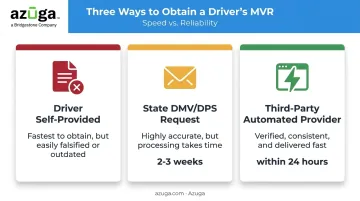
- Ask the driver to self-provide a copy. Fastest option, least reliable: there's no way to verify the document hasn't been altered or is current.
- Request directly from the state DMV or DPS. Accurate, but often slow, especially for mail-in requests.
- Use a third-party or automated MVR provider. Fastest and most consistent option, particularly for multi-state fleets.
Getting an MVR in Texas
Texas MVRs are requested through the Texas Department of Public Safety. You'll need the driver's full legal name as it appears on the license, their driver's license number, and the applicable fee.
- Online requests can return a record almost instantly for record types like the basic status check or the 3-year history.
- Mail-in requests using Form DR-1 typically take 2-3 weeks.
Whichever method you use, the request only moves forward once the driver has given consent.
Consent Comes First
Before pulling an MVR for employment purposes, employers must obtain written consent under the Fair Credit Reporting Act (FCRA) and, in some cases, the Driver's Privacy Protection Act (DPPA). If the results factor into a hiring decision, the adverse action process applies: provide the report, a summary of the applicant's rights, and a chance to respond before finalizing the decision.
Once consent is secured, speed becomes the differentiator. Automated, integrated MVR providers, including platforms like Azuga, can return records within 24 hours across many states — a meaningful upgrade over the days-to-weeks timeline of manual DMV requests.
How Far Back Does an MVR Go, and What Does It Cost?
Lookback windows depend on the violation type and the state
- Minor violations typically stay on record for 3-5 years
- Serious offenses like DUI or reckless driving often remain visible for 7-10 years or longer
- Some states, like New York, maintain separate lifetime abstracts specifically for certain license categories
Federal regulation requires carriers to review a driver's prior 3-year history at hire — but that's a floor, not a ceiling. Some states report further back than that by default.
Costs vary by state and record type. Here's how a few states compare
| State | Basic Record Fee | Certified/Extended Fee |
|---|---|---|
| California | $2 (online) | $5 (by mail) |
| New York | $7 | Varies by abstract type |
| Arizona | $3 (uncertified) | $5 (certified) |
| Massachusetts | $8 (unattested) | $20 (true and attested) |
| Texas | (status/history) | (certified/complete) |
Third-party providers sometimes add a service fee on top of the state charge, but they usually make up for it in speed and consistency across states.
Beyond the MVR: Why Continuous Driver Monitoring Matters
Here's the problem with relying on an MVR alone: it's a snapshot, not a live feed. A driver can accumulate a suspension, a DUI, or a serious violation the week after their annual review, and the employer won't know until the next pull, sometimes months later.
NIOSH research found that passive in-vehicle monitoring alone didn't reduce risky driving behavior on its own. It took supervisory coaching, layered on top of the data, to produce a measurable and lasting drop in unsafe events.
That's the gap continuous fleet monitoring is built to close. GPS telematics platforms like Azuga track driving behavior in real time, covering speeding, harsh braking, and distraction events, between MVR checks rather than waiting for the next scheduled review. Azuga customers have reported an average 38% reduction in accidents and a 57% drop in speeding citations after implementing continuous monitoring and driver coaching.
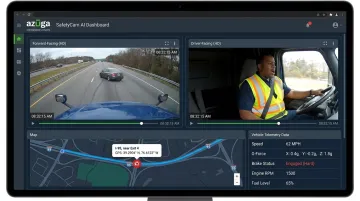
Video adds another layer. Azuga's SafetyCam AI with Collision Reconstruction pairs dual-facing HD video with GPS and vehicle telemetry to reconstruct what actually happened during an incident. That evidence matters. Industry data suggests 70% of commercial accidents involving a passenger vehicle aren't the fault of the commercial driver. Without objective proof, though, drivers can still struggle to defend themselves against a false claim.
The strongest approach combines MVR and telematics
- MVRs establish a baseline and satisfy compliance requirements at hire and annually
- Continuous monitoring catches what happens in between
- Video evidence protects drivers and the business when something goes wrong
Frequently Asked Questions
What does MVR stand for?
MVR stands for Motor Vehicle Record — a state-maintained summary of an individual's driving history. Employers use it for hiring decisions, ongoing compliance, and insurance purposes.
How do I get an MVR report in Texas?
You can request Texas MVRs through the Texas Department of Public Safety, either online, by mail using Form DR-1, or through an approved third-party provider. You'll need the driver's full legal name, license number, and the applicable fee.
Is an MVR the same as a background check?
No. An MVR is a specialized driving history report, separate from criminal or employment background checks. Employers often use both together for a fuller risk picture.
How much does an MVR cost?
Each state sets its own fees, typically ranging from about or more depending on the record type. Certified copies cost more, and third-party providers may add a service fee.
How long do violations stay on an MVR?
Minor violations usually stay on record for 3-5 years. Serious offenses like DUIs can remain visible for 7-10 years or longer, depending on the state.
Do I need consent to run an MVR check on an employee?
Yes. Employers must obtain written consent under the FCRA and, in applicable cases, the DPPA before pulling an MVR for employment purposes.