
Introduction
A driver walks into a job interview, and the hiring manager asks: "What's your CSA score?" The driver pauses. Is that even a real thing?
It's a fair question, and one that trips up a lot of people in trucking. CSA (Compliance, Safety, Accountability) is an FMCSA program, but here's the twist: it doesn't work the way most drivers assume.
This confusion carries real consequences. Safety scores influence hiring decisions, insurance premiums, and how shippers view a carrier's reliability, whether you're running one truck or five hundred. Get it wrong, and you could lose a job offer or a contract over a misunderstanding.
This article breaks down what a CSA score actually measures, whether drivers have their own version of it, and what carriers can do to keep their numbers where they need to be.
Key Takeaways
- CSA scores belong to carriers (by DOT number), not individual drivers
- Drivers have PSP records and state MVRs instead of a personal CSA score
- Scores are percentile rankings (0-100) across seven BASIC categories, refreshed monthly
- Lower percentiles are better; crossing FMCSA thresholds can trigger interventions
- Driver coaching and safety tech are the most reliable ways to keep scores low
What Is a CSA Score?
FMCSA launched the Compliance, Safety, Accountability program nationally in December 2010 to identify high-risk carriers before they cause crashes. The engine behind it is the Safety Measurement System (SMS), which pulls roadside inspection results, violations, and crash reports over a rolling 24-month window.
Here's the part that surprises most people: FMCSA does not technically "score" individuals. The percentiles published through SMS are calculated and displayed at the carrier level, tied to a USDOT number, not to a person's license.
Do Individual Drivers Have Their Own CSA Score?
No. There's no such thing as a personal driver CSA score. When a driver receives a violation during a roadside inspection, that violation gets attributed to the employing carrier's record, not a file that follows the driver from job to job.
FMCSA's official guidance on this topic confirms it: individual drivers do not have CSA scores, and the agency does not validate third-party driver scorecards claiming otherwise. Violations stay tied to the carrier for two years unless successfully disputed, even after the driver moves on.
So what do drivers actually have?
- PSP (Pre-Employment Screening Program) report – Contains 5 years of crash history and 3 years of roadside inspection history. Carriers pull this during hiring.
- MVR (Motor Vehicle Record) – A state-level record of license points and traffic convictions. It doesn't capture FMCSA-specific violations like HOS logs or maintenance citations.
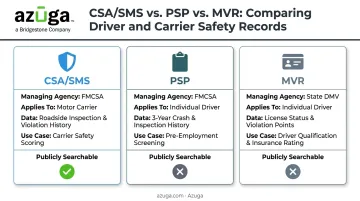
Here's how these three records break down
| Record | Used For | Managed By |
|---|---|---|
| CSA/SMS | Carrier oversight, insurance underwriting | FMCSA |
| PSP | Pre-hire driver screening | FMCSA (driver-requested) |
| MVR | License status, state insurance rating | State DMV |
The 7 BASIC Categories That Make Up a CSA Score
FMCSA organizes SMS data into seven Behavior Analysis and Safety Improvement Categories, or BASICs. Each one gets its own percentile score, calculated separately.
| BASIC | What It Covers |
|---|---|
| Unsafe Driving | Speeding, reckless lane changes, distracted driving caught during inspections |
| Crash Indicator | Crash frequency and severity (not visible to the public) |
| HOS Compliance | Exceeding driving-time limits, falsified logs, improper ELD use |
| Vehicle Maintenance | Faulty brakes, lights, tires, failed inspections |
| Controlled Substances/Alcohol | Drug and alcohol testing violations (restricted for privacy) |
| Hazmat Compliance | Packaging, labeling, and placarding for regulated materials |
| Driver Fitness | Licensing, medical certification, qualification file compliance |
Two categories, Crash Indicator and Hazmat Compliance, stay nonpublic. Enforcement staff and the carrier itself can see them after logging in, but the general public cannot pull these numbers up on a lookup site.
Dashcam footage and ELD logs give fleets an early read on two of these metrics: Unsafe Driving and HOS Compliance.
How Is a CSA Score Calculated?
Every BASIC percentile runs on the same basic math, even though the inputs differ.
Peer grouping comes first. The FMCSA sorts carriers into groups with similar volumes of relevant inspections or crashes, so a five-truck operation isn't measured against a 500-truck fleet on the same scale.
Severity weighting comes next. Every roadside violation carries a weight from 1 to 10, based on how strongly it correlates with crash risk. A worn taillight scores lower than a brake failure. Certain out-of-service violations add an extra weight of 2, and the total per inspection caps at 30 before recency adjustments.
Recency matters too. The FMCSA weights violations based on age:
- 0-6 months old – weight of 3 (heaviest impact)
- 6-12 months old – weight of 2
- 12-24 months old – weight of 1
- Older than 24 months – excluded entirely
The FMCSA's SMS Methodology documentation confirms these weighting rules and notes that SMS data refreshes monthly. That means a single bad inspection in March can still be dragging down a score in September, but its influence shrinks as it ages toward the 24-month cutoff.
What Is a Good CSA Score?
Lower is always better on the 0-100 percentile scale: a 0 signals a safer carrier than nearly all its peers, while 100 signals the opposite.
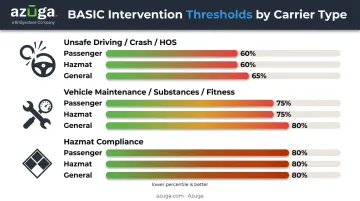
FMCSA doesn't publish a single universal "passing" number. Instead, intervention thresholds vary by BASIC category and carrier type:
| BASIC Group | Passenger Carrier | Hazmat Carrier | General Carrier |
|---|---|---|---|
| Unsafe Driving, Crash Indicator, HOS | 50% | 60% | 65% |
| Vehicle Maintenance, Controlled Substances, Driver Fitness | 65% | 75% | 80% |
| Hazmat Compliance | 80% | 80% | 80% |
Crossing a threshold doesn't automatically trigger punishment. It flags the carrier for prioritized attention, meaning more roadside stops, a possible warning letter, or a targeted investigation.
Staying well below these numbers pays off in ways that go beyond avoiding an audit
- Fewer roadside inspections eating into drive time
- Lower commercial auto insurance premiums
- Stronger standing with shippers and brokers who screen carriers before awarding freight
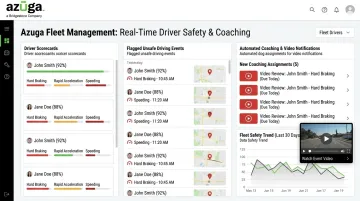
Telematics platforms like Azuga help carriers stay ahead of these thresholds by flagging unsafe driving and HOS issues in real time.
How to Check Your CSA Score
Carriers access their SMS data through the FMCSA Portal, using a Login.gov account tied to the company's USDOT number.
To get started:
- Request a USDOT PIN through the FMCSA PIN-request service if the company doesn't already have one
- Have the Company Official register the account and approve associate access
- Log into the Safety Measurement System to view BASIC percentiles
Publicly, most BASIC categories are visible to anyone searching by USDOT number. Crash Indicator, Hazardous Materials Compliance, and detailed underlying data stay restricted to the carrier and enforcement personnel.
Drivers wanting to check their own history can request a PSP report for $10 through the Pre-Employment Screening Program site. It won't show a score, but it will show the inspection and crash record a future employer would see.
How to Improve Your CSA Score
Improving a CSA score comes down to controlling what feeds into it: inspections, violations, and crashes. That starts before a driver ever gets behind the wheel.
Hire carefully. Pull PSP records and MVRs on every candidate before onboarding. A driver with a pattern of HOS violations at their last carrier will likely bring that pattern with them, even though the score itself doesn't transfer.
Coach against the highest-risk BASICs. Unsafe Driving and HOS Compliance generate the most frequent violations industry-wide. A structured coaching program, built around real incident data rather than guesswork, closes that gap faster than generic training modules.
This is where telematics earns its place in a safety program. Azuga's plug-and-play OBD-II device captures speeding, hard braking, harsh cornering, and rapid acceleration in real time, the same behaviors that drive Unsafe Driving BASIC violations.
That data feeds into individual driver scorecards. Azuga Coach then assigns targeted video training based on each driver's specific flagged behaviors rather than a one-size-fits-all course.
For crash disputes, SafetyCam AI with Collision Reconstruction pairs dual-facing HD footage with breadcrumb GPS tracking to help document what actually happened on the road. That kind of evidence matters when a fleet needs to contest an inaccurate inspection finding.
Other moves that move the needle:
- Run preventive maintenance schedules and digital inspection reporting to catch mechanical issues before they show up as roadside violations
- File a DataQs challenge for inaccurate violations. States must open the request within 7 days and complete review within 21 days
- Conduct internal audits of driver qualification files and HOS logs on a regular schedule, not just after a violation appears
The FMCSA's DataQs upgrade announcement confirms these review timelines apply to both carriers and drivers seeking corrections. Catching problems early, through audits and coaching, almost always costs less than fixing them after FMCSA flags them.
Frequently Asked Questions
What is a good driver safety score?
There's no single "good" number since CSA runs on percentiles, not a fixed scale. Staying well below your BASIC's intervention threshold (often 65% or lower for general carriers) signals strong safety performance.
How is a CSA score calculated?
Carriers are grouped into peer groups by inspection volume, then violations get weighted by severity (1-10) and recency before rolling up into a percentile per BASIC category. The Safety Measurement System handles this monthly.
Do individual truck drivers have their own CSA score?
No. CSA scores belong to carriers under their DOT number. Drivers instead have PSP reports (crash and inspection history) and state MVRs (license and violation records).
How often is CSA data updated?
SMS data refreshes monthly, typically with a snapshot taken on the third or last Friday, followed by 7-10 days of processing before publication. It covers a rolling 24-month window.
Can drivers check their own safety records?
Drivers can request a personal PSP report for $10 and pull their state MVR directly. Neither shows a "CSA score," since that metric doesn't exist at the individual level.
What happens if a carrier's CSA score is too high?
Crossing an intervention threshold can lead to warning letters, more frequent roadside inspections, or a formal investigation. This increases scrutiny without automatically penalizing the carrier.