
Introduction
A regional HVAC contractor gets a knock on the door: a surprise DOT audit. Three trucks have registrations that expired two months ago. Two drivers' inspection logs are nowhere to be found. The result: $4,200 in fines and four vehicles pulled from service for a week.
Fleet managers see this scenario play out more often than they'd like to admit. During the 2025 CVSA International Roadcheck, inspectors placed 18.1% of vehicles out of service across the US, Canada, and Mexico, with many violations tied directly to maintenance and documentation gaps.
Once a fleet grows past a handful of vehicles, these same documentation gaps widen, and paper folders and spreadsheets stop working. Renewal dates slip through the cracks. This guide covers exactly what documents to track, how long to keep them, and how digital tools simplify the entire process.
Key Takeaways
- Fleet document management directly impacts compliance, safety, and operating costs
- Track vehicle-level records (registration, insurance, inspections) and driver-level records (licenses, MVRs) separately
- Retention periods vary by document type, so when in doubt, keep records longer rather than deleting them too soon
- Manual, paper-based tracking causes most missed renewals and failed audits
- GPS and telematics platforms can auto-generate many of these records, cutting administrative work
What Is Fleet Document Management?
Fleet document management is the process of creating, organizing, and storing every record tied to a company's vehicles, drivers, and daily operations. It covers vehicle files, maintenance history, driver qualification files, and compliance reports: the records an auditor, insurer, or safety officer might ask to see.
A fleet, in this context, is simply any group of vehicles a business owns or leases to run its operations. It doesn't matter if that's three plumbing vans or 300 delivery trucks. The documentation obligations scale with the fleet, not the industry.
Why Organized Records Matter
Good documentation does more than satisfy inspectors. It
- Protects the company from liability after accidents or breakdowns
- Reduces unplanned downtime by catching maintenance needs early
- Speeds up insurance claims and audits
- Feeds data-driven decisions about vehicle replacement and driver training
Poor recordkeeping carries real financial weight. In the 2025 Roadcheck, brake systems and tires accounted for 24.4% and 21.4% of out-of-service violations, respectively — problems that proper inspection and maintenance records typically catch before a roadside stop ever happens.
Fleet documents fall into four buckets: vehicle/legal, maintenance, driver, and financial/operational records. The next section breaks down what belongs in each one.
Essential Documents Every Fleet Must Track
Missing any one of these document categories creates legal, financial, or safety exposure, regardless of fleet size or industry.
Vehicle Registration, Insurance & Licensing Records
These documents prove your legal right to operate a vehicle, establish ownership, and confirm financial coverage if an accident happens.
Track these details for every vehicle
- Registration expiration dates and renewal status
- Title records and lien information
- Insurance certificates, policy numbers, and coverage limits
- Special permits (oversize, overweight, hazmat)
Letting any of these lapse means fines, or worse, a vehicle pulled from service mid-route. A single lapsed permit can also trigger a roadside inspection failure, adding hours of downtime that ripple through the day's schedule.
Proactive renewal alerts, not annual manual checks, are the only reliable way to stay ahead of expiration dates.
DOT Compliance & Driver Qualification Files
Regulated fleets in trucking, utilities, and construction must maintain operating authority certificates, drug and alcohol program records, and safety compliance files on top of standard vehicle paperwork.
Under 49 CFR 396.3, motor carriers must "systematically inspect, repair, and maintain" every vehicle under their control. For vehicles held 30 or more consecutive days, that means keeping vehicle identification, inspection schedules, and repair records on file.
Driver-specific records to track
- License validity and class
- Motor vehicle records (MVRs), reviewed annually
- Complete qualification files, including medical certificates and road test results
Skipping regular MVR checks quickly puts an unqualified driver behind the wheel.
Maintenance, Inspection & DVIR Records
Maintenance logs and inspection reports, whether pre-trip, post-trip, or annual, prove a vehicle is safe to operate. They also support warranty claims and repair decisions down the line.
The closed-loop DVIR workflow works like this
- Driver flags a defect during a pre- or post-trip inspection
- Technician repairs and certifies the fix
- Next driver reviews the prior report and confirms the vehicle is safe before departure
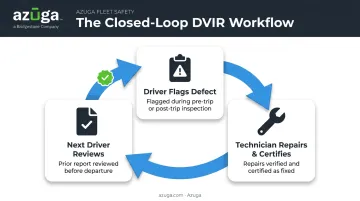
Connected devices simplify this loop considerably. Azuga's OBD-II based tracking, for instance, automatically timestamps mileage, trip data, and diagnostic trouble codes, giving fleet managers a live record tied to each vehicle without anyone touching a spreadsheet.
Fuel, Mileage & Accident Documentation
Fuel receipts, mileage logs, and trip records aren't optional extras. They're required for IFTA tax reporting and essential for cost control, especially for fleets crossing state lines.
Manual fuel logs invite errors. A driver forgets a receipt, estimates mileage instead of logging it precisely, and suddenly makes fuel theft or inefficiency nearly impossible to spot. Automated tracking ties fuel use directly to distance traveled, closing that gap.
Accident documentation carries the same stakes, turning a chaotic scene into a defensible record when it counts most. A proper accident report should capture:
- Driver and vehicle identification
- Time, date, and exact location
- Description of what happened
- Witness statements and contact information
- Photos of damage and the scene
Video changes the equation entirely. Azuga's SafetyCam AI with Collision Reconstruction, paired with 30-second location tracking, can show what happened in the seconds before and after impact.
According to Azuga's own product data, 70% of accidents are not the fault of the fleet's driver. That statistic makes objective video evidence a powerful tool for exoneration and faster claims resolution.
Structured accident documentation doesn't just win disputes. It also supports faster insurance claims and, over time, can help lower premium costs by demonstrating consistent, defensible safety practices.
How Long Should You Keep Fleet Documents?
Different document types carry different retention requirements. When in doubt, keep records longer, not shorter. Deleting too early is what triggers violations, sometimes even after a vehicle has already been sold.
Here's a quick reference for how long to hold onto each document type
| Document Type | Retention Period |
|---|---|
| Vehicle registration | Life of the vehicle |
| Insurance certificates | Several years post-expiration |
| Inspection/DVIR reports | Regulatory minimum, often 3+ months |
| Driver qualification files | Employment period plus several years |
| Accident reports | Several years (typically 3) |
| Maintenance/repair records | 1 year active, plus 6 months after disposition |
For DOT-regulated maintenance records specifically, remember the "1 & 6 rule": keep records for at least one year while the vehicle is active, plus six months after it's sold or retired.
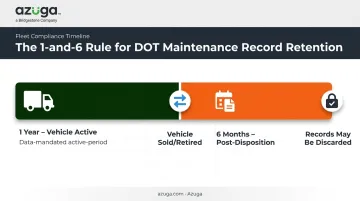
This single rule catches more fleets off guard than almost any other retention requirement. Managers often assume the clock stops the day a truck leaves the lot, but it doesn't.
Moving From Filing Cabinets to Automated Compliance
Spreadsheets and paper files fail in predictable ways
- Documents scattered across trucks, offices, and glove compartments
- Zero visibility into what's expiring this week versus next quarter
- Manual reminders that get missed when someone's on vacation
A centralized fleet management platform fixes this. It assigns clear document ownership, keeps storage consistent across every truck and office, and flags upcoming deadlines automatically—no dependence on someone's calendar app.
Azuga's GPS fleet tracking platform illustrates how this works in practice. The plug-and-play OBD-II device captures mileage, trip logs, and vehicle diagnostics automatically, feeding that data directly into digital recordkeeping instead of requiring manual entry.
Fleets using this kind of connected tracking report measurable gains, according to Azuga's internal customer data
- Average savings of over $9,000 annually in fleet cost management
- A 38% drop in accidents
- A 57% reduction in speeding citations
On the accident side, Azuga SafetyCam AI with Collision Reconstruction automatically generates video evidence and timestamped location data that can exonerate drivers and head off costly litigation before it starts.
The impact reaches beyond individual fleets. FMCSA has acknowledged the cost of unnecessary paperwork directly. Its move to eliminate no-defect DVIR requirements was projected to save the trucking industry $1.7 billion annually in administrative time alone. Digital tools that automate document capture chip away at that same burden, one renewal alert at a time.
Frequently Asked Questions
What is fleet documentation?
Fleet documentation is the collection of records covering vehicles, drivers, maintenance, and compliance that a business needs to operate legally and safely. It includes everything from registration papers to DVIRs and driver qualification files.
What is a fleet in a company?
A fleet is any group of vehicles a business owns, leases, or operates to support its operations. This spans industries from construction and utilities to delivery and towing, regardless of how many vehicles are involved.
What documents are required for DOT compliance?
Core DOT records include vehicle identification, inspection and maintenance schedules, repair history, and complete driver qualification files. Regulated carriers also need drug and alcohol program records and safety compliance files.
How long should fleet maintenance records be kept?
The general rule is at least one year while the vehicle remains active, plus six months after it's sold, retired, or otherwise leaves the fleet. This is often called the "1 & 6 rule."
What is a DVIR and why is it important?
A Driver Vehicle Inspection Report documents defects a driver finds before or after a trip. It flags safety issues early, before they turn into breakdowns or roadside violations.
How does fleet management software help with document management?
Software like Azuga centralizes records in one place, automates renewal reminders, and reduces the risk of missed compliance deadlines. Azuga's plug-and-play OBD-II device also captures mileage and diagnostic data automatically, cutting down on manual entry errors.