
Introduction
A fleet that only reacts to breakdowns will always pay more than it should. One blown transmission, one emergency tow, one vehicle pulled off the road mid-route — and suddenly you're eating repair bills, missed service windows, and a replacement decision you didn't have time to plan.
That reactive cycle is expensive. Unplanned vehicle downtime has historically run , per day, once you factor in lost productivity, driver wages, and idle assets, according to figures reported by Work Truck magazine.
Fleet lifecycle management flips that script. Instead of reacting to problems, you plan for every stage of a vehicle's life, from the day it's purchased to the day it's sold.
This article breaks down what fleet lifecycle management actually means, the five stages every vehicle moves through, where the costs really come from, and the practices that keep your fleet running lean.
Key Takeaways
- Manages a vehicle's entire journey from acquisition to retirement to minimize Total Cost of Ownership
- Works as a long-term strategy that complements maintenance checklists without replacing them
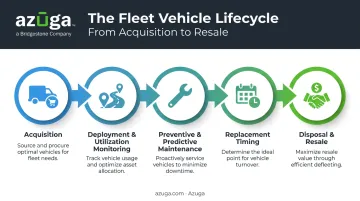
- Includes five stages: acquisition, deployment/monitoring, maintenance, replacement planning, and disposal
- Relies on telematics data, not guesswork, to determine when to repair, replace, or retire a vehicle
What Is Fleet Lifecycle Management?
Fleet lifecycle management is the end-to-end process of overseeing a commercial vehicle through every phase of its working life: purchase, deployment, maintenance, and eventual resale or disposal. This strategic framework guides decisions at every stage.
Simply keeping vehicles on the road isn't the goal. Minimizing Total Cost of Ownership (TCO) while maximizing uptime and resale value is the real target. That distinction matters more than it sounds.
Lifecycle Management vs. Fleet Maintenance
These two terms get used interchangeably, but they're not the same thing
| Aspect | Fleet Maintenance | Fleet Lifecycle Management |
|---|---|---|
| Approach | Task-based | Strategic |
| Focus | Oil changes, tire rotations, brake jobs, and other day-to-day upkeep | Whether a vehicle should stay in the fleet, and for how much longer |
Maintenance feeds into lifecycle decisions, but it's only one piece of a much larger equation.
TCO Is Bigger Than the Sticker Price
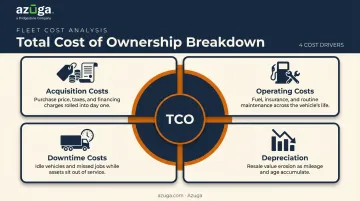
Most fleet managers underestimate TCO because they anchor on the purchase price. In reality, Fleetio's TCO framework breaks it into four buckets:
- Acquisition costs: purchase price, taxes, financing
- Operating costs: fuel, insurance, maintenance, repairs, licensing
- Depreciation: the vehicle's declining value over time
- Downtime costs: lost productivity when a vehicle is off the road
Fleets that rely on intuition instead of data tend to miss savings hiding in plain sight. They replace vehicles too early, hang onto money pits too long, or discover maintenance problems only after they've become expensive repairs. Lifecycle management closes that gap with actual numbers.
The Key Stages of the Fleet Lifecycle
Every vehicle in your fleet moves through five stages. Mismanage any one of them, and the costs ripple through the rest.
Acquisition: Building the Right Foundation
The lifecycle starts before the vehicle ever hits the road. Choosing based on duty cycle, fuel efficiency, and historical performance data (rather than instinct or "we need something now" urgency) sets the trajectory for everything that follows.
A vehicle mismatched to its job (underpowered for the load, wrong class for the terrain) racks up excess wear from day one. Getting acquisition right is the cheapest lever you'll ever pull in the lifecycle.
Deployment and Utilization Monitoring
Once vehicles are on the road, the question becomes: are they actually earning their keep? Tracking mileage and engine hours reveals underutilized or idle assets that quietly drain your budget.
A truck sitting mostly idle still costs you in insurance, depreciation, and opportunity cost. A few key metrics reveal which assets are pulling weight and which are dead weight
- Total distance traveled
- Average trips per vehicle
- Idle time percentage
Preventive and Predictive Maintenance
This is where telematics earns its keep. Diagnostic trouble codes, engine sensor data, and real-time alerts flag problems before they turn into roadside failures.
The cost math supports it. Trucking fleets spent an average of $0.202 per mile on repair and maintenance in 2023, according to ATRI's Operational Costs of Trucking research. That figure climbs sharply when routine maintenance gets skipped and small issues escalate into major repairs.
Fleets using Azuga's diagnostic alerts, for example, have reported catching fault codes early and avoiding costly breakdowns before they ever happen on the road.
Replacement Timing
This is the stage where fleets bleed money without realizing it. Replace a vehicle too early, and you leave usable value on the table. Hold it too long, and rising repair costs outpace falling resale value.
There's no universal age or mileage cutoff. But industry data offers a useful benchmark: medium-duty trucks rotated at roughly 5 to 6 years or 150,000 miles realized 5% to 10% higher resale values than units held longer, per Work Truck's 2025 fleet replacement analysis. One regional delivery fleet in that same report shortened its cycle from 7 years to 5 and sold before 200,000 miles, netting about 7% higher resale proceeds.
Your ideal number will differ by duty cycle. The point is having enough cost data to find it.
Disposal and Resale
The final stage closes the loop, and it's where earlier record-keeping pays off. A vehicle with a complete, verifiable service history sells for more confidence and less negotiation than one with gaps in its paper trail.
Black Book's residual-value team has noted that detailed service records support higher resale value and give buyers more transparency into what they're purchasing. Automated diagnostic logs (the kind generated continuously by telematics) remove the risk of incomplete manual records and give you a documented history ready to hand to the next buyer.
Breaking Down Fleet Lifecycle Costs
Every dollar spent on a fleet vehicle falls into one of two buckets
- Ownership costs — purchase price, financing or lease payments, depreciation
- Operating costs — fuel, insurance, maintenance, repairs, licensing, labor
Here's how those costs map to each lifecycle phase
| Lifecycle Phase | Major Cost Drivers | Management Priority |
|---|---|---|
| Acquisition | Purchase price, financing terms, spec selection | Match vehicle to duty cycle |
| Deployment | Fuel, idle time, underutilization | Track usage data closely |
| Maintenance | Parts, labor, unplanned repairs | Shift from reactive to preventive |
| Monitoring | Diagnostics, driver behavior, wear patterns | Centralize data visibility |
| Replacement | Depreciation, resale timing, repair frequency | Use cost thresholds, not fixed schedules |
Without visibility into utilization, fleets routinely overspend on vehicles that are underused, aging past their productive window, or poorly maintained. Most fleet managers already have plenty of data. What they need is a centralized view of it. Bringing acquisition records, telematics feeds, and maintenance logs into one dashboard is what turns scattered numbers into decisions you can actually act on.
Benefits of Effective Fleet Lifecycle Management
Get lifecycle management right, and the payoff shows up in several places at once.
Lower Total Cost of Ownership. Catching mechanical issues early and timing replacements correctly avoids both premature turnover and expensive last-mile repairs on vehicles that should've been retired months earlier.
Safety and compliance gains. Fleets using telematics have decreased accidents by an average of 38% and cut speeding citations by 57%, according to Azuga's customer data. Fewer incidents means fewer claims, lower insurance premiums, and less exposure to liability.
Stronger operational reliability. A well-maintained fleet breaks down less. That translates directly into
- Improves on-time performance for scheduled jobs
- Reduces emergency service calls disrupting the day
- Increases predictability of vehicle availability for dispatch
Sustainability improvements. Reducing unnecessary idling cuts fuel waste and emissions, while retiring inefficient, aging vehicles on schedule, rather than nursing them along, keeps your fleet's environmental footprint in check.
None of these benefits require a massive overhaul. They come from consistently acting on the data your fleet already generates.
Best Practices to Optimize Your Fleet's Lifecycle
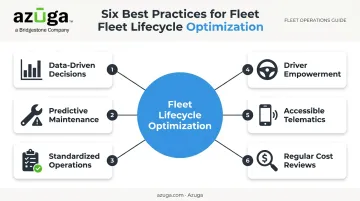
Six practices separate fleets that maximize vehicle lifespan from those that don't
- Let data drive decisions. Telematics and fleet management software replace guesswork with actual performance numbers, preventing premature replacements and missed maintenance windows.
- Prioritize predictive maintenance. Real-time diagnostic alerts flag issues while they're still cheap to fix, before a dashboard warning light signals you're already past the affordable window.
- Standardize your operations. Written policies for purchasing specs, maintenance intervals, and driver training keep every vehicle consistent, not just the ones a manager happens to be watching closely.
- Empower drivers. Idling reduction, pre-trip inspections, and smoother braking all extend vehicle life. Coaching tied to actual driving data reduces risky behavior more effectively than generic training modules.
- Make telematics accessible. Lifecycle-grade visibility doesn't require a major IT project. Azuga's plug-and-play OBD-II tracker installs in about 20 seconds with no mechanic and no vehicle downtime, giving fleets real-time visibility into vehicle health, driver behavior, and utilization from day one.
- Review lifecycle costs regularly. A quarterly look at cost-per-mile, maintenance spend, and vendor performance keeps replacement timing sharp instead of stale. What made sense two years ago may not hold up against today's repair costs and resale market.
Frequently Asked Questions
What is the fleet lifecycle?
The fleet lifecycle is the full journey of a vehicle within your operation, from acquisition and deployment through maintenance, monitoring, and eventual replacement or disposal. Each stage affects the cost and performance of the ones that follow.
What are the stages of fleet lifecycle management?
Five stages: acquisition, deployment and utilization monitoring, preventive and predictive maintenance, replacement planning, and disposal or resale. Skipping visibility into any one stage tends to raise costs in the others.
How do you calculate total cost of ownership for a fleet vehicle?
Add purchase price, financing costs, fuel, insurance, maintenance, repairs, and downtime, then subtract the vehicle's expected resale value. The result gives you a true per-vehicle cost, not just the listed rate.
What is the ideal fleet replacement cycle for commercial vehicles?
There's no single fixed number. Ideal timing depends on maintenance history, mileage, and how quickly repair costs are climbing relative to the vehicle's remaining resale value, not a flat age or mileage cutoff.
How does telematics support fleet lifecycle management?
Telematics delivers real-time data on vehicle health, utilization, and driver behavior: odometer readings, fault codes, idle time, and more. That data directly informs when to repair, replace, or retire a vehicle instead of guessing.
What's the difference between fleet lifecycle management and fleet maintenance?
Maintenance is task-based upkeep: oil changes, inspections, repairs. Lifecycle management is the broader strategy covering a vehicle's entire operational life, using maintenance data as one input among several.