
That's the gap dynamic route planning is built to close. Instead of locking in a route once and hoping conditions cooperate, it continuously recalculates based on live data throughout the shift.
The stakes are real. Last-mile delivery alone accounts for 41% of total logistics supply-chain costs, according to Capgemini Research Institute. This guide breaks down how dynamic routing actually works, step by step, so you understand the mechanics before evaluating software.
Key Takeaways
- Dynamic routing recalculates stops continuously using live traffic, weather, and order data, unlike static routes
- The process cycles through data intake, optimization, monitoring, and output in real time
- Service fleets, last-mile delivery, and waste collection see the biggest gains from dynamic adjustment
- Frequent-update GPS platforms make dynamic routing possible at scale
- Affordable cloud-based, plug-and-play systems bring dynamic routing to small fleets too
What Is Dynamic Route Planning and Optimization?
Dynamic route planning is the continuous, technology-driven process of calculating and re-calculating the most efficient sequence of stops for vehicles, based on real-time inputs, rather than a route that's set once and followed rigidly.
Here's the operational problem it solves: fixed routes break down the moment reality diverges from the plan. A road closure or a same-day order can turn a morning's carefully planned route useless by 10 a.m., and an emergency job request can do the same before lunch. Dynamic planning closes that gap by recalculating on the fly instead of forcing dispatchers to manually rebuild routes.
It's easy to confuse dynamic routing with related tools. It isn't
- Turn-by-turn GPS navigation: provides directions for a route someone already chose, without touching the stop sequence
- One-time static optimization: software that plans efficient routes in advance but leaves them unchanged for weeks or months
- Manual dispatcher rerouting: a person manually reshuffling stops by phone or spreadsheet instead of a system recalculating automatically
Why This Still Matters Today
Legacy routing tools have existed for decades, so why does dynamic planning matter now more than ever? Customer patience for slow delivery has thinned. In a global DHL survey, 52% of shoppers named long delivery times a top frustration, and over a third abandoned carts entirely because delivery felt too slow.
That said, speed isn't the whole story. McKinsey has found that many customers will happily wait two to three days when shipping is free. The real demand centers on reliability and flexibility, not raw speed, and that's exactly what continuous route recalculation delivers.
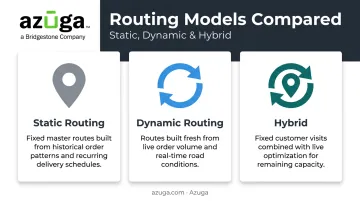
Three Models Businesses Use
| Model | How It Works |
|---|---|
| Static routing | Fixed, master routes built from historical patterns |
| Dynamic routing | Built fresh from live order and condition data |
| Hybrid | Some fixed customer visits, rest optimized live |
Many trades businesses run hybrid models, keeping loyal recurring customers on set visit days while letting the optimization engine fill remaining capacity dynamically.
How Does Dynamic Route Planning Work?
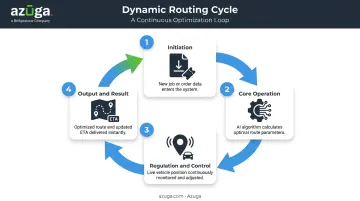
Dynamic route planning isn't a single "plan once" event. It runs as a continuous loop: data comes in, the system computes, drivers execute, and the loop adjusts again as new information arrives.
Initiation
The cycle starts when new information enters the system: a fresh order, a service ticket, or a dispatch request. This typically flows in through integrations with CRM, TMS, or work-order platforms.
Modern systems automate this step almost entirely. Rather than a dispatcher manually rebuilding a route each morning, data streams in continuously. Azuga's fleet platform, for instance, connects with dispatch and job-management tools like Fleetio, TowBook, and Ace-CO, so job data reaches the routing logic without manual re-entry.
Common bottleneck: siloed systems. If dispatch software, CRM, and GPS tracking don't talk to each other, new information sits in a queue instead of reaching the routing engine in time to matter.
Core Operation
Once data arrives, optimization algorithms evaluate the variables that matter most
- Distance between stops
- Delivery or service time windows
- Vehicle capacity
- Driver availability and skill match
The engine generates the most efficient stop sequence given those constraints. When something changes (a canceled stop, an urgent job, a traffic jam), the system reshuffles the route and reassigns stops within seconds, no manual rework required.
Performance here depends on three things: how fast the system recalculates, how accurate the new sequence is, and whether it balances workload evenly across multiple vehicles rather than overloading one driver while another sits idle.
Regulation and Control
Recalculating routes is only useful if the system knows where vehicles actually are, not just where they were scheduled to be. This requires high-frequency GPS tracking.
Azuga's platform, for example, updates vehicle location as frequently as every 30 seconds depending on plan tier, giving the optimization engine a live picture rather than a stale one.
That live location feed powers corrective action. When a driver hits unexpected traffic or a route drifts off pace, the system flags it and pushes updated instructions directly to the driver's app and the dispatcher's dashboard.
Without this real-time monitoring loop, "dynamic" routing is really just a more frequent static plan; it's the constant feedback that makes it genuinely responsive.
Output and Result
The end product of each cycle is a refreshed route: an updated stop sequence, turn-by-turn guidance, and revised ETAs, pushed straight to the driver's mobile device or in-vehicle unit.
That output rarely stays isolated. It typically feeds
- Customer notification systems (updated ETA texts or emails)
- Dispatcher dashboards, for oversight of every active vehicle
- Downstream tools like Towbook for dispatch and invoicing records
Real-world proof this matters: UPS's ORION system moved from route-once-a-day planning to dynamic, mid-route recalculation. That single shift reduced routes by an average of 2 to 4 miles per driver, according to Supply Chain Dive, and it's now running across 97% of UPS's van fleet.
Where Dynamic Route Planning Is Used
Dynamic routing earns its keep anywhere daily job mix varies. Common fits include
- Last-mile parcel and package delivery
- Service fleets dispatch (HVAC, plumbing, electrical, pest control)
- Waste and recycling collection
- Utility and telecom service calls
It performs best under specific conditions: high stop-density routes, unpredictable demand, tight time windows, or dispatchers juggling several jobs across a wide service area at once.
Trades fleets see this play out directly. HVAC provider Air Engineers uses live map tracking to route and schedule technician calls based on real-time vehicle position, letting dispatchers assign the closest available tech rather than the next one on a fixed list.
Auto recovery operator Courtice Auto Wreckers applies the same logic in reverse, locating empty trucks in real time and redirecting them to nearby jobs to cut unproductive drive time between calls.
That's the core value for towing, construction, electrical, and pest control fleets — pairing dynamic routing with GPS fleet visibility so dispatchers reassign the nearest available vehicle instead of dispatching whoever happens to be next in the queue.
Benefits of Dynamic Route Planning
The efficiency gains from dynamic routing show up in two places: fewer wasted miles and fewer safety incidents. Both hit the bottom line.
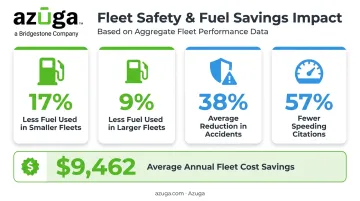
Cost reduction. Peer-reviewed simulation testing found dynamic routing models used 17% less fuel in smaller fleet scenarios and roughly 9% less in larger ones, compared to conventional route planning. This held true even when the optimized routes covered slightly more distance. The takeaway: minimizing fuel isn't the same as minimizing miles, and dynamic systems can optimize for the right variable.
Efficiency and productivity. Real-time optimization means more stops or jobs completed per shift, because drivers spend less time idling in traffic or backtracking for missed windows. Windshield time between jobs shrinks when the nearest available vehicle gets the next assignment automatically.
Combined safety and cost impact. When route optimization is paired with GPS tracking and driver behavior monitoring, the effects compound. Azuga customers using this integrated approach have reported
- 38% average reduction in accidents
- 57% fewer speeding citations
- $9,462 in average annual fleet cost savings
Those numbers reflect what happens when routing efficiency, live visibility, and driver coaching work together rather than as separate tools.
Conclusion
Dynamic route planning functions as a continuous cycle running throughout the day: data comes in, algorithms optimize, live GPS tracking monitors progress, and routes adjust as conditions change.
Understanding that mechanism matters more than most marketing pitches admit. Fleets that grasp how the loop actually functions are better equipped to evaluate routing software, GPS update frequency, and integration requirements like Azuga's telematics marketplace, rather than picking a tool based on a glossy feature list.
Frequently Asked Questions
What is dynamic routing with an example?
Dynamic routing continuously adjusts a vehicle's path based on live conditions. For example, a delivery van gets automatically rerouted around a traffic accident, or a field technician gets reassigned to a closer urgent job mid-shift.
Which is better, static or dynamic routing?
Static routing works well for stable, predictable schedules with little day-to-day variation. Dynamic routing serves businesses better when order volume, time windows, or job urgency change frequently.
What is the difference between route planning and route optimization?
Route planning determines which stops belong on which routes. Route optimization evaluates the possible combinations to find the most efficient or cost-effective sequence.
How does AI improve dynamic route planning?
AI and machine learning analyze historical and live data to predict delays, recognize patterns, and recalculate optimal routes faster than manual or rule-based methods can manage.
Which industries benefit most from dynamic route planning?
Industries with variable daily job volume, such as last-mile delivery, service fleets trades, waste collection, and utilities, see the greatest gains from continuous route adjustment.
Is dynamic route planning expensive or difficult to implement?
Modern cloud-based platforms with plug-and-play GPS hardware, available via quote, have made dynamic routing accessible even for small fleets without large IT budgets.