
Introduction
39,254 people died in traffic crashes in 2024, according to NHTSA's final crash data. That's roughly 107 deaths every single day on U.S. roads.
Behind most of these crashes sits a driver who made a split-second mistake, whether that's missing the brake, drifting out of a lane, or losing focus for a moment. Driver safety technology exists to catch those moments before they become fatalities.
This term covers two very different worlds. There's the driver-assistance tech built into the personal vehicles many of us drive to work. And there's the fleet-grade monitoring and coaching technology businesses use to manage risk across dozens or thousands of vehicles at once.
This guide breaks down both. You'll learn what these systems do and how to check whether your own car has them. Then you'll see how to combine the right tools if you're running a commercial fleet.
Key Takeaways
- Driver safety tech splits into reactive systems (warnings) and proactive systems (automatic intervention)
- ADAS features like forward collision warning vary by trim level and model year
- Commercial fleets add telematics, AI dashcams, and driver scoring that personal vehicles lack
- The right fleet solution depends on your fleet size, budget, and drivers' daily risks
What Is Driver Safety Technology?
NHTSA defines driver assistance technologies as active-safety systems that warn drivers of an impending crash or take limited action to help avoid or reduce one. The driver stays in charge. The system just adds a second set of eyes, or in some cases, a second set of hands on the brake.
Reactive vs. proactive systems
There's an important distinction here that shapes everything else in this guide
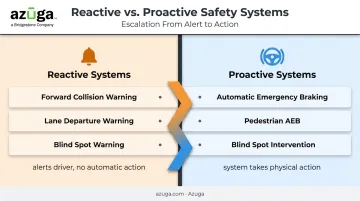
- Reactive technology alerts the driver but doesn't act on its own. Forward collision warning is a good example: it beeps when you're closing in on the car ahead, but you still have to brake.
- Proactive (intervention) technology takes physical action. Automatic emergency braking will apply the brakes itself if you don't respond in time.
Fleet technology follows a similar split. GPS tracking and driver scoring are reactive in a sense: they surface risky behavior after the fact so a safety manager can coach a driver. AI dashcams with real-time distraction alerts lean more proactive, nudging the driver before a mistake compounds into a crash.
Where automation currently stands
A lot of drivers assume "self-driving" tech is already mainstream. It isn't. Current consumer vehicles top out at Level 2 automation, meaning the system can handle steering and braking/acceleration together under specific conditions, but the driver must stay engaged and ready to take over at any moment. Nothing sold to consumers today removes driver responsibility.
A quick note on the human-error data: NHTSA's crash causation research assigned the "critical reason" (the last event in the chain before a crash) to the driver in 94% (±2.2%) of crashes studied. NHTSA is careful to point out this isn't the same as saying drivers "caused" 94% of crashes or were legally at fault. Still, it's a strong signal for why assistance technology matters.
Adoption has moved fast: In 2016, 20 automakers representing over 99% of the U.S. market pledged to make automatic emergency braking standard. By the 2022–23 production year, every one of them had fulfilled that commitment on light-duty vehicles, a shift from optional add-on to near-universal standard equipment in less than a decade.
Types of Driver Safety Technologies in Personal Vehicles
Modern vehicles pack in a range of ADAS features. Here's how they break down by function.
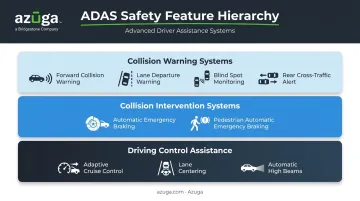
Collision Warning Systems
These systems detect a hazard and alert the driver, but they don't take the wheel or the brakes
- Forward collision warning: flags a vehicle ahead you're closing in on too fast
- Lane departure warning: alerts you if you drift out of your lane without signaling
- Blind spot warning: lights up a mirror icon when a vehicle sits in your blind zone
- Rear cross-traffic warning: catches traffic approaching from either side while backing up
Collision Intervention Systems
Where warning systems stop, intervention systems act
- Automatic emergency braking (AEB): brakes automatically if a forward crash looks imminent and you haven't reacted
- Pedestrian AEB: a variant that specifically detects people in your path
- Rear automatic braking: applies the brakes while reversing to prevent a backing collision
- Blind spot intervention: goes beyond a warning light, applying gentle steering or braking to discourage an unsafe lane change
Driving Control Assistance & Other Systems
This category covers the assistance features that make everyday driving smoother and safer
- Adaptive cruise control: holds your speed and following distance automatically
- Lane centering/keeping assistance: nudges the wheel to keep you centered or corrects drift
- Automatic high beams: switches between high and low beam based on traffic
- Backup cameras: standard on nearly all new vehicles now
- Automatic crash notification: alerts emergency responders with your location after a crash
One emerging category worth watching: drowsiness and fatigue detection. These tools analyze steering patterns, track eye movement through cabin cameras, or rely on wearables to flag when a driver is nodding off. The technology is still maturing, and there's no reliable industry-wide adoption figure yet, but it's an area regulators are actively researching. For commercial fleets, many of these same warning and intervention systems are now factory-installed on trucks and vans, feeding real-time data into fleet safety platforms that turn raw alerts into coachable driver insights.
Fleet-Specific Driver Safety Technologies (Going Beyond ADAS)
ADAS protects one driver in one vehicle. Fleet technology protects a whole operation. If you're managing 10, 50, or 500 vehicles, you need visibility ADAS was never built to provide.
Telematics and GPS tracking
Real-time location and behavior data across an entire fleet, not just one vehicle, is the foundation. Azuga's tracking, for example, updates every 30 seconds, giving dispatchers and safety managers near-live visibility instead of stale, minutes-old pings.
AI dashcams and collision reconstruction
AI-powered dashcams add a layer ADAS can't touch: evidence. Azuga's SafetyCam AI uses a neural learning network to detect distraction events (phone use, drowsiness, eyes off the road) and automatically captures footage around safety events.
That footage matters more than most fleet managers expect. Azuga cites data suggesting up to 70% of accidents aren't actually the fleet driver's fault. Collision reconstruction footage can prove it, which means fewer wrongful insurance payouts and less exposure to costly litigation.
Driver scoring and coaching
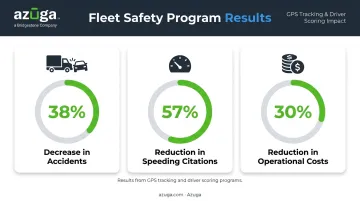
Raw telematics data (harsh braking, speeding, rapid acceleration) only helps if it turns into action. Driver scoring tools convert those events into a score that safety managers can use to coach specific habits. Fleets using Azuga's GPS tracking and scoring tools have reported
- A 38% decrease in accidents
- A 57% reduction in speeding citations
- A 30% reduction in operational costs through better route and behavior management
ELDs and hours-of-service tracking
For commercial carriers, Electronic Logging Devices aren't optional: they're a federal requirement for most drivers who must keep records of duty status. Azuga's Driver Logs app automates this: it records driving status the moment the vehicle moves, tracks on-duty/off-duty/sleeper-berth status, and flags HOS violations before they become FMCSA penalties.
Easy adoption removes the biggest barrier
A lot of fleets delay adopting safety tech because they assume installation means downtime. Azuga's OBD-II tracker plugs into the vehicle's diagnostic port and starts working in about 20 seconds — no technician, no wiring, no scheduled install window.
How to Check If Your Vehicle Has These Safety Technologies
How to Check If Your Fleet Vehicles Have These Safety Technologies
Not sure which advanced safety systems came standard on your fleet vehicles? Here's where to look before assuming coverage that isn't there.
- Check the window sticker (Monroney label) — every new vehicle has included a safety section since 2006, and NHTSA added recommended advanced tech listings starting in 2010
- Read the owner's manual — it lists which ADAS features each vehicle's trim includes and how to use them
- Search NHTSA's ratings database — the NHTSA vehicle ratings tool lets you search by year, make, and model for listed safety technology
- Look for physical indicators — a small camera housing near the rearview mirror, radar sensors behind the front grille, or sensors embedded in the side mirrors usually mean ADAS hardware is present
A word of caution: feature names vary by manufacturer, so a missing icon doesn't always mean a missing feature. Fleet telematics platforms like Azuga fill this gap, tracking actual driver behavior and events regardless of which factory-installed systems are on board.
Choosing the Right Driver Safety Technology for Your Fleet
Picking fleet safety tech isn't a one-size-fits-all decision. Start with your risk profile before you start comparing vendors.
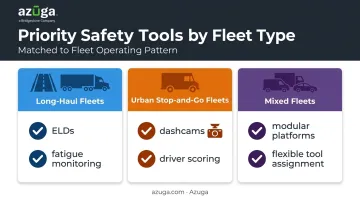
Match technology to your actual risk
- Long-haul fleets face fatigue, hours-of-service compliance, and highway-speed collisions, so prioritize ELDs and fatigue monitoring
- Urban stop-and-go fleets (delivery, HVAC, plumbing) deal more with distraction and hard braking in traffic, so prioritize dashcams and driver scoring
- Mixed fleets benefit from modular platforms that let you assign different tools to different vehicle types
Prioritize easy installation and packages matched to fleet needs
Complicated installs and opaque contracts kill adoption before it starts. Look for
- Self-install hardware that doesn't require a technician visit
- Plans that scale predictably as your fleet grows
- Azuga's entry point matches packages to fleet needs, with a plug-and-play device built for small businesses through enterprise fleets
Confirm integrations, support, and ROI
A safety platform that doesn't talk to your other systems creates more work, not less. Look for integrations with dispatch, fuel cards, and maintenance software.
Azuga connects with 75+ platforms, including ServiceTitan, Procore, Fleetio, and TowBook. Confirm support too: 24/7 phone, email, and web access matter once vehicles are on the road at 2 a.m.
Then weigh the ROI. Look past the listed rate: real returns show up in reduced accident frequency, fewer citations, lower insurance premiums, and better fuel efficiency.
Kitsap Garage Door Company, for example, used GPS tracking to cut daily vehicle costs to meaningful per-vehicle cost savings through fuel and idle-time improvements alone. That's a small, concrete number, but it adds up fast across a full fleet.
Frequently Asked Questions
Which cars have driver safety technology?
Most vehicles from 2018 onward include some level of ADAS, but exact features vary by manufacturer and trim. Check the Monroney label (window sticker) or NHTSA's ratings database for your specific model.
What devices and technologies do drivers use for safety?
Drivers rely on built-in ADAS (collision warning, automatic braking), aftermarket dashcams, GPS trackers, and, increasingly, wearable fatigue-monitoring devices. Fleet drivers often use all four together.
How can I tell if my car has driver safety technology (ADAS)?
Check your owner's manual, look for dashboard warning icons, and inspect for visible sensors or camera housings near the windshield, bumper, or side mirrors. These are the quickest visual clues.
What is the difference between reactive and proactive driver safety technology?
Reactive tech warns or responds in the moment, like lane departure warning beeping when you drift. Proactive tech tries to prevent the risky situation before it happens, like fatigue-prediction tools flagging drowsiness early.
Do fleet safety technologies actually reduce accidents?
Yes, when paired with coaching. Azuga customers using GPS tracking and driver scoring tools have reported a 38% decrease in accidents and a 57% reduction in speeding citations.
How much does fleet driver safety technology cost?
Costs vary based on hardware and feature sets, with affordable entry points for small fleets. Azuga matches packaging to fleet size and the features you select.