
By 2026, contractors are managing predictive fleet ecosystems that flag failing components before they fail, track everything from excavators to extension cords, and generate safety data insurers actually trust.
The pressure driving this shift is real. Equipment costs keep climbing, skilled operators are harder to find every year, and margins on most jobs are thinner than they used to be. Many contractors are still stuck juggling one system for GPS, another for maintenance, and a spreadsheet for everything else.
This article breaks down the trends reshaping construction fleet management heading into 2026, what's driving them, and how they're already changing daily operations on job sites.
TL;DR
- Predictive maintenance uses sensor data to catch failures before they cause downtime
- Fleet visibility now extends beyond vehicles to generators, trailers, and small tools
- AI dashcams detect driver distraction and reconstruct collisions to resolve liability disputes fast
- Fuel and idle-time analytics are becoming standard as diesel costs remain volatile
- Telematics platforms now integrate with ERP and project management tools, reducing duplicate data entry
Key Trends Shaping Construction Fleet Management Software in 2026
These trends aren't hypothetical. They're already showing up in fleet budgets and RFPs across the industry, and contractors are already moving on them.
AI-Powered Predictive Maintenance
Unplanned downtime is the most expensive word in construction. Every hour a paver or excavator sits broken instead of working, you're paying for it twice: once in repair costs, once in lost productivity.
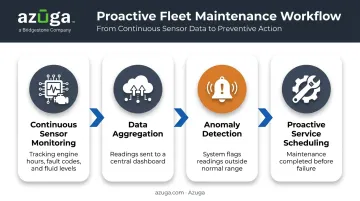
Predictive maintenance flips the old model. Instead of servicing equipment on a fixed calendar, or waiting for a breakdown, sensors monitor engine hours, fault codes, and fluid levels continuously. When something drifts out of normal range, the system flags it before it fails.
The strongest evidence for this approach still comes from broader industrial and manufacturing settings, where programs have delivered meaningful uptime gains and lower maintenance costs. Construction-specific data is catching up, but the mechanics translate directly: less guesswork, fewer surprise breakdowns, better-planned service windows.
Why this trend is accelerating now:
- Equipment costs have risen enough that unplanned downtime is a board-level concern, not just a maintenance headache
- OEM data standards, including ISO/TS 15143-3 (built from AEMP's telematics API work), make it easier to pull data from mixed-brand fleets into one dashboard instead of five manufacturer portals
- Sensor and telematics hardware costs have dropped enough to make continuous monitoring practical across mixed equipment fleets, not just premium machines
On the ground, this looks like diagnostic trouble codes flowing into a single maintenance dashboard alongside scheduled service reminders. Azuga's platform, for example, captures DTC codes across both vehicles and heavy equipment, giving fleet managers live visibility into machine health instead of waiting for a warning light on-site.
Unified Visibility Across Mixed and Non-Powered Assets
A generator sitting idle at one job site while another crew rents a duplicate three miles away is one of the most common, and most avoidable, costs in construction. The fix is tracking everything, not just what has an engine.
Modern platforms combine GPS trackers, Bluetooth Low Energy tags, and QR-code identifiers to monitor trailers, generators, compressors, and hand tools alongside the powered fleet. All of it lands on one dashboard instead of a scattered spreadsheet.
What this solves in practice:
- Reduces theft by flagging when equipment leaves a job site outside scheduled hours
- Improves utilization reporting by showing which assets sit unused at one site while a neighboring project pays to rent the same equipment
- Cuts the time crews spend physically searching a yard for a specific trailer or attachment
Idling and misuse compound the cost. The Association of Equipment Manufacturers found nonproductive idling accounts for 10% to 30% of fuel consumed by construction machinery, and telematics-driven monitoring can trim that idle time by another 10% to 15%. Multiply that across a fleet of loaders and generators running all season, and mixed-asset visibility pays for itself quickly.
Azuga's Equipment Management and Asset Management features apply this directly, keeping vehicles, trailers, and small equipment on one platform with geofencing that alerts managers the moment something crosses a boundary it shouldn't.
AI Dashcams and Advanced Driver/Operator Safety Analytics
Dashcams used to be glorified black boxes, footage nobody looked at until something went wrong. That's changed. AI-powered dashcams now detect distraction, harsh braking, and following distance in real time, then flag the clips that matter instead of dumping hours of footage on a safety manager's desk.
Collision reconstruction takes this further. When an accident happens, the system pieces together the sequence of events using video, GPS, and motion data, instead of relying on conflicting driver and witness accounts.
Azuga's SafetyCam AI with Collision Reconstruction is a direct example. It runs on a dual-facing HD camera, a driver monitoring system, and a neural learning network that analyzes in-cab video for distraction events.
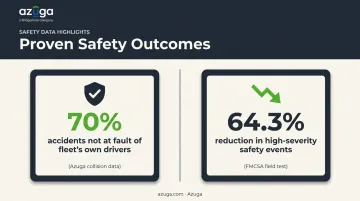
According to Azuga's own collision data, this system helps demonstrate that 70% of accidents are not the fault of the fleet's own drivers — a distinction that matters once litigation or insurance claims enter the picture.
Independent research backs the broader approach. An FMCSA field test involving 317 drivers and 156 instrumented vehicles found that combining video monitoring with real-time alerts and manager coaching reduced high-severity safety events by as much as 64.3% at some fleets. Results varied by fleet, and the technology worked alongside driver feedback rather than in isolation.
Why this matters for construction fleets specifically:
- Job sites involve tight quarters, pedestrians, and heavy equipment, a recipe for disputed liability after any incident
- Faster claims resolution through objective video evidence reduces legal exposure
- Documented safety improvements give fleets leverage in insurance renewal negotiations
Sustainability, Fuel Optimization, and Electrification Readiness
Fuel is one of the largest controllable costs on a construction fleet, and one of the easiest to lose track of. Idle time, unauthorized use, and inefficient routing between sites eat into the budget long before diesel prices even move.
Fuel analytics platforms now flag this waste directly. Azuga's idle-time reporting, for instance, gave Kitsap Garage Door Company visibility into engine idling and fuel use, generating a documented return on investment. The same logic scales across a mixed construction fleet: idle reports surface which machines are burning fuel without doing productive work.
What's pushing this trend forward:
- Fuel price volatility makes waste reduction a budgeting necessity, not a nice-to-have
- Regulatory standards, including EPA's finalized greenhouse gas rules for heavy-duty vehicles starting with model year 2027, are pushing fleets toward better fuel and performance data
- Early electrification of support vehicles is underway at larger firms; Turner Construction, for example, has committed to an all-electric vehicle fleet by 2028
Most construction fleets aren't going electric wholesale next year. But idle-time reduction, fuel card integration, and geofencing to catch unauthorized use are practical steps available now, with a shorter payback period than any equipment purchase.
Deeper Software Ecosystem Integration
Construction has a data fragmentation problem. Fleet tracking lives in one system, project management in another, accounting in a third. Someone re-enters the same information three times, and errors creep in every time.
Fleet platforms are closing that gap by integrating with tools contractors already run. Industry analysts have long described construction technology as a fragmented, point-solution market, one now shifting toward integrated platforms that connect fleet, project, and financial data.
What this looks like day to day:
- A project manager checks equipment location and utilization from the same dashboard used for scheduling
- Procurement sees maintenance flags before ordering replacement parts, instead of finding out after a breakdown
- Finance pulls fuel and maintenance costs directly into job costing without a manual export
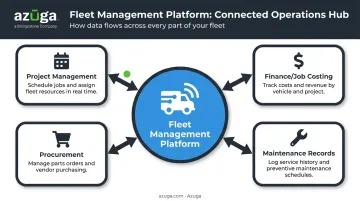
Azuga supports this through its integration marketplace, connecting with platforms like Fleetio and TowBook, letting fleet data flow into the systems teams already use rather than forcing another standalone login.
What's Driving These Trends in Construction
Technology adoption doesn't happen in a vacuum. A mix of technical, economic, workforce, and regulatory pressures is pushing construction fleets toward smarter software faster than most contractors expected even two years ago.
Affordable technology: Technology has matured enough to be affordable. AI processing, IoT sensors, and cloud computing that once required enterprise budgets now run on standard hardware. A modest monthly telematics plan delivers data that would have needed a custom system a decade ago.
Labor shortages: Skilled labor is scarce. Nearly every contractor feels it. In AGC's 2025 workforce survey, 92% of firms with job openings reported difficulty filling those positions, and 45% said labor shortages directly delayed projects. When you can't hire more people to manage fleets manually, software has to fill the gap.
Rising costs: Costs keep climbing. Fuel prices remain volatile, equipment costs are up, and commercial auto insurance premiums have continued rising in many markets. Every dollar saved through better routing, idle reduction, or fewer accidents goes straight to the bottom line.
Regulatory pressure: Compliance is getting more demanding. Emissions reporting requirements, ELD mandates for qualifying vehicles, and state-level programs like California's Clean Truck Check all require documentation that's far easier to generate automatically than to compile by hand.
How These Trends Are Impacting Construction Operations
These shifts aren't theoretical. Contractors are already seeing them show up in daily operations, not just in vendor pitch decks.
Operational Impact
Dispatch used to mean a radio call and a paper log at the end of the day. Now, site supervisors see real-time equipment location and availability across every active job site from one screen.
That shift changes allocation. Instead of a phone tree to find out if the skid steer at Site A is free, a manager checks the dashboard and reassigns it in minutes.
Business Impact
Fleet data is reshaping capital decisions. Utilization and maintenance history now inform buy-versus-rent-versus-replace decisions instead of gut instinct.
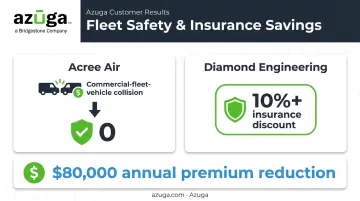
Insurance is the clearest financial win so far. Acree Air cut its accident rate from two incidents down to zero after adopting Azuga Fleet.
The company then used that documented safety record to negotiate an $80,000 annual reduction in insurance premiums. Diamond Engineering landed a discount greater than 10% after showing its insurer detailed asset-location and driver-behavior data.
Workforce Impact
None of this works without people who know how to use it. Operators and site managers now need comfort with mobile apps, digital dashboards, and safety scoring systems, not just the machinery itself.
That's a real training investment, especially for crews used to paper timesheets and radio check-ins. Fleets that build in ongoing coaching, similar to the driver feedback loops used with AI dashcams, get more consistent results from the technology they've already paid.
Future Signals for Construction Fleet Management Beyond 2026
The trends above are already in motion. A few earlier-stage developments are worth watching over the next one to three years, even if they're not mainstream yet.
- Semi-autonomous and remote-operated equipment. AEM tracks a shift from operator-assist features toward task automation and, eventually, full autonomy. Built Robotics has already deployed AI-enabled autonomous pile-driving equipment on active job sites, though this remains a specialized use case.
- Digital twins for job-site planning. McKinsey and Deloitte both point to digital twins for planning equipment allocation and simulating job-site logistics before a machine arrives, though outcomes still depend on data quality.
- AI-driven procurement forecasting. Deloitte's 2026 outlook expects more integrated data on tariffs, freight, and lifecycle performance to feed predictive purchasing decisions, helping fleets replace equipment based on actual performance instead of a fixed depreciation schedule.
None of these are ready to replace the fundamentals above. But they're the direction the data is heading.
Conclusion
Construction fleet management in 2026 comes down to combining predictive maintenance, mixed-asset visibility, smarter safety analytics, fuel discipline, and connected software into one real competitive edge.
Contractors adopting these tools early are already seeing it: less unplanned downtime, fewer disputed accidents, lower insurance costs, and fewer hours lost hunting for equipment across job sites.
Strategic fleet planning has become a core part of how competitive contractors run their business, not a side project left to the operations team.
Frequently Asked Questions
What are the benefits of using fleet management software?
Fleet management software reduces unplanned downtime, lowers fuel costs, and improves safety through real-time data and automated alerts. Azuga customers have reported a 38% average decrease in accidents and roughly 30% lower operational costs.
What makes good fleet management software for construction?
Good construction fleet software checks these boxes
- Rugged hardware built for job-site conditions
- Tracking that covers non-powered assets like generators and trailers
- OEM-compatible data integrations
- Installation simple enough for crews to handle themselves
How much does construction fleet management software typically cost?
Azuga matches packaging to fleet size and the features you select, with add-ons like AI dashcams available as optional add-ons, making costs scalable as a fleet grows.
Can fleet management software track non-powered equipment like generators and trailers?
Yes. Modern platforms use GPS trackers, BLE tags, and dedicated asset trackers to monitor generators, trailers, and small tools alongside powered vehicles, all from one dashboard.
Is fleet management software worth it for small construction businesses?
Subscription-based platforms scale down to small fleets, and fuel, maintenance, and insurance savings often cover the monthly cost within the first few months. Waiting until a fleet grows larger only delays those savings.
How does fleet management software help with driver safety and liability?
AI dashcams with collision reconstruction capture objective video and sensor data during an incident, helping exonerate drivers who weren't at fault and resolve claims faster. That reduces litigation exposure and supports lower insurance premiums over time.