
Introduction
Medium- and heavy-duty trucks generated 23% of U.S. transportation-sector greenhouse gas emissions in 2022, according to EPA data on transportation sector emissions. That single statistic explains why nearly 20 states have stopped waiting on federal rulemaking and adopted California's stricter emissions standards.
For fleet managers, this creates a real headache. A truck compliant in Ohio might not meet requirements in New York. Vehicle purchasing decisions, maintenance schedules, and even route planning now hinge on which state lines your vehicles cross.
This guide breaks down what CARB actually is, which states currently follow its rules, the specific regulations affecting heavy-duty fleets, and practical strategies for staying compliant without blowing your budget.
Key Takeaways
- CARB standards exceed federal EPA minimums, adopted by roughly 18 states plus D.C.
- Advanced Clean Trucks and Advanced Clean Fleets rules are reshaping heavy-duty vehicle manufacturing and fleet purchasing Clean Truck Check violations can cost $1,000 to $10,000 per day per vehicle
- Federal waiver status has shifted multiple times since 2019, requiring state-by-state monitoring
- Telematics data (idle time, mileage, fuel use) supports compliance planning and documentation
What Is CARB and How Does It Differ from the EPA?
The California Air Resources Board (CARB) is the state agency responsible for regulating air pollution and protecting public health. It traces back to 1967, when California created the Air Resources Board to address Los Angeles smog that had been choking the city since the 1940s.
That regulatory history still shapes compliance today. Being CARB-compliant means a vehicle or fleet meets emissions standards that typically exceed federal requirements, a distinction that matters more than most fleet managers realize.
Why California Gets Special Treatment
The EPA sets nationwide vehicle emissions standards under the Clean Air Act. Every state must follow these as a baseline. California, however, holds unique authority under Section 209 of the Clean Air Act to request waivers allowing stricter state-specific standards.
Other states can then adopt California's approved standards under Section 177, without needing separate federal approval. They simply mirror California's rules rather than creating their own.
A History of Regulatory Whiplash
This waiver authority has become a political football
- 2019: EPA withdrew portions of California's waiver for light-duty vehicle standards
- 2022: EPA reversed course and restored the 2013 waiver
- April 2023: EPA granted California's waiver for the Advanced Clean Trucks rule
- January 2025: California withdrew its pending Advanced Clean Fleets waiver request
- June 2025: Congress passed resolutions disapproving several California waivers, according to EPA's announcement on transmitting California waiver rules to Congress
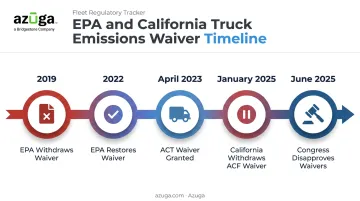
This back-and-forth isn't just political noise. It directly affects which rules apply to your fleet and when. A regulation that was enforceable last year might be paused today, or vice versa.
Practical takeaway: Compliance obligations depend heavily on where vehicles are registered and operated, not just where your company is headquartered.
Which States Are CARB States?
CARB states are those that have formally adopted California's vehicle emissions standards under Section 177, rather than relying solely on federal EPA rules. This isn't a fixed list. States join and leave based on legislative changes, shifting political priorities, or ongoing waiver litigation.
Current CARB-Adopting States
As of the latest CARB Section 177 dashboard, the following states have adopted some form of California's standards
California, Colorado, Connecticut, Delaware, D.C., Maine, Maryland, Massachusetts, Minnesota, Nevada, New Jersey, New Mexico, New York, Oregon, Pennsylvania, Rhode Island, Vermont, Virginia, and Washington.
Not every state adopts the same package of rules. Some follow only Low-Emission Vehicle (LEV) standards, while others also enforce Zero-Emission Vehicle (ZEV) sales mandates.
| Classification | States |
|---|---|
| ACT + ZEV/LEV programs | California, Colorado, Maryland, Massachusetts, New Jersey, New Mexico, New York, Oregon, Rhode Island, Vermont, Washington |
| ZEV/LEV only (no ACT) | Delaware, Maine, D.C. |
| Legacy ZEV/LEV programs | Connecticut, Minnesota, Nevada, Virginia |
| LEV only | Pennsylvania |
States That Reversed Course
A handful of states adopted CARB standards and later repealed them
- Arizona dropped its adoption in 2012 over disputes about electric vehicle mandates
- Virginia moved to exit its clean car commitment in 2024
- Minnesota wound down its Clean Cars MN program for model year 2025 vehicles, with rules being repealed as obsolete
Practical takeaway: If you operate vehicles across multiple states, verify each state's current adoption status regularly, since requirements can shift as states join or exit CARB programs from year to year.
Key CARB Vehicle Emissions Regulations Fleets Should Know
Four regulations matter most for fleet operators. Each targets a different part of the vehicle lifecycle, from manufacturing to daily operation.
Advanced Clean Trucks (ACT) Rule
ACT is a manufacturer sales mandate, not a direct fleet-purchase requirement. It requires truck makers to increase the percentage of zero-emission trucks in their sales mix over time.
According to CARB's Advanced Clean Trucks regulation summary, targets scale from single digits in 2024 up to these 2035 model-year requirements
- Class 2b-3 trucks: 55% zero-emission sales
- Class 4-8 straight trucks: 75% zero-emission sales
- Class 7-8 tractors: 40% zero-emission sales
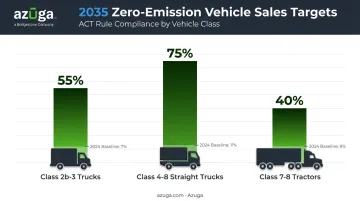
This affects fleets indirectly: as ZEV inventory grows and diesel options shrink in ACT states, procurement timelines and vehicle availability shift accordingly.
Advanced Clean Fleets (ACF) Rule
ACF sets ZEV purchase requirements for large fleets and government agencies. State and local government fleets faced a 50% ZEV purchase requirement starting in 2024, scaling to 100% by 2027.
Private fleet enforcement, however, remains in flux. CARB withdrew its federal waiver request for ACF in January 2025 and has since proposed repealing the high-priority and drayage fleet provisions while keeping the public-fleet rules intact.
Truck and Bus Regulation
This targets existing heavy-duty diesel vehicles already on the road. Most diesel vehicles over 14,000 lbs GVWR operating in California needed a 2010-or-newer engine and emissions system by January 1, 2023. Vehicles that don't meet this standard risk DMV registration denial.
Zero-Emission Vehicle (ZEV) Requirements
Separate from ACT and ACF, ZEV mandates require a set percentage of zero-emission vehicles within a manufacturer's or fleet's overall mix, depending on the state and program.
Important: Requirements vary significantly by state, fleet size, and vehicle class. Always confirm which specific rules apply to your operation rather than assuming uniform requirements across CARB states.
How CARB Compliance Impacts Fleet Operations and Costs
Compliance isn't just a paperwork exercise. It touches nearly every operational decision a fleet makes.
Upfront investment pressure. Transitioning to newer, cleaner vehicles or alternative fuel technology requires significant capital. Small and mid-sized fleets often feel this strain most acutely, since they lack the purchasing scale larger carriers use to negotiate better terms.
Operational ripple effects. CARB rules influence
- Route planning, especially for fleets crossing state lines with different requirements
- Vehicle replacement schedules, as older diesel equipment ages out faster in CARB states
- Maintenance practices, since aging emissions systems need closer monitoring
Enforcement consequences. Non-compliance carries real financial risk. Clean Truck Check violations alone can trigger civil penalties of $1,000 to $10,000 per day per vehicle, according to CARB's own FAQ documentation. Beyond fines, non-compliant vehicles can face registration denial or be barred from operating in certain states entirely.
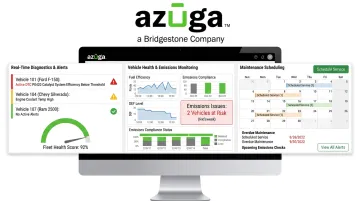
Proactive tracking changes the equation. Platforms like Azuga that monitor vehicle diagnostics and maintenance in real time help fleets catch emissions issues before they escalate into Clean Truck Check violations, turning potential penalty exposure into planned capital expenditure.
Compliance Strategies for Fleets Operating in CARB States
Staying ahead of shifting CARB requirements comes down to visibility and planning, not guesswork.
Build Your Baseline First
Start with a fleet audit covering
- Vehicle age and engine model year (not just chassis year)
- Current emissions levels and system health
- Fuel consumption patterns across your fleet
This baseline tells you which vehicles need attention first and which can wait.
Create a Compliance Timeline
With baseline data in hand, turn it into a schedule rather than a wish list. Map out ZEV research, vehicle procurement lead times, charging or fueling infrastructure installation, and staff training. Zero-emission trucks often have long lead times, so waiting until a deadline is months away almost guarantees a costly scramble.
Tap Available Incentives
Once a timeline is set, funding often determines how fast fleets can act. Several programs help offset transition costs. California's HVIP voucher program reopened in December 2025 with roughly $95 million available, including a $5 million set-aside for public fleets and tribal governments. EPA's Clean Heavy-Duty Vehicles Grant Program has funded over 2,400 zero-emission vehicles nationwide in recent competitions.
Use Telematics for Ongoing Documentation
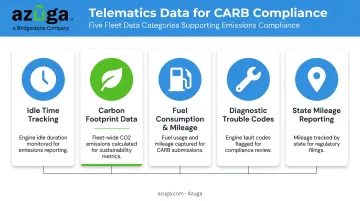
Timelines and incentives address the transition itself, but compliance also demands ongoing proof. This is where day-to-day tracking earns its keep. Azuga's platform captures data points that directly support CARB compliance planning
- Idle time tracking with a built-in calculator estimating fuel savings from reduced idling
- Carbon footprint data available directly in the fleet dashboard's ROI section
- Fuel consumption and mileage per vehicle, useful for emissions-per-mile calculations
- Diagnostic trouble codes flagging engine issues before they become compliance liabilities
- State mileage reporting, which helps fleets running across multiple CARB and non-CARB states track where miles are accumulating
Companies like Earthtech Landscape have used this kind of idle time and fuel data to cut per-vehicle costs from day one. For fleets managing aging diesel equipment or planning a phased ZEV transition, having this data in one dashboard makes audits and reporting far less painful than piecing together spreadsheets from multiple sources.
Frequently Asked Questions
What does CARB stand for?
CARB stands for the California Air Resources Board, a state agency created to regulate air pollution and protect public health. It sets vehicle emissions standards that are often stricter than federal requirements.
Which states are CARB states?
Roughly 18 states plus D.C. have adopted CARB standards, including New York, Massachusetts, Colorado, and Washington. The full current list appears earlier in this article.
What is the difference between CARB and EPA regulations?
The EPA sets federal minimum emissions standards that apply nationwide. CARB sets stricter state-level standards that other states can voluntarily adopt under Section 177 of the Clean Air Act.
What is a ZEV state?
A ZEV state requires automakers to sell a set percentage of zero-emission vehicles each model year. This program is managed by CARB and adopted by a subset of CARB states, not all of them.
Do non-CARB states have any emissions requirements at all?
Yes. Non-CARB states must still comply with federal EPA emissions standards. These are less stringent than CARB rules but remain enforceable nationwide.
How can fleet managers stay compliant across multiple CARB states?
Conduct regular fleet audits and monitor state-specific rule changes as they're issued. Fleet telematics platforms like Azuga track vehicle mileage, location, and compliance status in real time across every state you operate in.