
Fleet management software used to be built for enterprise logistics companies with dedicated fleet managers. That's changed. Small business adoption of telematics is accelerating fast, and the tools have gotten simpler, cheaper, and mobile-first.
This guide breaks down the best fleet management platforms for small businesses in 2026, based on total cost of ownership, ease of setup, and real safety outcomes.
Key Takeaways
- Fleet software centralizes GPS tracking, maintenance alerts, and safety scores.
- Prioritize total cost of ownership and contract flexibility over feature bloat.
- Azuga offers self-install hardware and packages matched to fleet needs.
- Full-featured platforms cost monthly; maintenance-only tools run cheaper.
- The best pick reduces accidents and missed maintenance without hiring a full-time fleet manager.
Overview of Fleet Management Software in the Small Business Market
Fleet management software combines GPS tracking, vehicle diagnostics, maintenance scheduling, and driver safety monitoring into one system. Instead of juggling a mileage spreadsheet, a paper maintenance log, and a group text for dispatch updates, everything lives in one dashboard.
The market has grown to support this shift. The U.S. fleet telematics industry generated an estimated $9.2 billion in revenue in 2025, according to IBISWorld, and small fleets are a growing share of that demand.
Industry tracking firm Fleet Equipment also found small fleets' technology adoption scores climbed sharply in 2025, signaling that telematics has moved from "nice to have" to standard practice.
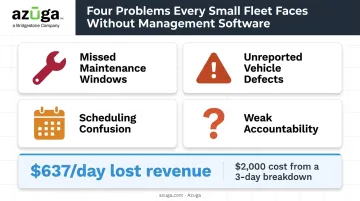
Without dedicated software, small fleets tend to hit the same walls
- Missed maintenance windows that turn a $200 fix into a $2,000 breakdown
- Unreported vehicle defects that create liability exposure
- Scheduling confusion from relying on group texts or whiteboards
- Weak accountability when no one can verify who was driving, where, or how fast
Penske's fleet cost data puts a number on the downtime problem: roughly $637 in lost truckload revenue per day. Three days of an unplanned breakdown can cost close to $2,000 in a single vehicle. For a 10-van HVAC company, that's not a rounding error. The right software closes these gaps before they turn into five-figure repair bills.
The section below evaluates the platforms best matched to small business budgets and daily operations, not enterprise procurement teams.
Best Small Business Fleet Management Software for 2026
Each platform below is evaluated on total cost of ownership, ease of use, safety features, scalability, and contract flexibility.
Azuga
Azuga is a GPS fleet management provider backed by Bridgestone, built for small and mid-size fleets in HVAC, construction, landscaping, electrical, and other service industries.
What sets it apart
- Self-install OBD-II device that plugs into the vehicle's diagnostic port and starts tracking in about 20 seconds — no technician needed
- Azuga SafetyCam AI with Collision Reconstruction, which Azuga says proves 70% of customer accidents aren't the driver's fault, helping exonerate drivers and speed insurance claims
- Gamified driver rewards program that turns safe driving into a competition instead of a lecture
- 24/7 unlimited support included across plan tiers
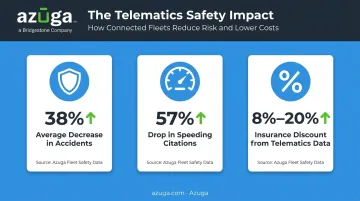
Azuga customers have reported a 38% average decrease in accidents and a 57% drop in speeding citations after adoption, alongside measurable savings on fuel and maintenance costs.
| Category | Details |
|---|---|
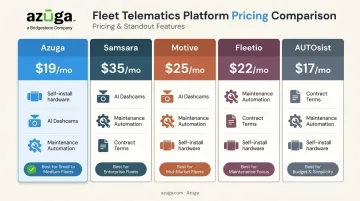
| Pricing | packages matched to fleet needs |
| Key Features | 30-second GPS tracking, AI dashcams, driver rewards, fuel card integration |
| Best For | Small businesses wanting affordable self-install hardware with strong safety incentives |
Samsara
Samsara serves fleets of every size with an IoT and AI-driven platform covering GPS, ELD compliance, maintenance, and video safety in one system.
Its Vehicle Gateway hardware supports plug-and-play self-installation, and the dual-facing AI dashcam offers real-time in-cab coaching for distracted driving, drowsiness, and lane departure. Samsara's app marketplace connects to 350+ third-party tools, which appeals to fleets planning to scale.
The catch: Samsara's official small-business program requires a 3-year software license paid upfront, and rates aren't published publicly, so you'll need a conversation to compare true cost.
| Category | Details |
|---|---|
| Pricing | package matched to fleet size and features |
| Key Features | Predictive maintenance alerts, AI dashcams, geofencing, ELD compliance |
| Best For | Growing small fleets that want room to scale into advanced features |
Motive
Motive leans hard into safety, using AI-powered dashcams to flag distracted or unsafe driving as it happens. The company states its AI Dashcam and Vehicle Gateway can help prevent accidents by up to 30%, though that's a vendor claim rather than an independent finding.
Setup is self-install via the diagnostic port, and live coaching alerts are a genuine differentiator for fleets trying to lower insurance costs. On the downside, Motive's Better Business Bureau profile shows a pattern of unresolved customer complaints worth reviewing before signing.
Industry benchmarks cite roughly monthly as typical, though that figure reflects general market averages rather than a confirmed Motive rate.
| Category | Details |
|---|---|
| Pricing | Contact for details |
| Key Features | AI distraction/collision detection, ELD compliance, maintenance alerts |
| Best For | Small fleets prioritizing driver coaching and insurance cost reduction |
Fleetio
Fleetio focuses on maintenance automation rather than GPS-first tracking, and it publishes plan details outright, a rarity in this space.
Automated service reminders, fuel card syncing, inspection workflows, and a customizable dashboard make it a strong fit for fleets whose biggest pain point is missed oil changes and inspection paperwork rather than driver behavior.
| Category | Details |
|---|---|
| Pricing | Contact for details |
| Key Features | Maintenance automation, inspection workflows, fuel tracking, document storage |
| Best For | Budget-conscious fleets wanting strong maintenance and process automation |
AUTOsist
AUTOsist is a mobile-first maintenance and tracking tool built for lean teams with no IT department. Setup takes minutes, and there's no lengthy onboarding curve.
It functions like a digital glove box: maintenance reminders, expense tracking, DVIR support, and basic GPS tracking, all accessible from a phone. A 14-day free trial with no credit card required makes it low-risk to test.
| Category | Details |
|---|---|
| Pricing | Contact for details |
| Key Features | Maintenance reminders, expense tracking, mobile-first GPS, DVIR support |
| Best For | Very small fleets or owner-operators wanting basic tracking without complexity |
How We Chose the Best Small Business Fleet Management Software
Small business owners often default to whatever platform their biggest competitor uses, or they get sold on an enterprise-grade feature list they'll never touch. Both mistakes lead to overpaying or abandoning the software within a year.
We weighted five factors, each tied to a business outcome
- Total cost of ownership: platforms that publish rates let you calculate total cost of ownership before a sales call, avoiding surprise fees.
- Ease of installation and onboarding: self-install hardware means faster adoption and no technician scheduling delays.
- Safety and compliance features: dashcams and driver scoring reduce accident frequency and support ELD compliance.
- Contract flexibility: shorter terms protect fleets that plan to grow or shrink within a year or two.
- Customer support responsiveness: unresolved support tickets translate directly into downtime and frustrated dispatchers.
Key Features Small Businesses Should Prioritize
Not every feature matters equally when you're running five vans instead of five hundred trucks. Focus on the ones that pay for themselves fastest.
Real-Time GPS Tracking and Geofencing
Location visibility replaces the "where's the truck?" phone call. It directly improves
- Customer ETAs, since dispatchers can confirm arrival windows without guessing
- Theft prevention, through instant alerts when a vehicle leaves an approved zone
- Route efficiency, especially for teams without a dedicated dispatcher
Driver Safety Scoring and Dashcams
Automated coaching catches risky habits before they become accidents. Azuga customers, for example, have reported a 57% reduction in speeding citations after rolling out safety scoring and dashcam alerts — a meaningful dent in both ticket costs and insurance risk.
Progressive's commercial telematics program backs this up from the insurance side: new customers see roughly 9% average savings, with first-renewal discounts reaching 8% to 20% based on driving data.
Flexible Contract Terms
Geotab's 2026 benchmark puts most full-featured fleet management platforms at, while maintenance-only tools like Fleetio and AUTOsist start lower. Before signing anything
- Confirm whether the price includes hardware and installation or bills them separately
- Ask what happens if you add or remove vehicles mid-contract
- Avoid multi-year lock-ins unless the discount clearly outweighs the flexibility you're giving up
Conclusion
The best fleet management software for a small business fits your daily operations, budget, and onboarding capacity. A long feature list or a recognizable logo doesn't guarantee that fit.
Before signing a contract, evaluate scalability, how fast you can actually get the system running, and total cost of ownership over the full contract term, not just the base package.
If you're a small business ready to cut accidents and operational costs without hiring a fleet manager, Azuga's self-install platform is a reasonable place to start comparing.
Frequently Asked Questions
How much does fleet management software cost for a small business?
Full-featured platforms and maintenance-only tools both scale with fleet size and selected features. Azuga matches packages to fleet needs tailored to hardware and capabilities rather than a one-size package.
What features should a small business look for in fleet management software?
Prioritize real-time GPS tracking, automated maintenance alerts, driver safety scoring, and packages matched to fleet needs. These four cover most of the ROI without requiring enterprise-level complexity.
Is fleet management software worth it for a small fleet with fewer than 10 vehicles?
Yes. Even basic tracking software can cut fuel waste, catch maintenance issues early, and reduce insurance costs. Those savings add up quickly, even at a small scale.
How quickly can I set up fleet management software?
Plug-and-play OBD-II devices, like Azuga's, install in about 20 seconds per vehicle with no professional installer required. Most small fleets are fully onboarded within a day.
Do I need to sign a long-term contract for fleet management software?
Some providers, like Samsara, require multi-year commitments paid upfront. Others offer monthly or annual billing with more flexibility, so compare terms carefully before signing.
Can fleet management software help reduce insurance costs?
Driver safety scoring, dashcams, and collision reconstruction data can support lower premiums over time. Progressive's telematics program, for instance, offers 8% to 20% first-renewal discounts based on driving data.