
The right platform pulls GPS tracking, ELD compliance, maintenance alerts, and fuel data into one screen. That means dispatchers spend less time chasing paperwork and more time keeping trucks moving. This guide compares the top trucking fleet management software for 2026, based on pricing, ELD/IFTA compliance, safety technology, and how easy each platform is to actually use.
Key Takeaways
- Trucking fleet software merges GPS tracking, ELD/HOS compliance, and safety scoring into one platform
- Prioritize FMCSA-certified ELD compliance, packages matched to fleet needs, and self-installable hardware
- Azuga, Samsara, Motive, Geotab, and Verizon Connect lead the market, spanning small owner-operators to 1,000+ truck enterprises
- Expect to pay, depending on dashcams and reporting features
- A solid platform pays for itself through fewer accidents, less fuel waste, and avoided fines
Overview of Fleet Management Software in the Trucking Industry
Trucking fleet management software combines GPS tracking, telematics hardware, ELD compliance tools, and reporting dashboards into a single system. Carriers use it to manage vehicles, monitor drivers, and stay on the right side of federal regulations.
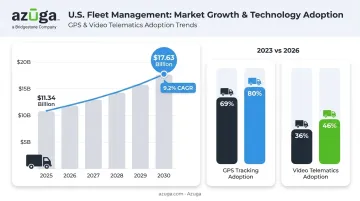
The category has grown fast. The broader U.S. Fleet management market sat at $11.34 billion in 2025 and is projected to hit $17.63 billion by 2030 — a 9.2% annual growth rate — according to a MarketsandMarkets industry report.
That growth tracks with adoption trends across commercial fleets. GPS tracking adoption reached 80% in 2026, up 11 points year-over-year, while video telematics adoption hit 46%, up 10 points since 2023, according to a Verizon Connect fleet technology survey of nearly 900 fleet professionals.
Rising insurance premiums, tighter driver pools, and the ELD mandate have pushed software from optional to near-universal for commercial carriers. The comparison below breaks down which platforms actually deliver on trucking-specific needs.
Top 5 Best Trucking Fleet Management Software for 2026
Each platform below was evaluated on ELD/IFTA compliance, total cost of ownership, safety technology, installation method, and support quality.
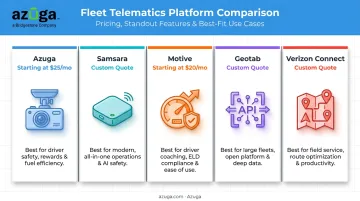
Azuga
Azuga is a GPS fleet management provider backed by Bridgestone, built to serve trucking fleets alongside construction, utility, and service businesses. Its self-installable OBD-II device plugs into a vehicle's diagnostic port and starts transmitting data in about 20 seconds. No technician visit required.
What sets Azuga apart for trucking fleets
- SafetyCam AI with Collision Reconstruction helps exonerate drivers, with Azuga citing that 70% of accidents are not the driver's fault
- An AI neural network analyzes driver-facing video to flag distracted driving events automatically
- 30-second high-frequency GPS tracking on the CompleteFleet plan gives dispatchers near real-time visibility
- A gamified driver rewards program that turns safety scoring into friendly competition instead of top-down criticism
According to Azuga's internal customer data, fleets using the platform have reported roughly 38% fewer accidents, 57% fewer speeding citations, and an average of $9,462 in annual savings from tighter cost management. Diamond Engineering, a construction fleet using Azuga, negotiated more than a 10% insurance premium discount after sharing telematics data with their carrier.
| Category | Details |
|---|---|
| Starting Price | Packages matched to fleet needs |
| Key Features | GPS tracking, driver safety scorecards, SafetyCam AI dashcams, fuel card integration, ELD compliance |
| Best For | Small to mid-size trucking fleets wanting affordable, self-installable hardware with 24/7 support |
Samsara
Samsara combines IoT sensors, AI dual-facing dashcams, and maintenance management into one platform built for fleets of any size. It's a favorite among large or complex trucking operations that need everything under one roof.
Samsara stands out for automatic engine fault code logging and predictive maintenance alerts. Most fleet managers pick up the interface quickly, without extensive training. The trade-off: Samsara typically requires longer contract terms than competitors with self-serve pricing.
In a Samsara-commissioned survey of 521 fleet professionals managing 11+ vehicles, 84% reported satisfaction with the platform, the highest score among the providers compared in that study.
| Category | Details |
|---|---|
| Starting Price | package matched to fleet size |
| Key Features | AI dual-facing dashcams, predictive maintenance, real-time GPS, ELD/HOS compliance |
| Best For | Large or complex trucking fleets needing a fully customizable, all-in-one solution |
Motive
Motive, formerly known as KeepTruckin, built its platform around ELD compliance and AI-driven driver coaching, specifically for trucking safety needs. It's less of a general fleet tool and more of a trucking-first solution.
The differentiator is Motive's computer vision dashcams. They detect distraction and unsafe following distance in real time, then feed that data into location-based driver scoring.
That scoring treats long-haul truckers differently than local delivery drivers, since a driver on a six-hour interstate run faces different risk factors than one making twenty stops in a city.
Category pricing guidance puts Motive in a custom-quote range on average, though the company works with packages matched to fleet needs for most fleets.
| Category | Details |
|---|---|
| Starting Price | Contact for details |
| Key Features | ELD/HOS compliance, AI dashcams, live coaching, maintenance and dispatch tools |
| Best For | Trucking fleets prioritizing driver safety coaching and insurance rate reduction |
Geotab
Geotab is an open-platform telematics provider known for scale. It processes vehicle data spanning GPS location, engine diagnostics, and driver behavior, and supports an extensive third-party integration marketplace called the Geotab Marketplace.
Geotab's advantage is flexibility. Fleets keep full data ownership, use open APIs to build custom reporting, and select a base plan plus modular add-ons for ELD, IFTA, and HOS tracking specific to trucking compliance. That modular structure means smaller fleets aren't paying for enterprise features they'll never touch.
Geotab's own guidance notes that basic track-and-trace plans sit at the lower end of the market, with more advanced configurations running higher depending on hardware and support needs.
| Category | Details |
|---|---|
| Starting Price | Contact for details; modular add-ons for compliance and EV support |
| Key Features | GPS tracking, VIN lookup, harsh braking detection, ELD/IFTA regulatory plan, open data export |
| Best For | Data-focused trucking fleets and enterprises wanting deep analytics and integration flexibility |
Verizon Connect
Verizon Connect pairs telecommunications infrastructure with fleet tracking and dispatch tools, adding route optimization for larger operations. It's built for enterprise-scale trucking operations that need dispatch and asset tracking working together.
The platform's dynamic routing engine adjusts in real time for traffic and driver hours, helping dispatchers avoid HOS violations before they happen. Verizon Connect also offers strong asset and trailer tracking, a must for larger operations managing detached equipment.
Pricing tends to run higher than competitors, and the company doesn't publish flat rates.
In the same 521-fleet satisfaction survey referenced above, Verizon Connect scored 67% satisfaction, the lowest among the four platforms measured, though its enterprise feature set remains a draw for large carriers.
| Category | Details |
|---|---|
| Starting Price | Contact for details |
| Key Features | Dynamic route optimization, ELD/DVIR compliance, asset and trailer tracking, two-way driver messaging |
| Best For | Large trucking fleets needing dispatch integration and enterprise-level support |
How We Chose the Best Trucking Fleet Management Software
Providers were compared on published or researched pricing, ELD and IFTA compliance capability, safety technology, hardware installation method, and verified customer satisfaction data from independent surveys.
Price carried heavy weight in this evaluation, but it's also where buyers most often stumble: choosing the lowest advertised price without checking for hidden fees, multi-year contract lock-ins, or missing ELD/IFTA features required for compliance. A cheap platform that fails an audit costs far more in fines than a slightly pricier one that doesn't.
ELD and Regulatory Compliance
FMCSA-mandated ELD compliance and IFTA reporting aren't optional extras for trucking fleets. Before purchasing, confirm the device is on FMCSA's registered ELD list, not just described as "ELD compatible." IFTA licensees must retain fuel and distance records for four years, and electronic location records need to log data at least every 10 minutes while the engine runs.
Contract Flexibility and Installation
Azuga uses packages matched to fleet needs with a self-installable OBD-II device that plugs in without a technician. Competitors like Samsara, Motive, Geotab, and Verizon Connect also require a quote, so compare total cost of ownership including installation and onboarding time.
Safety Technology, ROI, and Scalability
AI dashcams and driver scorecards can directly influence insurance costs. Sentry, a commercial auto insurer, offers eligible trucking customers up to a 3% premium discount for sharing ELD data through its partnership with Motive. That discount is conditional and insurer-specific, so check with your own carrier before assuming savings.
Beyond safety tech, long-term scalability determines whether a platform still fits once your fleet grows. Before signing a multi-year contract, confirm
- 24/7 support across phone, email, and chat
- Integration options with fuel cards, dispatch software, and accounting tools
- Clean pricing scalability as your fleet grows, without forced renegotiation
Conclusion
Choosing the best trucking fleet management software means matching a carrier's compliance needs, fleet size, and budget to the right platform, not chasing brand recognition.
Before signing anything, request trials, compare simple packaging against tailored packages, and evaluate onboarding support closely. A platform that takes three weeks to install costs you more than the monthly fee suggests.
If you're ready to see how straightforward trucking compliance and safety can be, explore Azuga's plug-and-play GPS fleet management platform, with packages matched to fleet needs.
Frequently Asked Questions
What is trucking fleet management software?
It's software combining GPS tracking, ELD/HOS compliance, maintenance alerts, and driver safety reporting into one platform. Carriers use it to manage vehicles, drivers, and regulatory requirements from a single dashboard.
How much does trucking fleet management software cost in 2026?
Azuga matches packages to fleet needs tailored to fleet size and features.
Is ELD compliance software required for all trucking fleets?
FMCSA mandates ELDs for most commercial drivers required to keep Records of Duty Status. Limited exceptions apply, including short-haul drivers and vehicles older than model year 2000.
Can small trucking fleets benefit from fleet management software?
Yes. Even fleets with a handful of vehicles save on fuel, maintenance, and insurance costs through automated tracking and driver scoring, often recovering the software cost within months.
How does fleet management software reduce fuel and maintenance costs?
Automated idling alerts, route optimization, and predictive maintenance reminders cut fuel waste and catch mechanical issues before they turn into costly roadside breakdowns.
Which fleet management software integrates with IFTA and ELD reporting?
Most major providers, including Azuga, Geotab, Motive, and Samsara, offer built-in or add-on IFTA and ELD reporting to keep carriers compliant with federal and state fuel tax requirements.