
Introduction
A dispatcher scribbles down ten stops on a whiteboard, orders them by gut feel, and sends the driver out. Three hours later, that driver is stuck in traffic they could have avoided, backtracking across town, and running an hour behind on appointment windows.
This is what manual routing looks like at most small and mid-size fleets. It burns fuel, frustrates customers, and eats into margins nobody can afford to lose.
Route optimization fixes this by using data and algorithms to calculate the most efficient path for every stop, factoring in traffic, time windows, and vehicle capacity, not just distance.
This article breaks down what route optimization actually is, how the technology works behind the scenes, the measurable benefits fleets see, and what to look for when choosing software.
Key Takeaways
- Route optimization weighs traffic, time windows, vehicle capacity, and driver availability, not just distance
- Distinct from route planning and scheduling, though all three work together
- Fleets using it report lower fuel costs, better on-time rates, and safer driving
- The right software combines real-time GPS data, scalability, and easy integration with tools you already use
What Is Route Optimization?
Route optimization is the process of calculating the most efficient and cost-effective route for a vehicle making multiple stops. The goal is finding the best sequence of stops when dozens of variables are pulling in different directions, not just the shortest distance between two points.
A true optimization engine accounts for
- Traffic conditions — current and predicted congestion along possible routes
- Delivery or appointment time windows — customer commitments that can't slip
- Vehicle capacity — weight, volume, or equipment limits
- Road restrictions — bridge heights, weight limits, no-truck zones
- Driver and technician availability — shift limits, skills, certifications
Why This Is a Genuinely Hard Math Problem
Here's where it gets interesting. Once you have more than a handful of stops, the number of possible route combinations explodes.
The University of Waterloo's Traveling Salesman Problem research documented a real-world case with 49,603 sites. The number of possible orderings for that route came out to roughly 3 followed by 211,367 zeros. Solving it exactly took an estimated 178.9 aggregate computing years.
That's the Traveling Salesman Problem (TSP) in action. Add multiple vehicles, capacity limits, and time windows, and you get the Vehicle Routing Problem (VRP), an even more complex version of the same puzzle.
No dispatcher, no matter how experienced, can mentally solve that. This is exactly why route optimization runs on algorithms and software rather than a whiteboard and a gut check.
What Is a Route Optimization Method?
A "method" is the specific algorithmic approach used to solve the routing puzzle. Common ones include
- Nearest neighbor: builds a route by always choosing the closest next stop
- Genetic algorithms evolve better route combinations across successive generations
- Ant colony optimization: mimics how ants find efficient paths using pheromone trails
- Simulated annealing pushes past "good enough" solutions by testing alternative routes in search of something better
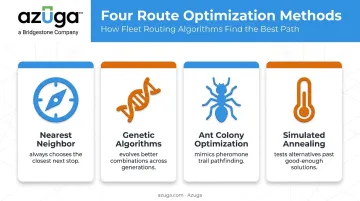
Most modern platforms don't rely on just one method. They use hybrid approaches, chaining a fast first-solution heuristic with a refinement step, often layered with AI, to balance speed against real-world accuracy.
Route Optimization vs. Route Planning vs. Scheduling
These three terms get used interchangeably, but they're not the same thing
| Term | What it does |
|---|---|
| Route planning | Decides which stops to make and in what general order |
| Route optimization | Refines that path against traffic, cost, and constraints |
| Scheduling | Assigns specific time windows and resources (drivers, vehicles) to each job |
Scheduling optimization, specifically, is the process of assigning the best time windows and resources to jobs so a fleet maximizes efficiency while still meeting service commitments. Think of it as the layer that answers "who does this job, and when," while route optimization answers "in what order and by what path."
How Does Route Optimization Work?
Route optimization software pulls in real-time and historical data—GPS location, live traffic, weather, and delivery windows—and then runs that data through an optimization engine to calculate the most efficient sequence.
GPS tracking and telematics devices form the data backbone of this process. A vehicle's location feeds directly into the routing algorithm, and the frequency of those updates matters. Azuga's GPS trackers, for example, refresh vehicle location every 30 seconds, giving dispatchers a tighter picture of where every vehicle actually is versus where it was supposed to be.
Dynamic vs. Static Routing
There are two modes fleets operate in
| Mode | How It Works |
|---|---|
| Static routing | Planned before the day starts and doesn't change |
| Dynamic routing | Reroutes in real time when traffic shifts, a job gets cancelled, or an emergency pops up |
Dynamic optimization is where the real value shows up for busy fleets. A blocked road or a last-minute job cancellation shouldn't mean the whole day falls apart.
From Algorithm to Driver's Phone
Once a route is calculated, it needs to reach the driver instantly. That's where dispatch integration and mobile driver apps come in
- Updated routes push directly to the driver's phone or in-cab device
- Customer ETAs recalculate automatically as conditions change
- Dispatchers can reassign jobs on the fly without a phone call
AI and machine learning play a growing role here too. Instead of treating every day as a blank slate, learning-based systems study historical performance data, actual drive times, service durations, and traffic patterns, to make smarter suggestions for future routes.
Benefits of Route Optimization
The case for route optimization isn't theoretical. Fleets that have implemented it report measurable gains across cost, productivity, and safety.
Lower Costs and Higher Productivity
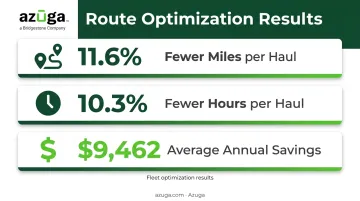
Fewer miles and less idle time translate directly into fuel savings and reduced vehicle wear. Waste Management's optimization pilot cut miles per haul by 11.6% and hours per haul by 10.3% compared to manually planned routes, according to a 2025 study published in INFORMS Interfaces. Azuga customers have reported saving an average of $9,462 annually through better fleet cost management.
These savings compound with productivity gains. When stops are sequenced efficiently, drivers and technicians spend less time behind the wheel and more time on billable work, completing more service calls or deliveries per shift without adding vehicles or staff.
Better Customer Experience and Driver Safety
Accurate ETAs and consistent on-time arrivals build trust. WM reported a 10% improvement in meeting customer-requested service windows after adopting dynamic route optimization.
Reliable service isn't the only payoff. Optimized routes also reduce unnecessary driving time and exposure to risk, and when routing is paired with driver behavior monitoring, the safety gains compound. Fleets using Azuga's combined platform report
- 38% average reduction in accidents
- 57% fewer speeding citations
Sustainability and Smarter Decision-Making
Fewer miles driven means less fuel burned and lower emissions, a direct win for fleets tracking sustainability goals alongside cost savings.
These environmental gains are easy to track, too. Route optimization platforms generate ongoing analytics on mileage trends, on-time rates, and fuel usage by vehicle, letting fleet managers keep refining operations instead of guessing.
How to Choose the Right Route Optimization Software
Not all route optimization tools are built the same. Before committing, weigh these factors
- Fleet size and growth plans: Confirm the platform scales from a handful of trucks to a hundred-plus vehicle enterprise fleet without a system overhaul.
- Real-time GPS integration and easy installation: Azuga's OBD-II device installs in minutes without a technician, a must-have for small trade businesses that can't afford downtime.
- Integrations with existing tools: Check compatibility with fuel cards, dispatch software, and platforms like ServiceTitan, Procore, or Fleetio. Azuga offers over 75 integrations across service fleets, construction, and logistics tools.
- Reliable ongoing support: Look for 24/7 phone, email, and web-based assistance. Route optimization isn't "set and forget," so you'll want help when something changes.
Route Optimization Use Cases by Industry
Route optimization looks different depending on what a fleet actually does
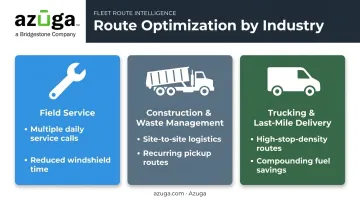
- Service fleets trades (HVAC, plumbing, electrical, pest control): These fleets juggle multiple daily service calls across scattered locations, and optimization sequences those calls to cut windshield time and fit in extra jobs per technician, per day.
- Construction and waste management: Heavy-equipment fleets and collection trucks deal with site-to-site logistics and recurring pickup routes, and rerouting idle vehicles to nearby jobs instead of sending them back empty cuts wasted drive time.
- Trucking and last-mile delivery: High-stop-density routes are where optimization pays off fastest, since shaving even a few miles per route across dozens of daily stops adds up quickly in fuel costs and on-time delivery performance.
Frequently Asked Questions
What is a route optimization method?
A route optimization method is the algorithmic approach, such as nearest neighbor, genetic algorithms, or AI-hybrid models, used to calculate the most efficient route among countless possibilities.
What is scheduling optimization?
Scheduling optimization assigns the best time windows, drivers, and resources to jobs so a fleet operates efficiently while still meeting delivery or service commitments.
What's the difference between route planning and route optimization?
Route planning is the manual or basic sequencing of stops. Route optimization uses data and algorithms to refine that sequence against traffic, cost, and time windows.
Is route optimization only useful for large fleets?
No. Small fleets and even single-vehicle operations benefit, since optimizing just a few stops a day can meaningfully reduce fuel costs and drive time.
How much can route optimization save my business?
Savings vary by fleet size and route density, but documented cases show double-digit reductions in miles and hours per route. Results depend heavily on your starting baseline.
Does Google Maps offer route optimization for fleets?
The consumer Google Maps app supports basic multi-stop routing, up to nine stops including the destination. It lacks fleet-specific features like vehicle capacity, time windows, and real-time dynamic rerouting.