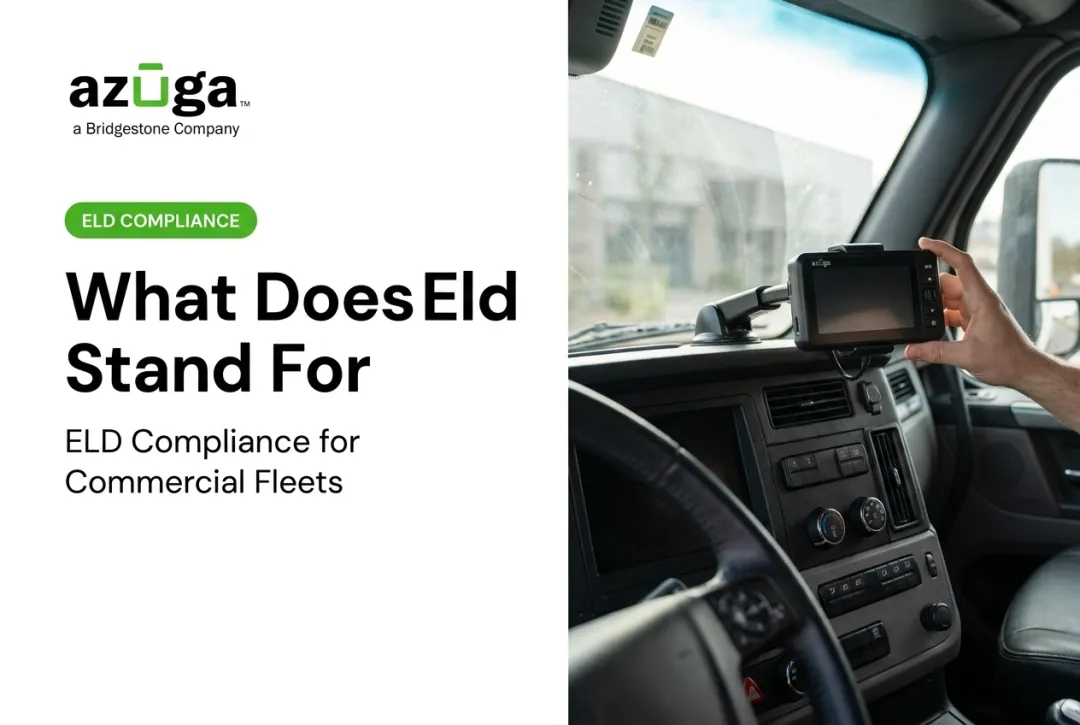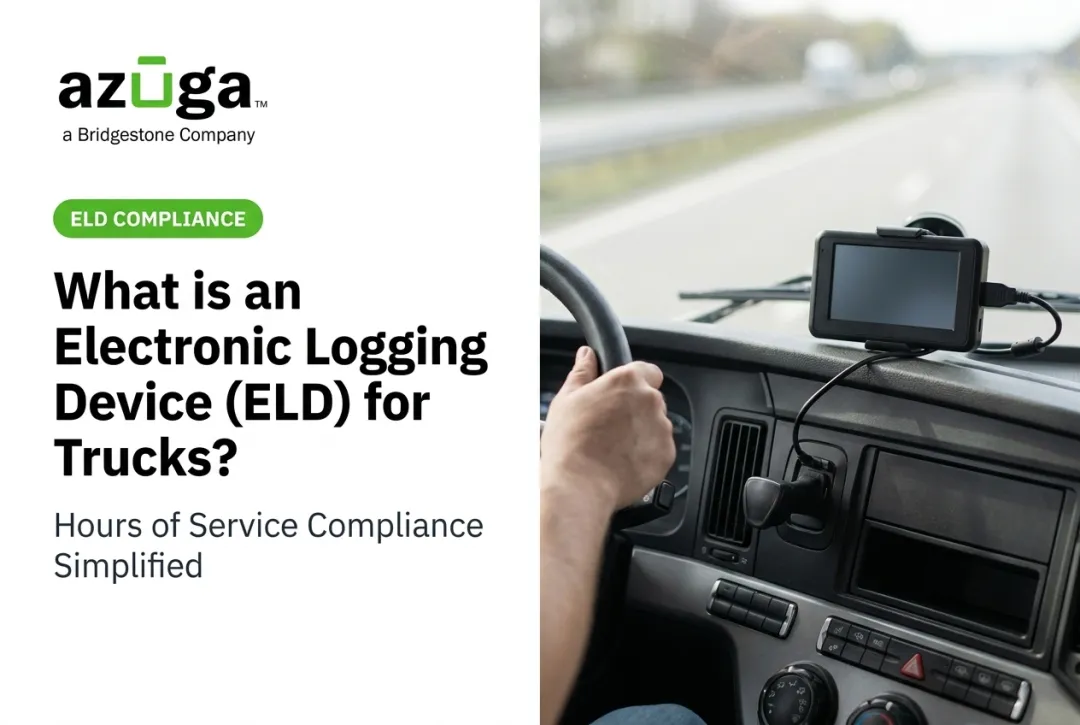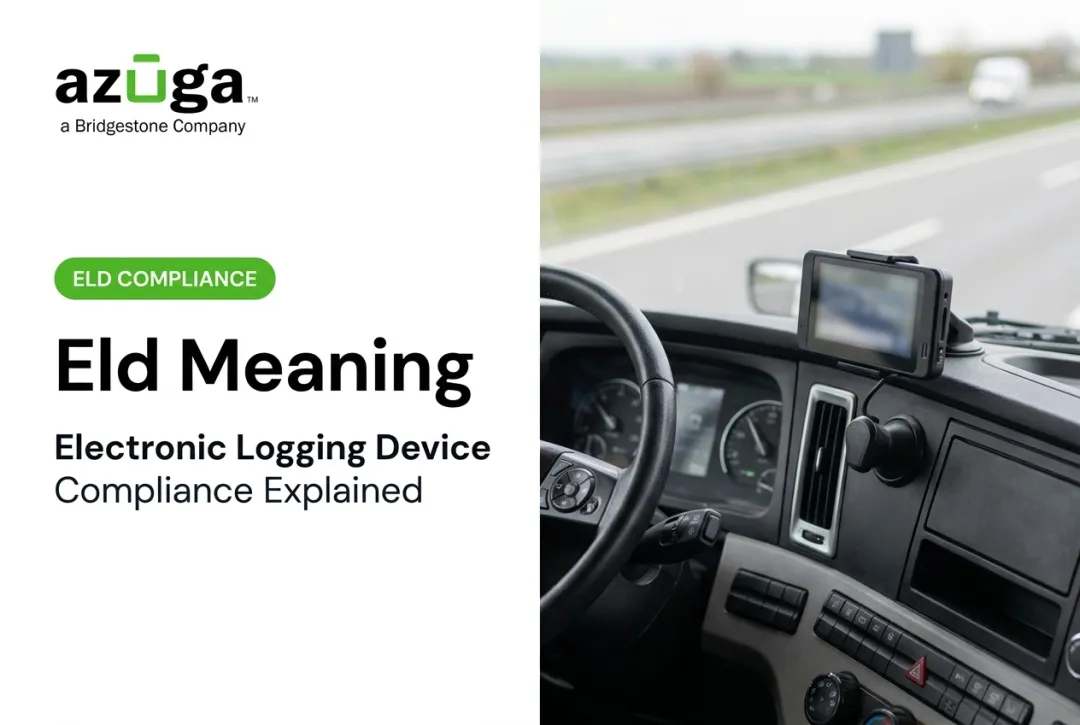

This guide covers the trucking definition.
Understanding ELDs matters because the FMCSA mandate isn't optional for most commercial fleets. Non-compliance carries real financial risk — fines for hours-of-service violations can run into the thousands of dollars per incident. We'll walk through what an ELD is, how it works, who needs one, the benefits it offers beyond compliance, and what carriers must do to stay on the right side of the rule.
Key Takeaways
- An ELD connects to a commercial vehicle's engine to automatically record driving time and Hours of Service (HOS).
- The mandate has applied to most commercial motor vehicle (CMV) drivers since December 2017, with full compliance required by December 2019.
- ELDs must be FMCSA self-certified and registered to be legally compliant.
- Beyond compliance, ELDs give fleets clear visibility into safety risks, driver behavior, and operating costs.
What Is an ELD (Electronic Logging Device)?
An ELD is a hardware and software system that syncs with a commercial motor vehicle's engine. It automatically captures driving time, location, engine hours, and miles driven — no manual entry required.
ELDs replaced two things: paper logs and their less rigorous predecessor, AOBRDs (Automatic On-Board Recording Devices). AOBRDs, established under a 1988 FMCSA rule, had looser technical requirements. The 2012 ELD mandate under the MAP-21 Act phased them out, though existing AOBRDs got a grandfather period that ended December 16, 2019.
To be legally compliant, an ELD must be
- FMCSA-registered — listed on the agency's official registry
- Self-certified by the manufacturer — carriers can't self-certify their own devices
Core Data an ELD Records
Every compliant ELD captures the same baseline data points
- Date and time
- Vehicle location
- Engine hours and status
- Vehicle miles driven
- Driver identification
A typical ELD setup includes three components
- Vehicle tracking device connected to the engine
- Backend software for hours-of-service storage and reporting
- Driver-facing mobile app or in-cab display

If you searched "ELD" for education content, you're in the wrong place: English Language Development is a school instructional standard for students learning English, not a trucking compliance device.
How Does an ELD Work?
Most ELDs connect through the vehicle's diagnostic port, using 6-pin or 9-pin connectors depending on the make and model. Installation typically takes minutes, not hours.
Automatic Duty Status Detection
Once installed, the device monitors vehicle speed. Under FMCSA technical rules, the motion threshold cannot be set above 5 mph. Once the truck crosses that speed, the ELD automatically logs "Driving" status. Driving status continues until speed drops to 0 mph for three consecutive seconds.
At the end of each shift, drivers must certify their logs. They can add annotations or request edits, but the underlying automatically captured data can't be erased.
Data Transmission
ELDs move data through a few different channels
- Bluetooth or USB for local roadside transfer during inspections
- Cellular/telematics connections for continuous transmission to a server
- Mobile apps that give drivers and dispatchers real-time visibility

Carriers cannot self-certify their own ELDs. Only the device manufacturer can register and self-certify a model with the FMCSA. If a carrier is using a device that isn't on the FMCSA's registered ELD list, it isn't compliant, regardless of how well it functions.
Who Needs an ELD and Are There Exemptions?
The ELD mandate applies to any CMV driver required to maintain Records of Duty Status (RODS) for more than 8 days in a 30-day period.
Vehicles are generally covered if they:
- Have a gross vehicle weight rating (GVWR) over 10,001 lbs
- Are DOT-registered and require a USDOT number
- Cross state lines for interstate commerce
- Transport passengers (9+ for commercial transport, or 16+ including the driver) or hazardous materials requiring placards
Key Exemptions
Not every commercial vehicle needs an ELD. Common exceptions include
- Short-haul drivers operating within a limited air-mile radius of their home terminal and returning within 14 hours
- Pre-2000 model vehicles, based on the VIN listed on the registration
- Agricultural operations, during state-designated planting and harvesting windows
- Driveaway-towaway operations, where the vehicle being driven is itself the shipment (or is a motorhome/RV)
Penalties for Non-Compliance
Non-compliance is expensive. Fleet-compliance data puts the average ELD fine for improperly logged hours of service around $2,867.
Penalty tiers climb quickly:
- Hazardous materials violations: as high as $182,877
- Non-recordkeeping violations: civil penalties up to $19,246 per violation, with daily accrual for continuing violations
Why ELDs Matter: Key Benefits for Fleets
Compliance is the baseline reason fleets adopt ELDs. But the upside goes further.
Compliance and safety gains
- Automatic tracking eliminates the guesswork (and gaming) that came with paper logs
- Roadside inspections move faster because records transfer electronically instead of requiring manual review
- Trucks with electronic HOS recorders showed an 11.7% lower total crash rate and 53% fewer driving-related HOS violations
Those figures come from a DOT-funded study covering 224,034 truck-years and 15.6 billion miles.
Operational visibility
Real-time location data does more than satisfy auditors. It lets dispatchers spot fatigue risk, coach drivers before small issues become accidents, and plan routes more efficiently.
ELD data gains more value inside a full telematics stack. Azuga pairs ELD/HOS compliance with GPS tracking, AI dashcams, and driver safety scoring on one plug-and-play OBD-II system. Fleets using Azuga have reported
- 38% decrease in accidents
- 57% reduction in speeding citations
- $9,462 saved annually through better cost management

Layer ELD data with video and behavior insights, and a regulatory requirement becomes a tool for fewer crashes, cleaner inspections, and tighter cost control.
ELD Compliance Requirements
Carriers have ongoing obligations beyond just installing a device.
Documentation in the cab: Every commercial vehicle must carry an information packet that includes the driver's ELD user manual, data-transfer instructions, and malfunction-reporting procedures. The packet also needs enough blank paper log forms to cover at least 8 days if the device fails.
Record retention: Carriers must keep a backup copy of ELD records for a minimum of six months. Store that backup on a separate device from the original and protect driver privacy.
Malfunction reporting: If a device fails, the driver must
- Note the malfunction and notify the carrier within 24 hours
- Reconstruct the current 24-hour period and prior 7 days on paper
- Keep manual records until the device is repaired
- Present those records if inspected
Carriers then have 8 days to fix the malfunction, or must request an extension from the FMCSA within 5 days of notification.
Frequently Asked Questions
Is ELD a word in English?
No. ELD is an acronym, not a standard dictionary word. It most commonly stands for Electronic Logging Device (trucking) or English Language Development (education), depending on context.
What does ELD mean in Old English?
Nothing. ELD isn't derived from Old English vocabulary. It's a modern acronym created for regulatory and educational purposes, with no historical linguistic roots.
What is the difference between ELD and ESL?
ESL (English as a Second Language) refers to direct instruction for non-native English speakers. ELD (English Language Development) is the broader instructional framework and standards schools use to guide that teaching. Neither relates to the trucking ELD covered in this article.
What is the difference between AOBRD and ELD?
AOBRDs were the earlier devices with fewer technical requirements used before the 2012 mandate. They were phased out for compliance purposes by December 16, 2019, in favor of ELDs with stricter FMCSA specifications.
How much does an ELD cost?
Azuga provides packages matched to fleet size and the features you need.
Do Canadian and Mexican drivers need ELDs?
Yes. The FMCSA rule applies to Canada- and Mexico-domiciled drivers operating in the U.S., unless they qualify for one of the standard exemptions like short-haul or pre-2000 vehicles.