
A DVIR is a federally mandated daily safety report, governed by 49 CFR §396.11 and §396.13, requiring commercial drivers to document vehicle conditions before and after operation. This guide breaks down the regulations, the required steps, the penalties for skipping them, and how digital tools are reshaping compliance.
Fleets still relying on paper DVIRs often deal with lost forms, illegible handwriting, and defects that slip through the cracks. That's where electronic solutions come in, and we'll get to those later.
Key Takeaways
- DVIRs are federally required (49 CFR §396.11/§396.13); records must be kept 3+ months
- Compliant DVIRs cover 8+ vehicle systems through inspection, repair, and certification steps
- Skipping or falsifying a DVIR risks $15,000+ fines and CSA score damage
- Electronic DVIRs cut paperwork, curb "pencil-whipping," and alert managers instantly
What Is a DVIR?
A DVIR is a formal record confirming that a driver inspected a commercial motor vehicle for safety defects before, during, or after a day's operation. The requirement lives in two connected rules
| Regulation | Requirement |
|---|---|
| 49 CFR §396.11 | Drivers of property-carrying CMVs must prepare and sign a report at the end of each day's work whenever a defect is discovered or reported |
| 49 CFR §396.13 | Drivers must review the prior DVIR and confirm the vehicle is safe before driving it |
Here's where a lot of drivers and fleet managers get confused. FMCSA's 2014 rule change eliminated the requirement to file a DVIR for property-carrying vehicles when no defects are found. FMCSA estimated this change would eliminate 46.7 million paperwork hours and save $1.7 billion annually, without weakening safety, since defect reporting and repair obligations stayed fully intact.
Passenger-carrying vehicles are the exception. Those drivers must still submit a DVIR after every day's work, even when the inspection turns up nothing wrong.
Who Must Complete a DVIR
Federal thresholds determine which vehicles fall under the DVIR requirement
| Trigger | Threshold |
|---|---|
| Weight | GVWR, GCWR, or gross weight of 10,001 lbs or more |
| Compensated passengers | Designed for more than 8 people, including the driver |
| Noncompensated passengers | Designed for more than 15 people, including the driver |
| Hazardous materials | Requires placarding for hazmat transport |
A few operations are exempt from the §396.11 DVIR requirement: private motor carriers of passengers operating for non-business purposes, driveaway-towaway operations, and carriers running only a single commercial motor vehicle. These exemptions don't erase the §396.13 duty to confirm the vehicle is safe before driving.
There's also a timing distinction worth knowing. The pre-trip review happens at the start of a shift, when the driver checks the previous DVIR for unresolved defects. The post-trip walkaround happens at the end of the day, when the driver documents any new issues found during operation.
What Must a DVIR Include?
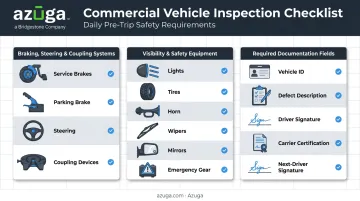
Regulators specify content, not format, so fleets have flexibility in how they design their DVIR forms, whether paper or digital. But every compliant report needs to cover the same ground.
Braking, steering, and coupling systems:
- Service brakes, including trailer brake connections
- Parking (hand) brake
- Steering mechanism
- Coupling devices
Visibility and safety equipment:
- Lighting devices and reflectors
- Tires, wheels, and rims
- Windshield wipers
- Rear-vision mirrors
- Emergency equipment
Required documentation fields:
- Vehicle identification (unit number or license plate)
- Description of any defects discovered or reported
- The reporting driver's signature
- Carrier or agent certification confirming repairs were made, or that repairs weren't necessary
- The next driver's signature, acknowledging the repair status, but only when the prior report listed a defect
Once a driver signs off, the paperwork isn't done: records must be kept for at least three months from the date they were prepared, filed at the vehicle's home terminal or the carrier's principal place of business.
Retention rules only matter if the inspections behind them are thorough, not just a checkbox exercise. FMCSA's most recent full-year data shows how often defects turn up on the road.
In 2023, inspectors conducted 3,011,902 roadside inspections nationwide, including nearly 2 million vehicle-focused inspections. Of those, 450,477 resulted in out-of-service violations, a 22.6% out-of-service rate. A solid DVIR habit is what keeps a fleet's vehicles off that list.
The DVIR Process: 7 Steps Explained
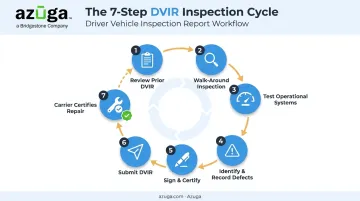
FMCSA doesn't label this an official "7-step process," but combining §396.11, §396.13, and agency guidance produces a clear, repeatable cycle:
- Review the prior DVIR. Before operating the vehicle, the driver checks the last post-trip report for any unresolved defects.
- Conduct the walk-around inspection. The driver physically examines the vehicle, checking under the hood and around the exterior.
- Test operational systems. The driver starts the vehicle to confirm brakes, lights, horn, and wipers all function correctly.
- Identify and record defects. Any issue that could affect safe operation or cause a breakdown gets documented on the report.
- Sign and certify. The driver signs the DVIR to confirm the inspection took place and reflects what was found.
- Submit the DVIR. The report goes to the carrier or a mechanic for review and any needed corrective action.
- Carrier certifies the repair. The carrier confirms repairs were completed, or that none were necessary, before the vehicle returns to service. The next driver reviews and signs off, restarting the cycle.
FMCSA guidance clarifies that §396.11 doesn't require a separate post-trip inspection form — only an end-of-day report covering whatever defects the driver found or was told about that day.
Most fleets still treat the post-trip walkaround as its own step, since it's the easiest point to catch problems before the vehicle sits overnight.
Consequences of Non-Compliance
Skipping a DVIR isn't a minor paperwork slip. FMCSA treats it as a recordkeeping violation with real financial teeth.
Current penalty exposure includes:
- Failure to prepare or maintain a required DVIR: up to $1,584 per day, capped at $15,846
- Knowingly falsifying a DVIR: up to $15,846 per violation
- Failure to repair a documented defect: subject to the general non-recordkeeping FMCSR maximum of $19,246 per violation
These figures come from FMCSA's 2025 civil penalty schedule, and they represent statutory maximums, not fixed ticket amounts. Actual assessments vary by case.
Beyond fines, a failed inspection can place a vehicle out-of-service immediately. That means the truck sits until repairs are certified, which turns into lost revenue, missed delivery windows, and a scramble to find backup equipment.
Repeated DVIR violations also chip away at a carrier's CSA score. FMCSA places inspection, repair, and maintenance violations under the Vehicle Maintenance BASIC, with severity weighted from 1 to 10 and 2 extra points added whenever an out-of-service order results.
A pattern of poor scores here can limit which shippers will contract with a carrier and tends to draw closer scrutiny during future audits. Digital DVIR tools and fleet maintenance tracking, like those built into Azuga's platform, help carriers catch and close out defects before they turn into flagged violations.
Electronic DVIRs (eDVIRs): The Modern Compliance Solution
An eDVIR is exactly what it sounds like: the inspection report completed on a smartphone or tablet instead of a paper form clipped to a dashboard. FMCSA's electronic recordkeeping rule permits this, provided the record accurately reflects the required information and the electronic signature clearly identifies and authenticates the signer.
Why fleets are making the switch:
- Faster submission, since reports go straight from the driver's device to the office
- Fewer instances of "pencil-whipping," where drivers sign off on an inspection without actually walking the vehicle
- Simplified audit trails, with digital timestamps replacing stacks of paper
- Easier record retrieval when it's time to produce documentation for an FMCSA audit
These efficiencies are why Azuga's fleet management platform builds DVIR reporting into its broader ELD and compliance toolset, supporting U.S. and Canada DVIR requirements alongside hours-of-service tracking. The platform's OBD-II device also captures diagnostic trouble codes and vehicle health data, feeding scheduled maintenance alerts. This helps fleets catch problems before they turn into a documented defect on the road.
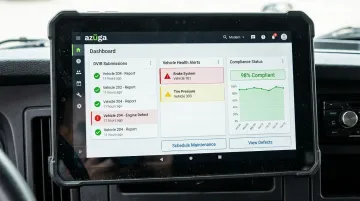
That combination matters most for fleets juggling mixed operations, where the same underlying discipline applies across very different vehicle types
- Construction companies running box trucks
- HVAC contractors managing service van fleets
- Trucking outfits hauling freight across state lines
Each needs to catch the defect, document it, fix it, and prove it. Pairing DVIR compliance with Azuga's plug-and-play hardware and driver safety tracking gives fleet managers one place to see inspection status alongside everything else happening across their vehicles.
Frequently Asked Questions
What is a DVIR inspection?
A DVIR inspection is the physical walk-around check a driver performs on a commercial vehicle to identify safety defects before or after operation. Federal regulation 49 CFR §396.11 requires this inspection for most commercial motor vehicles.
What is an electronic DVIR inspection?
Drivers complete an electronic DVIR inspection through a smartphone or tablet app instead of paper forms. It allows instant submission and sends real-time alerts to fleet managers when defects are logged.
What are the 7 steps of a DVIR inspection?
The cycle includes reviewing the prior report, conducting a walk-around, testing operational systems, recording defects, signing off, submitting the report, and having the carrier certify repairs before the vehicle returns to service.
How long must carriers retain DVIR records?
Carriers must keep DVIRs and related repair certifications for a minimum of three months from the date the report was prepared. Carriers must store records at the vehicle's home terminal or their principal place of business.
Do all commercial drivers need to complete a DVIR?
Federal rules require DVIRs for vehicles over 10,001 lbs, those carrying more than 8 compensated passengers, or hazmat-placarded vehicles. Exemptions exist for single-vehicle carriers and certain private, non-business passenger operations.
What happens if a driver finds a defect during inspection?
The driver must document the defect on the DVIR before the vehicle is used again. The carrier must then repair the issue or certify that repair wasn't necessary before returning the vehicle to service.