
Here's the problem: GPS pings and harsh-braking alerts tell you something happened. They don't tell you why. A driver flagged for hard braking might have made a mistake, or might have been cut off by a swerving car. Without visual proof, you're stuck guessing, or worse, defending a claim with zero evidence.
This guide breaks down what video telematics actually is, how it works, the real benefits fleets see, and how to pick a solution, like Azuga, that fits your operation.
Key Takeaways
- Video telematics combines GPS, engine, and AI dashcam data to reveal what happened and why
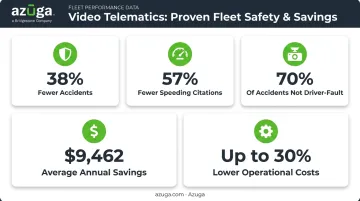
- Azuga customers report a 38% average drop in accidents and 57% fewer speeding citations
- AI collision reconstruction can prove about 70% of accidents aren't the driver's fault
- Fleets save an average of $9,462 a year and cut operational costs by up to 30%
- Plug-and-play OBD-II hardware gets small fleets running without a professional install
What Is Video Telematics?
Video telematics combines two data streams: the vehicle telemetry fleets already track (GPS location, speed, engine diagnostics, braking) and AI-analyzed dashcam footage. Together, they give fleet managers full visual context around every driving event, not just a data point on a spreadsheet.
In short, video telematics is a safety intelligence system that pairs raw data with visual proof of what happened on the road, giving fleet managers context that raw telemetry alone can't provide.
A modern telematics device does far more than mark a dot on a map, too. It typically monitors
- Vehicle location and route history
- Engine health and diagnostic trouble codes
- Driver behavior, including speeding, braking, and cornering
- Safety events in real time, as they happen
Video Telematics vs. Traditional Telematics
Traditional telematics is a data reporter. It flags a harsh-braking event, but it can't explain the reason behind it. Was the driver distracted? Or did the car ahead slam its brakes for no reason at all?
Here's the classic scenario: a harsh-braking alert comes in, and on paper, it looks like driver error. Pull up the video, though, and you see another vehicle cutting sharply into the lane, forcing an emergency stop. Same event, completely different story.
| Traditional Telematics | Video Telematics | |
|---|---|---|
| Data captured | GPS, speed, braking, diagnostics | Same data, plus synchronized footage |
| Explains "why" | No | Yes |
| Best for | Location and vehicle health monitoring | Fault determination, coaching, litigation defense |
Video telematics doesn't replace the sensors and GPS your fleet already relies on. It enhances them, attaching visual evidence to every alert so you're not left interpreting numbers in a vacuum.
How Does Video Telematics Work?
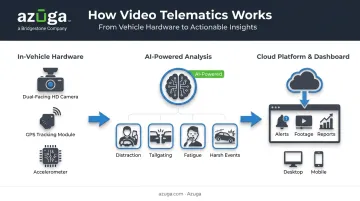
Every video telematics system runs on three components working together: in-vehicle hardware, AI-driven software, and a cloud platform that ties it all together.
Hardware Components
Most systems use dual-facing HD cameras, one pointed at the road, one pointed at the cabin, paired with night vision or infrared for round-the-clock clarity. GPS modules and accelerometers detect motion-based events like hard braking, sudden acceleration, and collisions, often pinging location data every 30 seconds for near-real-time tracking.
Azuga's dual-facing SafetyCam options, for example, monitor driver behavior and road conditions at the same time, so managers get both sides of every incident.
Event-triggered recording solves this problem. Rather than recording nonstop and burying managers in footage, the system automatically captures video before, during, and after a triggering event, whether that's a hard brake, a collision, or a speeding violation.
Software, AI & Real-Time Alerts
Raw footage is useless if someone has to review hours of it manually. AI models scan footage and flag risky behaviors automatically
- Distracted driving and phone use
- Tailgating
- Drowsiness and fatigue
- Aggressive cornering or acceleration
Flagged events trigger instant alerts to fleet managers. Some in-cab alerts warn drivers the moment risky behavior is detected, correcting bad habits in real time instead of three days later in a coaching session.
Once tagged, footage and telemetry data upload to the cloud, giving managers centralized, on-demand access from a single dashboard on desktop or mobile. That same cloud layer often feeds into maintenance, dispatch, and other fleet software, so safety data doesn't sit in a silo. No hunting through SD cards or waiting on IT.
Key Features to Look For in a Video Telematics System
Video telematics systems vary widely in capability. Before committing, check for
- Camera quality: 1080p HD resolution minimum, with night vision for 24/7 clarity. Dual-facing setups add cabin context on top of road footage.
- Cloud storage and dashboards: Centralized platforms should let you review, download, and share footage instantly, from anywhere, not just from an office desktop.
- Integration depth: The system should connect with GPS tracking, ELDs, fuel cards, and maintenance platforms. Azuga's marketplace, for instance, links with 75+ third-party systems.
- Tracking frequency: High-frequency GPS updates, like 30-second intervals, pinpoint events more precisely than standard trackers that refresh every few minutes.
Skipping any of these usually means fragmented reporting later, right when you need answers fast.
Benefits of Video Telematics for Fleets
Driver Safety and Insurance Savings
Real-time feedback and video-backed accountability change driving habits faster than a memo ever could. Azuga fleets see this play out in the numbers: a 38% average decrease in accidents and a 57% reduction in speeding citations after adopting video telematics.
That same accountability pays off when claims come in. Documented video evidence speeds up claims investigations. Instead of conflicting accounts, adjusters get footage.
Azuga's SafetyCam AI with Collision Reconstruction proves that roughly 70% of accidents aren't the fleet driver's fault, which matters when a false claim threatens tight margins.
Insurance discounts vary by carrier, but they're real. Cover Whale's Driver Safety Program offers qualifying policyholders up to a 30% discount on renewal premiums based on verified safety performance, though that's a carrier-specific maximum, not a flat industry rate.
Azuga customer Diamond Engineering saw a more typical outcome: after sharing asset-location and driver-behavior data from Azuga with their insurer, they secured more than a 10% discount on their premium.
Operational Savings, Coaching, and Compliance
Better route efficiency, less idle time, and fewer preventable incidents add up. Azuga customers report saving an average of $9,462 annually, with some fleets cutting operational costs by up to 30%.
Those savings compound when coaching turns raw data into better driving habits. Footage-backed coaching replaces vague, subjective conversations with specific, factual feedback. "You were driving too fast" becomes "here's the tailgating event from Tuesday at 2:14 p.m." Drivers respond better to proof than to accusations.
That same footage supports compliance too. Automatic, time-stamped documentation simplifies DOT audits and dispute resolution. When litigation hits, having footage ready to hand over, rather than reconstructing events from memory, can be the difference between a quick resolution and a drawn-out legal fight.
Who Uses Video Telematics? Industries That Benefit Most
Field-service and trade fleets face some of the highest on-road accountability risk, and video telematics has caught on fast across these verticals
- Construction
- Plumbing
- Electrical
- Landscaping
- Pest Control
- Trucking
- Waste Management
- Utilities
Work-related motor vehicle crashes aren't rare in these industries. CDC research puts the cost to U.S. employers at billion in 2019, averaging per nonfatal injury and per death, a scope that includes plenty of the trade fleets on this list.
Small and mid-sized fleets benefit disproportionately. A single accident, or a single false claim, can wipe out a tight margin fast. That's exactly why affordable, plug-and-play solutions matter more for a 10-vehicle operation than a 500-vehicle one.
Take Kitsap Garage Door Company, a small fleet that turned to Azuga to keep better tabs on service vehicles and protect against liability disputes. For operations this size, even modest gains in accident prevention or fuel efficiency translate into meaningful savings relative to revenue.
How to Choose the Right Video Telematics Solution
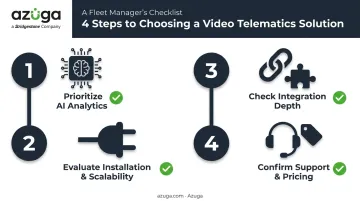
- Prioritize AI analytics. Look for systems that automatically detect distraction, fatigue, and unsafe behaviors, instead of forcing your team to review hours of raw footage manually.
- Evaluate installation and scalability. Self-installable, plug-and-play OBD-II devices, like Azuga's, get a vehicle running in minutes without a costly professional install appointment, and the same simple process works whether you're adding one van or fifty.
- Check integration depth. Confirm the platform connects cleanly with your existing GPS tracking, fuel cards, and ELD systems. Gaps here mean fragmented reporting down the road.
- Confirm support and pricing. Look for 24/7 phone, email, and web support, plus packages matched to fleet needs that scales with fleet size. Azuga matches packaging to fleet size and the features you select, making the technology accessible for fleets of nearly any size.
Frequently Asked Questions
What is the purpose of telematics?
Telematics gives fleet managers real-time visibility into vehicle location, driver behavior, and vehicle health. That visibility drives better safety outcomes and lower operational costs across the fleet.
What does video telematics mean?
Video telematics combines dashcam footage with telematics data like GPS and speed. Together, they give fleet managers visual context around driving events instead of just numbers on a screen.
Is a telematics device a tracker?
GPS tracking is one function, but modern telematics devices do far more. They also monitor driver behavior and vehicle diagnostics, flagging safety events well beyond simple location tracking.
How much does video telematics cost for a fleet?
Azuga matches packaging to fleet size and the features you select, which serves as a useful benchmark for budgeting.
Can video telematics reduce insurance premiums?
Documented footage helps fleets qualify for insurer discounts and reduces disputed claim costs over time. Actual savings depend on your carrier and safety record, but the potential is real.
Is video telematics worth it for small fleets?
Small fleets often see fast returns through fewer accidents and lower insurance costs, cutting operational waste along the way. For tight-margin operations, that ROI usually shows up within the first year.