
For small and mid-size fleets in construction, HVAC, plumbing, and similar trades, the margin for error is thin. Motor-vehicle crashes alone cost U.S. employers an estimated $62 billion annually in medical care, liability, and lost productivity. That's not a big-enterprise problem. It hits a 12-truck plumbing outfit just as hard, proportionally, as a national logistics carrier.
Here's the good news: AI is no longer locked behind enterprise software budgets. It's becoming a practical, affordable layer sitting right on top of the GPS tracking many fleets already use. This guide covers what AI in fleet operations actually means, where it delivers value, how it improves safety, and how to pick a solution that fits your fleet's size and budget.
Key Takeaways
- AI turns raw telematics data into actionable fixes, not just dots on a map
- Predictive maintenance and driver behavior coaching directly reduce breakdowns, accidents, and insurance costs
- Dashcam footage proves drivers weren't at fault in up to 70% of crashes, cutting legal costs
- Affordable, plug-and-play AI tools now exist for fleets with 5 vehicles, not just 500
What Is AI in Fleet Operations?
AI in fleet operations means applying machine learning, computer vision, and predictive analytics to the data your vehicles already generate. Instead of just reporting where a truck is, the system interprets patterns in that data to predict what's likely to happen next and recommend what to do about it.
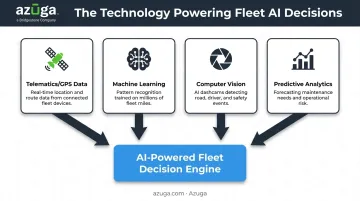
Four technologies typically work together
- Telematics/GPS data collection: the raw feed of location, speed, and engine diagnostics
- Machine learning: pattern detection across thousands of trips to flag anomalies or predict outcomes
- Computer vision: analyzing dash cam footage to identify distraction, drowsiness, or unsafe following distance
- Predictive analytics: forecasting maintenance needs, delivery windows, or risk scores before problems occur
The distinction matters. Traditional GPS tracking answers "where is my truck right now?" AI-enhanced platforms answer "which of my trucks needs attention today, and why?" That shift, from reporting to recommending, is what separates a basic tracker from a genuine decision-support tool.
| Traditional GPS Tracking | AI-Enhanced Fleet Platform |
|---|---|
| Reports location, speed, and idle time | Flags risky driving patterns before they cause accidents |
| Shows engine fault codes as they occur | Predicts which vehicle will likely break down next |
| Displays a map of completed routes | Recommends real-time route changes based on traffic |
| Requires managers to interpret raw data | Surfaces prioritized alerts managers can act on immediately |
Key Benefits & Use Cases of AI in Fleet Operations
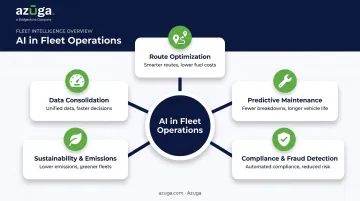
This is where AI earns its keep. The real value comes from turning raw fleet data into decisions your team can act on across routing, maintenance, compliance, and cost control.
Smarter Route Optimization
AI-powered routing looks beyond a static map. It factors in live traffic conditions, driver availability, and delivery windows to reroute vehicles mid-shift rather than locking in a plan at 7 a.m. and hoping for the best.
Azuga's platform, for instance, calculates ETAs that account for departure timing, congestion, and reported incidents along the route, giving dispatchers real-time visibility to adjust on the fly. Ko Olina Transportation used this capability to optimize routing based on live traffic and driver availability, cutting the guesswork out of dispatch decisions.
The result for most fleets: fewer wasted miles, less idle time at red lights and detours, and drivers who reach job sites faster.
Predictive Maintenance
Rather than waiting for a dashboard warning light, AI models compare live sensor data against historical baselines to catch problems while they're still small.
Azuga tracks this through several data points
- Diagnostic trouble codes (DTCs) pulled directly from the OBD-II port
- Odometer readings that trigger service intervals automatically
- Fuel efficiency trends, where a sudden drop often signals a mechanical issue
- Maintenance alerts sent proactively before small issues become breakdowns
At Smith & Solomon, Fleet Director Chris Barbayanni used DTC alerts to monitor trucks driven by student drivers, a group known for putting extra wear on vehicles. He even combined geofencing with maintenance alerts: when a flagged vehicle entered the zone around the repair shop, the on-duty mechanic got notified instantly.
Pest control fleets using Azuga's maintenance tools have seen breakdowns drop by 50% as a direct result of catching issues early.
Compliance & Fraud Detection
ELD and hours-of-service tracking used to mean stacks of paper logs and manual audits. AI-backed platforms automate the recording of duty status and flag exceptions before they become violations, reducing the manual review burden on safety managers.
The same underlying data helps spot anomalies that look like fraud or misuse. Azuga's FuelSave module cross-references fuel card purchases against actual routes, making it easier to catch discrepancies.
Idle time reports do similar work. At Hobart Service, the branch manager set up automated alerts whenever a technician stayed at a job site more than 45 minutes, using that threshold to separate legitimate work from wasted time.
Sustainability & Emissions Reduction
Idling burns fuel without moving a single mile. AI-optimized routing shortens trips and reduces unnecessary stops, while idle-time monitoring gives managers a clear picture of where fuel is being wasted.
Azuga's route optimization tools work alongside FuelSaver, which directs drivers to the cheapest nearby fuel stations. Driver behavior coaching adds another layer, discouraging the hard braking and rapid acceleration that steadily drain fuel efficiency over time.
Data Consolidation for Faster Decisions
One underrated benefit: AI pulls GPS, dash cam footage, and maintenance logs into one dashboard. A single OBD-II device connects simultaneously to the vehicle's onboard computer, GPS, and camera, transmitting everything to one portal.
That means a fleet manager can see a hard-braking event, the video clip, the location, and the vehicle's maintenance status without logging into three different systems.
AI-Powered Safety and Driver Behavior Monitoring
Speeding alerts and harsh-braking notifications were the first generation of fleet safety tech. AI has moved well past that baseline. Modern systems detect distraction, fatigue, and near-miss patterns before they turn into an actual accident.
How AI Dash Cams Catch What Humans Miss
AI dash cams use computer vision and neural network models to analyze driver-facing video in real time. Azuga's SafetyCam AI, for example, runs footage through a neural learning network that tags distraction events (including phone use) the moment they're detected.
That data feeds directly into in-cab coaching, so a driver gets corrective feedback close to the moment of the risky behavior, not weeks later in a performance review.
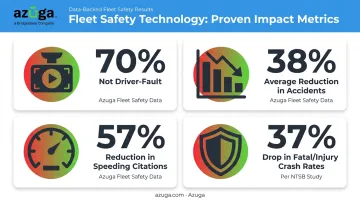
Collision Reconstruction takes this a step further. When an accident occurs, the system compiles video and telematics data to reconstruct exactly what happened leading up to impact. Azuga reports that 70% of accidents are not the fault of the fleet driver, meaning objective video evidence can exonerate a driver who would otherwise be blamed by default.
One insurance-focused client, QuadScore, used stored dash cam footage to help police determine a fleet driver wasn't at fault in a crash. That evidence avoided over $50,000 in forensic reconstruction costs and a potential $1 million claim.
This isn't just an Azuga-specific pattern. A study cited by the National Transportation Safety Board found that video monitoring combined with structured coaching reduced fatal and injury crashes per million miles by 37%, with total crash rates dropping 20%. Cameras paired with a structured coaching workflow drive that behavior change, not the hardware alone.
Azuga customers using this combination have reported a 38% average reduction in accidents and a 57% reduction in speeding citations. Those numbers depend on catching risky moments fast enough to act on them, which is where refresh rate comes in.
Why refresh rate matters: A system that only updates every few minutes can miss a risky lane change or a moment of distraction entirely. Azuga tracks data at 30-second intervals, giving fleet managers a tighter window to catch patterns that slower-refresh systems would simply miss.
How to Choose the Right AI Fleet Management Solution
Not every fleet needs the same setup. A 6-vehicle HVAC company has different requirements than a 200-truck logistics operation, and paying for enterprise complexity you'll never use is money wasted.
When evaluating options, weigh these factors
- Real-time analytics: Does the platform generate alerts you can act on immediately, or just historical reports?
- Predictive capability: Can it flag a developing maintenance issue or risky driver before it becomes a costly problem?
- Installation complexity: Plug-and-play OBD-II devices install in about 20 seconds with no technician required, while dash cam systems typically need a more involved setup with mounting and wiring.
- Integration compatibility: Does it connect with your existing fuel cards, accounting software, or service fleets platforms like ServiceTitan or Fleetio?
Affordability matters just as much as capability, especially for small and mid-size fleets. Azuga's entry-level plan matches packages to fleet needs, giving fleets a scalable way to add GPS tracking and predictive maintenance features without committing to a full enterprise contract from day one.
Finally, prioritize 24/7, unlimited support. AI insights only create value if your dispatch team can get help interpreting or acting on them at 2 a.m. when a truck is down. A platform with limited support hours undercuts the very speed advantage AI is supposed to deliver.
Best Practices for Implementing AI in Your Fleet
Getting AI right requires laying the right foundation before you can expect real results.
- Start with clean, consistent data. AI predictions depend entirely on input quality, so inconsistent GPS pings or missing maintenance logs produce unreliable recommendations.
- Pilot on a high-risk subset first. Choosing your worst-performing vehicles or drivers for the initial rollout builds internal trust through early wins before you expand fleet-wide.
- Train your team to act on alerts, not ignore them. Dispatchers and technicians need to understand what a predictive maintenance flag or safety alert actually means — otherwise it becomes background noise nobody checks.
Fleets that skip this groundwork often end up with expensive software that nobody trusts or uses properly.
The Future of AI in Fleet Operations
Fleet intelligence is heading toward vehicle-to-vehicle communication, where trucks share real-time hazard data with each other. The U.S. Department of Transportation's national V2X deployment plan is already laying groundwork for this at the infrastructure level, including queue-warning systems near highway work zones.
Electric fleets are seeing similar advances, with energy-aware planning tools that estimate battery drain and optimize charging stops rather than treating an EV like a gas truck with a different fuel gauge.
Fleets that adopt these AI tools now, rather than waiting, gain an edge before it becomes standard
- Lower costs through predictive maintenance and optimized routing
- Fewer accidents and safer driver behavior
- Smoother compliance audits as new regulations take effect
Azuga's AI-powered routing and safety tools help fleets build that edge today.
Frequently Asked Questions
What is AI in fleet management?
AI in fleet management applies machine learning and predictive analytics to telematics data, optimizing routes, forecasting maintenance, and improving driver safety. It turns raw GPS data into actionable recommendations for fleet managers.
How does AI improve fleet safety?
AI dash cams use computer vision to detect distraction, drowsiness, and risky driving, feeding data into in-cab coaching. Paired with collision reconstruction, this approach has helped fleets cut accidents by 38% and speeding citations by 57%.
What are the benefits of AI-powered predictive maintenance?
Predictive maintenance compares live sensor data against historical baselines to flag developing issues before they cause a breakdown. This catches problems early, reducing unplanned downtime and unexpected repair costs.
Is AI fleet management affordable for small businesses?
Yes. Modern platforms scale down to small fleets with packages matched to fleet needs and self-install hardware. You don't need an enterprise budget for predictive maintenance or safety monitoring.
How is AI different from traditional GPS fleet tracking?
Traditional GPS tracking reports location, speed, and basic diagnostics. AI-enhanced platforms analyze those same data streams to detect patterns and generate proactive recommendations, like flagging a vehicle likely to break down soon.
What technologies power AI in fleet operations?
Four core technologies work together: telematics/GPS for raw data collection, machine learning for pattern detection, computer vision for dash cam analysis, and predictive analytics for forecasting maintenance and risk.