
Here's the tension every fleet operator feels: you need visibility to control costs and keep drivers safe, but you also have to respect employee privacy and navigate a messy patchwork of state and federal rules. Get it wrong, and you either expose the business legally or breed resentment among your drivers.
This guide breaks down what's actually legal (including state-specific questions like Pennsylvania), the clauses your policy needs, the ROI you can expect, and how to roll it out without a mutiny.
Key Takeaways
- Tracking company-owned vehicles is legal in all 50 states with proper notice, given employer ownership and legitimate business interest.
- A written, signed policy prevents disputes and builds trust, though requirements vary sharply by state.
- Strong policies define scope, disclosure, data rules, and enforcement consequences in plain language.
- Fleets using telematics report real savings, including 38% fewer accidents and 30% lower operational costs.
What Is a GPS Vehicle Tracking Policy?
A GPS vehicle tracking policy is a formal internal document that spells out how, why, and when a company monitors GPS-equipped vehicles. It's the rulebook that governs everything from data collection to disciplinary action.
Most policies draw a hard line between two categories
- Company-owned fleet vehicles — tracked during business hours as a condition of using employer property
- Personal vehicles used occasionally for work — subject to stricter consent expectations, especially for mileage reimbursement tracking
These aren't interchangeable, and a policy that treats a driver's personal truck the same as a company van is asking for a lawsuit.
Who Should Weigh In Before You Finalize It
Don't write a tracking policy in a vacuum by one department. Instead, gather input from
- HR — for consistency with existing employment policies
- Fleet or operations managers — for practical scope and technology fit
- Legal or compliance — for state-specific requirements
- Drivers themselves — for buy-in and real-world feedback on take-home vehicle scenarios
Skipping the driver input step is a common mistake. Policies built without frontline feedback tend to get treated as surveillance rather than safety infrastructure.
Is GPS Tracking of Employees Legal? Understanding the Legal Landscape
The general rule across the US: tracking a company-owned vehicle during work hours is legal, because the employer owns the asset and has a legitimate business interest in how it's used. Courts have consistently sided with employers on this point when notice was given.
Take Stern Produce Co. v. NLRB, decided by the D.C. Circuit in March 2024. The case involved delivery trucks fitted with telematics and cameras, governed by a handbook that clearly reserved the company's right to monitor and disclaimed any employee privacy expectation in company property.
The court vacated an NLRB finding against the employer, reinforcing that a disclosed, uniformly enforced monitoring policy holds up.
Ownership alone isn't a blank check, though. Notice requirements, off-duty scope, and state statutes still matter — a lot.
Addressing State-Specific Rules (Including Pennsylvania)
Is GPS tracking legal in PA? Yes. Pennsylvania doesn't have a statute governing private-employer GPS tracking of company vehicles, and its existing electronic surveillance law (Title 18, Section 5761) applies to court-authorized law enforcement tracking, not workplace monitoring.
That means employers generally can track company vehicles without employee consent, since the vehicle is employer property. Written disclosure isn't legally mandated in Pennsylvania, but it's still smart practice.
Other states are stricter, and you cannot treat them the same
- New Jersey requires prior written notice before using a tracking device in an employee's vehicle, with no exceptions and penalties up to $1,000 for a first violation, $2,500 after that
- California exempts tracking when the vehicle's owner (in this case, the employer) has consented, though it doesn't eliminate other privacy considerations
- Connecticut requires written notice for electronic monitoring, but its statute applies specifically to monitoring on employer premises, not necessarily fleet GPS on the road
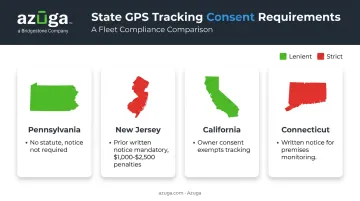
Check your state before finalizing a policy: what's fine in Pennsylvania could violate the law in New Jersey.
Employee Consent and the Right to Refuse
Can I refuse to be tracked at work? Generally, no, not on a company-owned vehicle. Using the vehicle is a condition of employment, and refusing tracking is functionally refusing to follow a lawful workplace policy.
That said, personal-time or personal-vehicle tracking, like mileage reimbursement, should always include an opt-out, since the consent expectations there are different.
There's no verified nationwide rule granting employees a blanket right to refuse. It varies by state law, employment contracts, and collective bargaining agreements. That's exactly why you shouldn't rely on assumptions.
Get a signed consent form anyway. Even in states like Pennsylvania where it isn't strictly required, a signed acknowledgment
- Documents that the employee received and understood the policy
- Reduces the odds of a "nobody told me" dispute later
- Signals professionalism rather than surprise surveillance
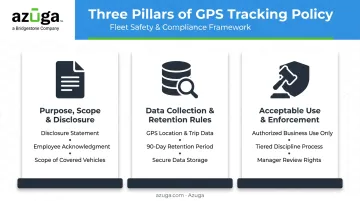
Key Components Every GPS Tracking Policy Should Include
A vague policy is almost as risky as no policy. Here's what needs to be in writing.
Purpose, Scope, and Disclosure
State the business justification up front: safety, efficiency, cost control, or asset protection. Vague justifications don't hold up if challenged.
Your scope section should specify
- Exactly which vehicles are covered (all company-owned vehicles, specific classes, or take-home vehicles too)
- Which roles or departments are affected
- When tracking is active (business hours only, or continuously)
Include an explicit disclosure statement describing what's tracked, and a consent acknowledgment section with a signature line. This is your paper trail.
Data Collection, Usage, and Retention Rules
Employees deserve to know exactly what's being captured. Define it clearly
- Location and route data: where the vehicle travels, at what frequency
- Speed and driving behavior: hard braking, acceleration, speeding events
- Idle time and mileage: for fuel management and job costing
- Retention period: how long data is stored and who can access it
Address personal-time privacy directly. If drivers take vehicles home, allow trip-tagging (business vs. personal) or a privacy mode after hours where feasible. Azuga's mobile app, for example, lets drivers flag trips as personal so companies aren't capturing every after-hours errand as work activity.
Acceptable Use, Violations, and Enforcement
Spell out what's prohibited
- Unauthorized personal use of company vehicles outside approved limits
- Device tampering: unplugging, disabling, or obstructing the tracker
- Falsifying trip logs or misrepresenting vehicle use
Pair this with a tiered disciplinary framework (verbal warning, written warning, suspension, termination) so consequences are predictable, not arbitrary. Add a fair-use clause stating tracking data won't be used punitively outside the policy's stated scope. This one clause does more for driver trust than almost anything else in the document.
Benefits of a Well-Implemented GPS Tracking Policy
A policy paired with real coaching (not just silent monitoring) changes driver behavior. Businesses using Azuga's platform see accidents decrease by 38% on average, and speeding citations drop by 57%.
Does vehicle tracking reduce insurance? Often, yes. Commercial auto insurers increasingly reward telematics adoption
| Insurer | Published Discount |
|---|---|
| Progressive Commercial (Snapshot ProView) | 5% enrollment savings |
| The Hartford | Up to 5% per qualifying vehicle |
| Nationwide (Vantage 360 Fleet) | 10% on select policies |
Progressive's commercial telematics program is one example of how insurers are formalizing these incentives. Azuga customer Diamond Engineering used driver behavior data to negotiate a 10%+ premium discount directly with its provider, proof that the conversation is worth having with your own carrier.
Cost savings extend beyond insurance:
- Azuga customers save an average of $9,462 annually through better fleet cost management
- Fleet operating costs drop by up to 30% when fleets address fuel, maintenance, and labor inefficiencies together
- SafetyCam AI collision reconstruction proves 70% of accidents aren't fleet drivers' fault, arming teams with evidence against unfair liability claims
There's also a quieter benefit: accountability. Real-time visibility discourages unauthorized stops, and accurate trip data supports honest job costing and customer billing — which matters a lot if you bill by the hour.
Best Practices for Rolling Out and Enforcing Your Policy
How you introduce tracking matters almost as much as what the policy says.
Lead with why, not how. Hold a dedicated rollout meeting before activating anything. Explain the business case (safety, cost control, liability protection) before walking through the mechanics. Employees who understand the reasoning are far less likely to assume the worst.
Choose driver-friendly technology. A clunky, invasive-feeling system breeds resentment regardless of your intentions. Look for
- Self-installed, plug-and-play devices (Azuga's OBD-II tracker installs in minutes, no mechanic required)
- A driver-facing mobile app showing employees their own scores, trip data, and video footage, not just what managers see
- Responsive, 24/7 support that resolves technical hiccups before they turn into daily frustrations
When drivers can see the same data as their supervisors, tracking feels less like surveillance and more like a shared performance tool.
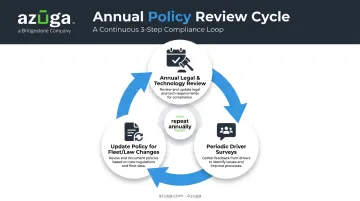
That transparency needs upkeep over time. Review annually, at minimum. Laws change (New Jersey's notice statute is only a few years old), and technology evolves faster than policy documents usually get updated. Schedule
- An annual legal and technology review
- Periodic driver surveys to catch concerns before they become grievances
- Updates whenever your fleet composition or vehicle use policies shift
Frequently Asked Questions
Is GPS tracking legal for employers?
Yes, in most U.S. states. Employers can track company-owned vehicles without employee consent since the vehicle is company property. Written disclosure isn't always legally required, but it's strongly recommended.
Can I refuse to be tracked at work?
Typically no, for company-owned vehicles — using them is a condition of employment. Employees may request opt-outs for personal-time use or personal-vehicle mileage tracking instead.
Does vehicle tracking reduce insurance?
Many insurers offer telematics-based discounts, ranging from about 5% to 10% depending on the carrier and program. Check directly with your fleet's insurance provider for specific eligibility.
Do I need written consent to track a company vehicle?
Not always required by law, but a signed acknowledgment form is strongly recommended. It proves employees received and understood the policy before any dispute arises.
How often should a GPS tracking policy be reviewed?
At least once a year, plus any time relevant state laws or your tracking technology changes. Treat it as a living document, not a one-time signature.
What happens if an employee violates the GPS tracking policy?
Most policies use a tiered process: a documented warning first, escalating through suspension for repeat issues. Serious violations, like tampering with the device, can justify immediate termination.