
Introduction
A truck sitting idle isn't just an inconvenience. According to Penske, average truckload revenue hit $4,457 per truck per week in 2024, or roughly $637 a day.
Three days of unplanned downtime can mean nearly $2,000 in lost revenue, before you even count towing or emergency repairs.
Construction crews, HVAC contractors, utility teams, and trucking fleets all feel this pain differently, but the root cause is the same: maintenance that happens after something breaks instead of before.
Preventive maintenance (PM) software in 2026 has moved well past static spreadsheets. AI-driven scheduling, IoT sensors, and telematics-based triggers now let teams catch problems before they cause a breakdown. The right platform shifts your crew from firefighting to planning, which shows up directly in uptime and repair costs.
This guide compares five leading PM software options for 2026, from general-purpose CMMS platforms to a fleet-specific telematics solution, so you can pick the one that actually fits your operation.
TL;DR
- Preventive maintenance software automates scheduling, work orders, and asset tracking to prevent breakdowns.
- Top 2026 platforms offer mobile access, usage-based triggers, and ERP or telematics integrations.
- Your best fit depends on business size and industry; fleet-heavy operations need telematics-driven PM.
- This list covers four CMMS leaders plus one fleet-specific telematics platform for vehicle-heavy industries.
Overview of Preventive Maintenance Software in 2026
Preventive maintenance software is a digital system that automates the scheduling, tracking, and documentation of recurring maintenance tasks. Instead of relying on memory or paper logs, the software triggers work orders based on time intervals, usage thresholds, or sensor data — before equipment or vehicles fail.
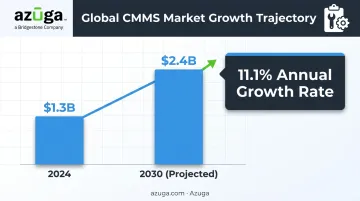
The category keeps growing for good reason. Grand View Research valued the global CMMS market at $1.3 billion in 2024, with projections reaching $2.4 billion by 2030 at an 11.1% annual growth rate. More businesses are adopting AI-assisted scheduling and IoT integration to squeeze more value out of their maintenance programs.
Industries with high-value physical or mobile assets feel this most acutely
- Construction firms managing heavy equipment across multiple job sites
- Utilities running critical infrastructure where failures affect public service
- Trucking and logistics companies where every idle vehicle costs direct revenue
- Waste management operations with fleets running daily, tight-margin routes
These operations share one vulnerability: deferred maintenance compounds. A skipped oil change becomes an engine rebuild. A missed inspection becomes a safety incident. That's why the software solutions below were selected based on scheduling automation, mobile usability, integration depth, and how well each one handles different asset types, from fixed equipment to vehicle fleets.
Top Preventive Maintenance Software for 2026
We evaluated each platform against five criteria: automated scheduling capability, mobile accessibility, integration options, industry fit, and total cost of ownership. Four are traditional CMMS platforms built for fixed and mixed assets. One is a telematics platform built specifically for vehicle fleets.
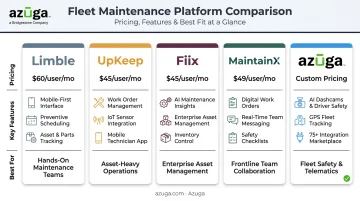
Limble CMMS
Limble is a cloud-based CMMS built around an intuitive, mobile-first interface. It's a popular pick across manufacturing, food and beverage, and facilities management teams that want something their technicians will actually use.
What sets it apart is the combination of calendar- and meter-based PM triggers with automated work order generation. Reviewers consistently point to strong customer support as a differentiator, which matters more than people expect during rollout.
| Category | Details |
|---|---|
| Pricing | Standard, Premium+, and Enterprise tiers; contact vendor for details |
| Key Features | Automated PM scheduling, asset hierarchy, mobile work orders, customizable reporting |
| Best For | Mid-size to large teams needing a highly customizable, easy-to-adopt CMMS |
UpKeep
UpKeep was built for field technicians first. Work orders, PM tasks, and asset updates all happen from a smartphone, which matters if your team rarely sits at a desk.
The mobile experience and recurring task automation are genuine strengths. That said, some users note the desktop side feels thinner and lower tiers restrict customization more than competitors.
| Category | Details |
|---|---|
| Pricing | Essential and Premium tiers; free trial available, no credit card required |
| Key Features | Recurring task scheduling, automated work orders, PM compliance reporting |
| Best For | Distributed teams and technicians who work primarily in the field |
Fiix by Rockwell Automation
Fiix leans into data-driven maintenance, offering IoT sensor integration and AI-powered insights through its Foresight tool. Being backed by Rockwell Automation gives it credibility with businesses running complex industrial equipment.
It suits companies wanting to move toward condition-based decisions, though the more advanced analytics and multi-site hierarchy tools sit behind the higher-priced tiers.
| Category | Details |
|---|---|
| Pricing | Free plan includes 25 active PMs; Basic, Professional, and custom Enterprise tiers |
| Key Features | Resource-based scheduling, PLC/SCADA/sensor integrations, AI-driven maintenance insights, failure code tracking |
| Best For | Businesses with complex equipment hierarchies wanting data-driven PM |
MaintainX
MaintainX puts checklists, SOPs, and inspections front and center, with preventive maintenance built in alongside them. Technicians tend to pick it up fast because the interface is simple and works offline in the field.
If your priority is standardized procedures and audit-ready inspection trails rather than deep asset hierarchies, this is worth a close look.
| Category | Details |
|---|---|
| Pricing | Basic is free; Essential and Premium annual tiers; Enterprise is custom-priced |
| Key Features | Digital checklists and SOPs, automated reminders and escalations, offline mobile functionality |
| Best For | Teams needing strong inspection and procedure compliance alongside PM |
Azuga
Azuga takes a different approach entirely. Rather than a general CMMS retrofitted for vehicles, it's a GPS fleet management platform built around telematics data — making it a natural fit for construction, trucking, utilities, and waste management fleets.
Instead of manually logging mileage or waiting on a technician to flag an issue, Azuga triggers maintenance alerts directly from real-time vehicle diagnostics. Key capabilities include
- Plug-and-play OBD-II device that relays engine data and diagnostic trouble codes to the dashboard
- Service intervals set by mileage or engine hours, with automated alerts before small issues become breakdowns
- Azuga SafetyCam AI for collision reconstruction footage and driver behavior scoring, since accidents cause downtime as often as mechanical failure
- Connections with 75+ third-party tools, including Fleetio, ServiceTitan, Procore, and TowBook, so maintenance data doesn't live in a silo
According to Verizon Connect's 2025 fleet technology trends report, telematics-driven maintenance programs achieve 16% average cost reductions industry-wide.
| Category | Details |
|---|---|
| Pricing | packages matched to fleet needs, with 24/7 support included |
| Key Features | Mileage/engine-based maintenance alerts, real-time GPS tracking at 30-second intervals, SafetyCam AI collision reconstruction, fuel card and third-party integrations |
| Best For | Fleet-based businesses in construction, trucking, utilities, and towing that need combined vehicle maintenance and safety oversight in one platform |
How We Chose the Best Preventive Maintenance Software
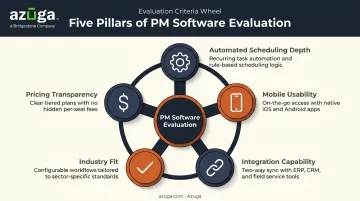
Each platform on this list was assessed against five factors: automated scheduling depth, mobile usability, integration capability, industry fit, and total cost of ownership. Brand recognition alone doesn't tell you whether a tool's scheduling automation actually works for your specific asset types. That's the most common mistake buyers make.
Instead of relying on feature checklists, tie your evaluation to measurable outcomes
- Does it reduce downtime hours per asset or vehicle?
- Will it speed up technician response time to flagged issues?
- Can it generate compliance-ready documentation automatically?
A platform loaded with features that nobody on your team actually uses isn't a win. Test scheduling automation against your real assets before signing anything long-term.
Conclusion
The right preventive maintenance software depends entirely on what you're maintaining. Fixed equipment in a single facility usually favors a traditional CMMS like Limble, UpKeep, Fiix, or MaintainX. Vehicle-heavy operations get more value from a telematics-integrated platform that pulls data directly from the asset itself.
Before committing to any contract, pilot-test the scheduling automation and mobile experience with your own technicians. What looks great in a sales demo doesn't always hold up when a tech is standing in a parking lot trying to close a work order on their phone.
That real-world testing should guide which type of system you choose. If your business runs a fleet of vehicles or heavy equipment, Azuga's GPS fleet management platform combines maintenance alerts and safety monitoring in one system, making it worth a closer look.
Frequently Asked Questions
What is preventive maintenance software?
It's a digital tool that automates scheduling, work orders, and tracking of recurring maintenance tasks. The goal is catching issues on a set interval before equipment or vehicles fail unexpectedly.
How does preventive maintenance software (CMMS) integrate with systems like SAP and SCADA?
Most modern CMMS platforms offer API-based or native integrations with ERP systems like SAP, industrial control systems like SCADA, and IoT sensors. This syncs asset data, work orders, and sensor readings in real time across your operation.
What features should I look for in preventive maintenance software?
Prioritize automated scheduling, mobile access for field technicians, asset tracking, and reporting/analytics. These four features form the core of any platform worth considering.
Is preventive maintenance software suitable for small businesses?
Yes. Providers like MaintainX, Fiix, and Azuga offer affordable options scaled for small teams, from free tiers to per-vehicle plans with packages matched to fleet needs. You can add enterprise features later as your fleet or facility grows.
What's the difference between preventive and predictive maintenance?
Preventive maintenance follows a set schedule based on time or usage, per the Department of Energy's maintenance guidelines. Predictive maintenance uses sensor data and analytics to flag failures before they happen, regardless of schedule.
How much does preventive maintenance software typically cost?
Fleet-specific tools like Azuga are typically packaged by fleet needs, with packages matched to fleet needs.