
Every operator already knows PM matters. The real proof shows up in fewer roadside breakdowns, smaller repair invoices, and trucks that stay in service instead of sitting in a shop bay. This article breaks down what PM actually means, the measurable advantages it delivers, what happens when it gets skipped, and how to build a program that pays off.
Key Takeaways
- Preventative maintenance catches problems early, preventing breakdowns and DOT violations
- Well-maintained trucks improve safety, cut repair costs, and boost resale value
- Skipping PM compounds costs through downtime, fines, and accelerated depreciation
- Telematics tools turn PM from a paper checklist into a trackable, data-backed program
What Is Preventative Maintenance (Brief Context)
What Is Preventative Maintenance
Preventative maintenance (PM) is scheduled inspection, servicing, and part replacement performed at set mileage or time intervals, done to prevent failures rather than react to them after the fact.
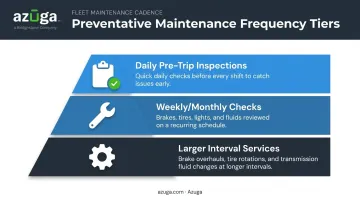
PM covers more than oil changes. It spans
- Daily pre-trip inspections conducted by drivers before every haul
- Weekly or monthly checks on brakes, tires, lights, and fluid levels
- Larger interval services like brake overhauls, tire rotations, and transmission fluid changes across both trucks and trailers
PM directly controls three things that affect the bottom line: uptime, safety, and cost, extending far beyond a routine compliance check.
Key Advantages of Preventative Maintenance
The advantages below aren't abstract. They tie directly to metrics fleets already track every month: cost per mile, downtime hours, DOT violation counts, and resale value at trade-in.
Enhanced Safety and Accident Prevention
Routine checks on brakes, tires, lights, and steering components catch wear before it turns into a roadside failure. PM shifts inspection from reactive, catching problems after an incident, to proactive, flagging worn components while they're still fixable in the shop.
Why this matters: In FMCSA's Large Truck Crash Causation Study, brake problems were coded as an associated factor in roughly 29% of the 141,000 trucks examined. That's not a claim that brakes caused those crashes, but it does show how often brake condition shows up alongside serious incidents, according to FMCSA's Report to Congress on the Large Truck Crash Causation Study.
Fewer mechanical red flags on the road also means less liability exposure and fewer disputes after an incident. Insurance underwriters increasingly weigh maintenance and safety records when setting rates, even without a fixed formula tied to PM compliance.
KPIs impacted:
- Accident rate
- DOT out-of-service violations
- Insurance premiums
Long-haul fleets, night driving operations, and high-mileage trucks feel this benefit most acutely, since component wear on these routes accelerates well beyond what a casual glance would catch.
Reduced Operational and Repair Costs
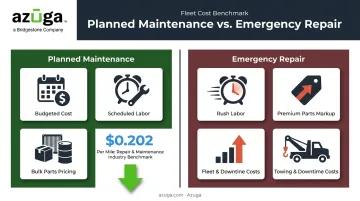
PM catches the cheap fixes, worn belts, dirty filters, small fluid leaks, before they escalate into a blown engine or a seized transmission. A scheduled parts-replacement cycle also avoids the markups that come with emergency repairs and rush labor.
Commercial trucking's repair and maintenance spend hit $0.202 per mile in 2023, up 3.1% year over year, according to ATRI's Operational Costs of Trucking research. That figure sets a useful benchmark, but the real savings come from predictability. Planned service work fits into a budget. Emergency roadside repairs don't.
KPIs impacted:
- Cost per mile
- Average repair invoice size
- Annual maintenance spend
This advantage matters most for owner-operators and small fleets running tight cash flow, where one unplanned $3,000 repair can wreck a month's margin.
Increased Uptime Through Data-Driven Visibility
Modern PM programs don't rely on mileage guesses or a driver's memory of "when the oil was last changed." They pair scheduled service with real-time vehicle health data.
Azuga's OBD-II devices, for instance, plug directly into a truck's onboard computer and stream data at intervals as frequent as every 30 seconds on its CompleteFleet plan. That includes diagnostic trouble codes surfaced through the FleetMobile app, giving fleet managers visibility into engine health between scheduled services instead of only at the next appointment.
Why this matters:
- Automated mileage tracking removes the human error baked into spreadsheet-based scheduling
- Maintenance alerts notify the service team the moment a fault code appears, not weeks later
- Fleet managers using telematics-driven maintenance monitoring frequently report meaningfully fewer unexpected breakdowns, since alerts catch developing issues before they cause a failure
KPIs impacted:
- Vehicle uptime percentage
- Missed-service rate
- Mean time between failures
Multi-truck fleets see the biggest payoff here, since manually tracking service intervals across a dozen or more vehicles becomes error-prone fast.
What Happens When Preventative Maintenance Is Ignored
Skipping PM doesn't save money. It just moves the cost downstream, and adds interest.
- Inconsistent performance. Fuel economy becomes unpredictable as dirty filters and underinflated tires quietly drag down mileage
- More roadside breakdowns. Towing costs and lost hours stack up fast when a preventable failure happens at mile marker 200
- Reactive repair cycles. Emergency fixes cost more per incident than planned shop work, in parts, labor, and downtime combined
- DOT violations climb. The 2025 International Roadcheck placed 18.1% of inspected vehicles out of service, mostly for brake, tire, and lighting failures, according to CVSA's 2025 Roadcheck results
- Faster depreciation. Trucks with spotty maintenance records fetch lower resale prices because buyers can't verify condition
None of these consequences hit in isolation. A skipped brake inspection can trigger a DOT violation, a roadside incident, and a lower trade-in value, all from one deferred service call.
How to Get the Most Value from a Preventative Maintenance Program
PM only pays off when it's applied consistently, across every truck in the fleet, not just the ones that are convenient to schedule.
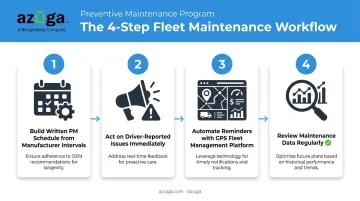
- Build a written PM schedule based on manufacturer intervals. Freightliner's Cascadia manual, for instance, sets initial service at 10,000 miles for short-haul duty and 25,000 miles for long-haul routes. Match A/B/C service tiers to your actual duty cycle, not a generic fleet-wide number.
- Act on driver-reported issues immediately. A driver flagging a soft brake pedal or a slow leak is reporting a real warning sign that shouldn't sit in an inbox for a week.
- Use a GPS fleet management platform to automate reminders. Azuga's fleet maintenance management tools centralize maintenance scheduling and diagnostic alerts in one dashboard, replacing sticky notes and spreadsheets with a system that flags issues as they happen.
- Review maintenance data regularly. Look for recurring issues and cost trends across the fleet. A tire that keeps wearing unevenly on the same truck points to an alignment problem, not bad luck.
Fleets that treat PM as a living process, adjusted based on real data, consistently outperform those running it as a once-a-year checklist exercise.
Conclusion
Preventative maintenance delivers more than avoided breakdowns. It creates control: predictable costs, steady uptime, and fewer surprises on a DOT inspection report.
These advantages compound. A truck maintained properly this year has fewer expensive problems next year, and the year after that. PM works best as an ongoing operational habit, supported by fleet maintenance software like Azuga that flags service intervals and keeps records visible—not a task completed once and forgotten in a filing cabinet.
Frequently Asked Questions
What regular maintenance should be done on a truck?
Core recurring tasks include oil and filter changes, brake and tire inspections, fluid level checks, and battery testing. Frequency depends on the manufacturer's schedule and your duty cycle.
What are the 5 types of preventive maintenance?
Common approaches include time-based, usage-based, condition-based, predictive, and prescriptive maintenance. Most fleets combine several of these rather than relying on just one.
How often should preventive maintenance be performed on a commercial truck?
Intervals typically range from 10,000 to 25,000 miles depending on duty cycle, following A/B/C service levels set by the manufacturer. Short-haul trucks generally need more frequent service than long-haul units.
What happens if you skip preventive maintenance on a truck?
Skipping preventive maintenance increases breakdown risk, drives up repair costs, and raises the odds of DOT violations during inspection. It also reduces resale value since buyers can't verify the truck's condition history.
What is the difference between preventive and reactive maintenance?
Preventive maintenance means performing scheduled service to catch issues before they cause failure. Reactive maintenance means fixing something only after it breaks, usually at a higher cost.
Can GPS tracking or telematics help with truck maintenance scheduling?
Yes. Telematics devices track mileage and engine diagnostics automatically, sending service reminders and flagging fault codes before they become expensive repairs. Platforms like Azuga centralize this data so nothing falls through the cracks.