
Introduction
Running a commercial fleet in 2026 means juggling more variables than ever: tighter delivery windows, stricter compliance rules, and drivers who need real support to stay safe on unpredictable roads. Many fleet managers still rely on spreadsheets and guesswork, and it's costing them in fuel, downtime, and insurance claims.
The right fleet management system changes that math directly. It cuts accident rates, controls fuel and maintenance spend, and gives dispatchers real-time visibility into every vehicle on the road.
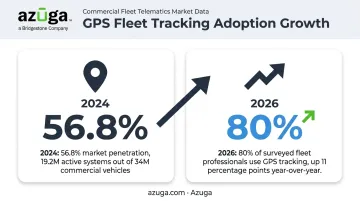
The numbers back this up. Fleet management system penetration across North America hit 56.8% by the end of 2024, covering roughly 19.2 million active systems out of 34 million non-privately owned commercial vehicles, according to a 2024 industry report from Berg Insight.
This guide ranks the five systems worth your attention this year.
Key Takeaways
- Fleet management systems combine GPS tracking, telematics, and software for real-time visibility into vehicles, drivers, and compliance
- Top providers reduce accidents, speeding, and costs while boosting vehicle uptime
- This guide ranks Azuga, Geotab, Motive, Samsara, and Verizon Connect on pricing, features, and fit
- Match your choice to fleet size, industry, and budget rather than brand alone
Overview of Fleet Management Systems in the US Market
A fleet management system pairs hardware, GPS and OBD-II devices, dash cams, sensors, with cloud software that tracks vehicle location, driver behavior, fuel use, and maintenance needs in one dashboard.
Adoption has moved from optional to standard practice. 80% of surveyed fleet professionals used GPS fleet tracking in 2026, an 11-percentage-point jump from the prior year, according to Verizon Connect's fleet technology trends report.
Regulatory pressure adds to the push. The FMCSA's ELD mandate requires electronic logging for most drivers who track hours of service. This rule nudges trucking, construction, HVAC, and utility fleets toward connected systems, even when specific vehicles fall outside the strict requirement.
The result is a crowded vendor market, but not every provider fits every fleet. Below, we rank the five systems that consistently deliver value across pricing, safety technology, and scalability for U.S. businesses.
Top Fleet Management Systems of 2026
We evaluated each platform on five criteria: affordability, ease of installation, safety technology, scalability, and customer support quality.
Azuga
Azuga is a GPS fleet management provider backed by Bridgestone, built for fleets of all sizes across construction, HVAC, landscaping, trucking, and waste management. The platform emphasizes simplicity: a self-install OBD-II device that's ready in about 20 seconds, paired with software that doesn't require a technical background to run.
What sets it apart
- Azuga SafetyCam AI with Collision Reconstruction, which the company says helps exonerate drivers and speeds up claims resolution
- 30-second high-frequency GPS tracking, tighter than the 1-2 minute polling common elsewhere
- 24/7 unlimited phone, email, and web support across plan tiers
- Recognition as a G2 Leader across multiple fleet management categories
Azuga customers have reported an average 38% decrease in accidents, a 57% reduction in speeding citations, and roughly $9,462 in annual savings from tighter cost management, according to company data.
| Category | Details |
|---|---|
| Pricing | packages matched to fleet needs that scales from small fleets to enterprise |
| Key Features | GPS tracking, AI dashcams with collision reconstruction, driver safety scorecards, fuel card integrations, real-time alerts |
| Best For | Small to enterprise fleets in construction, trucking, HVAC, and waste management wanting an affordable, easy-to-install safety-first platform |
Geotab
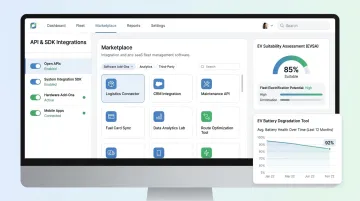
Geotab runs one of the largest open-platform telematics ecosystems in the industry, pairing its MyGeotab software with GO tracking hardware and a marketplace of more than 400 third-party integrations.
Its strength lies in customization. A fleet running box trucks, EVs, and heavy equipment side by side can build a system around its exact needs rather than settling for generic dashboards. Standout capabilities include
- Deep API/SDK access for custom development
- GO Focus Plus, an AI-powered dash cam that gives drivers real-time voice coaching
- EV Suitability Assessment, modeling electrification economics from real-world duty-cycle data
- A marketplace ecosystem supporting global, multi-vehicle-type fleets
| Category | Details |
|---|---|
| Pricing | Contact for details; varies by hardware tier and software subscription package |
| Key Features | Open API/SDK, predictive maintenance, EV fleet tracking, ELD and IFTA compliance automation |
| Best For | Large enterprise or global fleets needing deep customization and multi-vehicle-type support |
Motive
Motive positions itself as an all-in-one AI platform, unifying driver safety, fleet management, spend management, and workforce management under a single dashboard.
The AI Dashcam and AI Omnicam anchor its safety pitch. The company claims detection of 20+ safety events at up to 99% accuracy, a figure worth validating against your own event types during a pilot. Motive also folds fuel and spend controls into the same platform, flagging mismatches between vehicle location and card purchases.
- AI vision-based safety cameras with real-time in-cab alerts
- Integrated fleet spend and fuel card management
- Dispatch and driver workflow tools
- ELD and IFTA compliance automation
- Ranked #1 on G2's fleet management grid based on customer reviews
| Category | Details |
|---|---|
| Pricing | packages matched to fleet needs, tiered by selected modules |
| Key Features | AI vision safety cameras, dispatch and workflow tools, spend management, ELD/IFTA compliance |
| Best For | Mid-size to large fleets wanting an all-in-one AI safety and spend management platform |
Samsara
Samsara built its platform around a broader idea: Connected Operations, extending visibility beyond vehicles into equipment, job sites, and frontline workflows.
That breadth appeals to enterprise fleets managing more than trucks. A construction company, for instance, can track excavators and generators on the same dashboard as its delivery vans. Core strengths include
- Unified visibility across fleets, physical assets, and facilities
- AI dash cams with strong computer-vision safety detection
- Route planning and a driver workflow app for HOS logs and digital inspections
- A developer-facing REST API for custom integrations
| Category | Details |
|---|---|
| Pricing | Contract-based, quote-required, typically positioned at a premium tier |
| Key Features | AI dashcams, equipment and site monitoring, route planning, driver workflow apps |
| Best For | Enterprise fleets wanting a single platform across vehicles, equipment, and facility operations |
Verizon Connect
Verizon Connect leans on its parent company's telecom infrastructure to deliver reliable nationwide connectivity, a factor that matters more than people expect when fleets operate in rural or low-signal areas.
The Reveal platform covers standard GPS tracking, driver safety scorecards, and fuel reporting, but its service fleets and route planning tools give it an edge for fleets juggling scheduled stops and dispatch. Notable features
- GPS tracking with driver safety scoring
- Fuel management, including MPG and idling reports
- Service fleets dispatch and multi-stop route planning
- A dedicated offering built for fleets of 50+ vehicles, though it serves other sizes too
| Category | Details |
|---|---|
| Pricing | Subscription-based, quote required depending on fleet size and modules |
| Key Features | GPS tracking, driver safety scoring, fuel management, service fleets and routing tools |
| Best For | Mid-size fleets seeking a well-established, telecom-backed provider with reliable connectivity |
How We Chose the Best Fleet Management Systems
Many fleet buyers pick a provider based on brand recognition alone, then discover months later that the platform doesn't match their fleet's size, industry, or budget. We evaluated each system against factors tied to real business outcomes, not just feature checklists.
- Ease of installation - Plug-and-play OBD-II devices get fleets operational in minutes, not weeks, reducing downtime during rollout
- Total cost of ownership - Published scalable packaging, versus quote-only models, lets small fleets budget and commit faster
- Safety technology - AI dashcams and collision reconstruction directly reduce accident rates and help resolve liability disputes faster
- Scalability - A system that works for 10 vehicles should still work at 500, without forcing a platform switch
- Integration options - Compatibility with fuel cards, TMS, and fleet management software cuts down on double data entry
- Customer support quality - 24/7 availability matters most during roadside issues or after-hours compliance questions
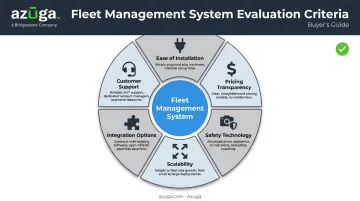
Each criterion ties to a number fleet managers can track: accident rates, fuel spend, onboarding time, or admin hours.
Conclusion
The best fleet management system for your business is the one that fits your fleet size, industry, and specific pain points, whether that's accident reduction, fuel cost control, or compliance automation. Brand recognition matters less than functional fit.
Before signing a contract, look past the listed rate. Evaluate total cost of ownership, how support responds when something breaks, and whether the platform can scale as your fleet grows.
If you're running a small to mid-size fleet and want a fast, affordable path to safer operations, Azuga's self-install hardware and 24/7 support make it worth a trial run.
Frequently Asked Questions
What does a fleet management system do?
It combines GPS tracking, telematics, and software to monitor vehicle location, driver behavior, fuel use, and compliance status in real time. Fleet managers use this data to reduce accidents and cut costs.
How much does fleet management software cost?
Enterprise features and larger fleets usually require details from the provider.
What features should I look for in a fleet management system?
Prioritize GPS tracking frequency, AI dashcam and safety technology, ease of installation, automated compliance reporting, and integrations with your existing fuel cards or dispatch software.
How do fleet management systems improve driver safety?
AI dashcams flag risky behavior like harsh braking or distracted driving instantly, while collision reconstruction tools help determine fault after an incident. Driver scorecards turn this data into targeted coaching.
Can small businesses benefit from fleet management software?
Yes. Plug-and-play systems with packages matched to fleet needs let small fleets access the same GPS tracking and safety scoring larger operations use, without a big upfront investment.
What is the difference between fleet management and asset tracking?
Fleet management covers vehicles, drivers, maintenance, and compliance as a whole. Asset tracking focuses narrowly on location and condition monitoring for equipment, trailers, or other non-powered assets.