
Here's the twist most people miss: aviation black boxes aren't even black. They're painted bright orange so crash investigators can spot them in wreckage. The name survives purely as an engineering shorthand, not a literal description.
This guide breaks down what a black box actually does across industries, walks through the four-stage process every version of it follows, and explains why the automotive version matters if you manage drivers or vehicles for a living.
Key Takeaways
- A black box turns inputs into a reviewable result while keeping its internal process hidden.
- Aviation recorders (FDR + CVR) log flight data and cockpit audio for crash investigations.
- Car EDRs record only a few seconds of pre-crash data as a secondary airbag-module function.
- GPS fleet trackers use the same OBD-II port but add continuous location and driver behavior monitoring.
- Medical monitors and streaming devices are sometimes called "black boxes" too, despite lacking any crash-recording function.
What Is a Black Box?
A black box, in the strict engineering sense, is any device or system studied only by what goes in and what comes out: its internal workings stay hidden from the observer. This idea comes from systems theory, not from any one industry.
The concept exists to solve a specific problem: capturing objective, tamper-resistant data about an event after it happens, when memory and witness accounts fall short. A pilot can't recall every instrument reading during a stall. A driver can't accurately estimate their speed a half-second before impact. The box remembers instead.
A few things a black box is not
- Some versions are purely diagnostic, not safety-critical
- Many activate only on trigger events rather than recording continuously
- In consumer electronics, "black box" often just means a compact, self-contained unit rather than a data recorder
The name has stuck even as the hardware moved from magnetic tape and photographic film to solid-state memory and cloud-connected sensors. You'll run into four common types, each working differently
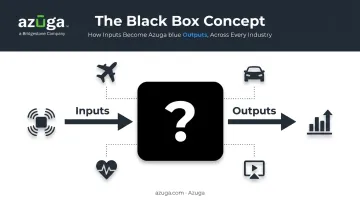
- Aviation flight recorders
- Automotive event data recorders
- Medical monitoring devices
- Consumer streaming boxes
We'll cover each below.
How Does a Black Box Work?
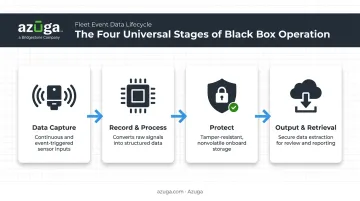
Strip away the industry-specific details, and nearly every black box follows the same four-stage logic: capture, record and process, protect, then retrieve.
Data Capture (Initiation)
Sensors or connectors feed raw signals into the box. In a car, that's GPS and accelerometer data pulled from the diagnostic port. In an aircraft, it's cockpit instrument sensors. In a medical device, it's an implanted lead reading electrical activity.
Capture happens one of two ways
- Continuous: always recording, then looping over older data once memory fills up
- Event-triggered: activated only by a specific condition, like sudden deceleration or airbag deployment
Core Recording & Processing
Once captured, raw electrical signals get converted into structured data points (speed, G-force, altitude, throttle position) and written to memory in real time. This is where processing capacity has changed the most over the decades.
Older aircraft built before October 1991 only needed to record 11 to 18 parameters under FAA rules. Aircraft manufactured after August 18, 2000, must record a minimum of 88 parameters under 14 CFR 135.152. That's not a universal figure for every recorder in service, but it shows how far data density has scaled as memory got cheaper and sensors got smarter.
Protection & Data Integrity
A black box has to survive the exact event it's built to document. Aviation recorders sit in fire- and impact-resistant housings, positioned to reduce the chance the container ruptures on impact.
Automotive EDRs handle it differently. Under 49 CFR Part 563, data must be stored in nonvolatile memory, and once an airbag deploys, that event gets locked, meaning it can't be overwritten by a later event. Non-deployment data doesn't get that same protection and can be replaced.
Data that doesn't survive the crash is useless to investigators, insurers, and engineers trying to reconstruct what happened.
Output & Data Retrieval
Finally, someone has to get the data out. Aircraft recorders require physical recovery and download at a lab. Cars need specialized crash data retrieval hardware, like Bosch's CDR tool, connected either through the diagnostic port or directly to the airbag control module. Connected telematics devices, like Azuga's fleet trackers, skip all that: data streams to the cloud and shows up in a dashboard in real time.
This last stage decides how useful the whole system is. An investigation, insurance claim, or maintenance decision is only as good as how quickly and completely the data can be pulled.
Types of Black Boxes You'll Encounter
Aviation black box. This is really two devices working together: the Flight Data Recorder (FDR) and Cockpit Voice Recorder (CVR). Both are painted bright orange with reflective tape, built specifically so search crews can spot them after a crash. They're engineered to withstand extreme heat, impact, and water pressure.
Vehicle black box (fleet telematics). Commercial vehicles carry a similar device: GPS trackers, OBD-II dongles, and AI dashcams that double as event data recorders. They log speed, location, harsh braking, and driver behavior, giving fleet managers the same after-the-fact clarity crash investigators rely on.
Medical black box devices. In healthcare, the term usually refers to implantable or wearable monitors (cardiac loop recorders, for example) that log physiological data like heart rhythm episodes for a clinician to review later. The patient doesn't see the internal processing; they just know the device is tracking something.
Streaming/media black box. Here, "black box" has nothing to do with recording events. It's just industry slang for a compact set-top device (an Android TV box, for instance) that processes and delivers video content. The term describes the form factor, not a data-capture function.
The common thread: every one of these devices hides complex internal processing behind a simple relationship between what goes in and what comes out, whether the goal is crash investigation or Saturday-night streaming.
Vehicle Black Boxes vs. GPS Fleet Tracking: What's the Difference?
This is the distinction that actually matters if you're running a fleet, and it's the one most commonly confused.
A car's black box (technically an Event Data Recorder) lives inside the airbag control module, and its main job is triggering airbag deployment. Recording crash data is only a secondary function.
That crash-data window is short. Historically it meant 5 seconds at 2 Hz; a 2024 NHTSA rule extends that to 20 seconds at 10 Hz for future vehicles, on a phased compliance schedule.
A GPS fleet tracking device is a different animal entirely. It's built for continuous monitoring: location, speed, driver behavior, and vehicle diagnostics, rather than short-burst crash capture.
Both technologies plug into or draw from the same OBD-II port and CAN bus. That means a fleet telematics device can access much of the same underlying vehicle data an EDR does, but it streams it continuously instead of storing a few seconds around a single event.
| Feature | Automotive EDR | GPS Fleet Telematics |
|---|---|---|
| Primary function | Airbag deployment; crash data is secondary | Continuous location and behavior monitoring |
| Recording window | Seconds before/after a crash only | Ongoing, real-time |
| Access point | OBD-II port or direct module connection | OBD-II port (plug-and-play) |
| Data ownership | Vehicle owner/lessee, by federal statute | Fleet operator, real-time platform access |
| Retrieval | Specialized tools, often legal authorization required | Dashboard, mobile app, instant access |
The business case is straightforward: an EDR only proves what happened in the moments before a collision. A telematics platform helps prevent the collision from happening at all.
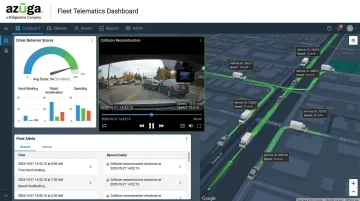
Azuga's plug-and-play OBD-II devices, for example, combine real-time location tracking at 30-second intervals with dashcam-based Collision Reconstruction, giving fleets both prevention tools and after-the-fact evidence in one system.
The practical takeaway: pair passive, black-box-style crash data with active telematics and AI dashcams. In a disputed claim, synchronized video and driving data together carry far more weight than either alone. Azuga's own data shows 70% of accidents its customers experience aren't caused by their own drivers, supporting faster claim resolution and fewer unnecessary payouts.
Conclusion
A black box works the same underlying way in every industry. It follows four consistent steps
- Captures raw inputs from sensors, controls, or cameras
- Converts those inputs into structured, timestamped data
- Protects that data against the very event it's meant to document
- Makes that data retrievable when someone needs answers
Understanding that logic changes how you read the evidence. You can read an aviation incident report more critically, and know exactly what a car's EDR can and can't tell you. It also shows why a modern fleet telematics platform, like Azuga's, beats a passive recorder: it doesn't just document risk, it reduces it before a crash happens.
Frequently Asked Questions
What is a black box device?
It's a general term for any device that captures and processes data internally without exposing its mechanism. The specific meaning shifts by industry: an aviation recorder, a vehicle EDR, a medical monitor, or a streaming unit.
Is a black box a tracker device?
A traditional automotive black box (EDR) is not a live tracker; it only stores a short window of pre-crash data. GPS fleet tracking devices are true continuous trackers, though both can plug into the same vehicle diagnostic port.
What is the black box medical device?
In healthcare, it typically refers to implantable or wearable monitors that log physiological data (like heart rhythm) for clinicians to review later. It works on the same principle as a flight recorder logging data for investigators.
What is a black box streaming device?
This refers to a compact set-top box, like an Android-based streaming device, used to access and play media content. The term relates to its simple, self-contained form rather than any event-recording function.
How does a car's black box differ from an airplane's black box?
A car's EDR sits inside the airbag control module and records a few seconds of pre-crash data as a secondary function. An aircraft's black box is a dedicated system combining flight data and cockpit audio recording across a much longer window.
Can fleet companies or insurers access black box data?
Automotive EDR data requires specialized retrieval tools and legal authorization, as it's the legal property of the vehicle owner or lessee. GPS fleet telematics platforms give fleet managers direct, real-time access to driving data and video evidence, no download required.