
Introduction
Picture a driver parked at a loading dock, engine running, waiting for a dispatch call. Or a delivery van sitting in traffic with the AC blasting. The vehicle isn't moving an inch, but the fuel gauge is still dropping.
Idling burns real fuel, and the amount varies widely. According to the U.S. Department of Energy's Fact #861, idling can waste up to a gallon of fuel per hour in a light-duty vehicle, with heavy trucks burning far more.
Engine size, RPM, weather, and accessory use all shift that math. A compact sedan idling for an hour doesn't burn anywhere close to what a Class 8 tractor-trailer does.
This article breaks down idling fuel consumption by vehicle type, what drives it up or down, hidden costs beyond the fuel gauge, and practical ways fleets can track and cut it.
Key Takeaways
- Idling burns roughly 0.16 to 0.5 gallons per hour in passenger cars and vans, versus 0.6 to 1.5 gallons per hour in heavy trucks
- Engine displacement, idle RPM, and accessory load (AC/heating) are the biggest drivers of idle fuel burn
- Extra idle hours don't add mileage, but they still accelerate engine wear and shrink maintenance intervals
- GPS and telematics visibility into idle time helps fleets target worst offenders and cut wasted fuel
How Much Fuel Does Idling Consume? (By Vehicle Type)
Idling fuel consumption isn't one-size-fits-all. It depends heavily on engine displacement, vehicle weight class, and how the engine is being used while stationary.
Many drivers and fleet owners assume idling "barely uses any fuel." In reality, it accumulates fast. An engine that burns half a gallon an hour adds up to real money and real gallons over a workweek, let alone a year.
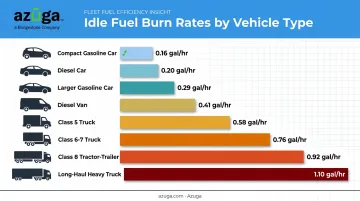
Fuel Burn by Vehicle Class
| Vehicle Type | Idle Fuel Rate (per hour) |
|---|---|
| Compact gasoline car (2.0L) | 0.16 gal |
| Standard diesel car (2.0L) | 0.17 gal |
| Larger gasoline car (4.6L) | 0.39 gal |
| Diesel van/light-goods vehicle | ~0.17 gal |
| Class 5 diesel delivery truck | 0.84 gal |
| Class 6-7 diesel truck | 0.44 gal |
| Class 8 tractor-trailer | 0.64 gal |
| Long-haul heavy truck (average) | 0.8 gal |
These figures come from Argonne National Laboratory's idling reduction calculator and the Department of Energy's long-haul truck idling analysis.
Vans tend to sit closer to the passenger car range at idle, but real-world consumption climbs quickly once refrigeration units, lift gates, or extended AC use enter the picture. Heavy trucks show the widest range, since sleeper-cab climate control and PTO-driven equipment push consumption well above baseline no-load figures. These per-vehicle differences add up fast once you multiply them across a full fleet.
What This Looks Like for a Small Fleet
Say a 30-vehicle delivery fleet averages 45 minutes of idling per vehicle per workday, at 0.3 gallons per hour on average across the mixed fleet. Over 250 working days, that's
- 0.75 hours × 0.3 gal/hr × 30 vehicles × 250 days = 1,687 gallons wasted annually
At current diesel or gasoline prices, that's a real budget line, before a single vehicle has driven a single mile. Fleet tracking platforms like Azuga surface this idle time automatically, turning an invisible fuel drain into a number you can actually manage.
Key Factors That Affect Idling Fuel Consumption
Idle fuel burn depends on a mix of mechanical and situational variables, not vehicle size alone. Here's what actually moves the number.
Engine Size and Displacement
Bigger engines burn more fuel at idle even with zero load. A 3-liter engine typically burns around 1.8 liters per hour at idle, while a 5-liter engine burns closer to 3.0 liters per hour, according to Natural Resources Canada's idling research. The relationship isn't perfectly linear, but the trend holds: more displacement means more fuel consumed just to keep the engine running.
Idle Speed (RPM)
Idle RPM matters more than most drivers realize. Argonne's testing found that raising idle speed sharply increases fuel burn:
- Gasoline passenger car: 0.16 to 0.29 gallons per hour, an 81% increase
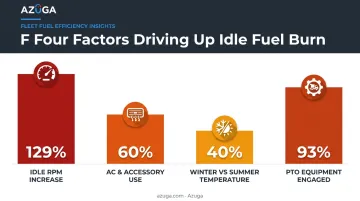
- Diesel passenger car: 0.17 to 0.39 gallons per hour, a 129% increase
High idle settings used for cab comfort or battery charging can nearly double fuel burn compared to standard idle.
Use of Accessories (AC, Heating, Electronics)
Running the air conditioner while idling adds meaningful load. Testing on a Toyota Corolla found AC pull-down added roughly 0.13 gallons per hour, a 60% jump over idling with accessories off. Heating draws less extra fuel from the main engine, but it still adds up over a shift.
Ambient Temperature and Weather Conditions
Cold and hot weather both push idling duration up. A Canadian national survey found summer idling ran about 40% lower than winter idling, with winter idling exceeding 75 million minutes per day nationally. Drivers warm up cabins in winter and cool them in summer, and both habits compound fuel waste across a season.
Vehicle Load, PTOs, and Auxiliary Systems
Vehicles running power take-off (PTO) systems, like tow trucks, bucket trucks, or refrigerated delivery vans, burn substantially more fuel while idling than a standard vehicle. Argonne's data shows a Class 6 tow truck jumping from 0.59 to 1.14 gallons per hour with PTO engaged, a 93% increase. A Class 8 bucket truck saw a 67% increase under similar conditions. Because these factors compound across a fleet's mix of vehicles and duty cycles, tracking idle time by vehicle and driver turns guesswork into actionable data fleets can actually manage.
The Real Cost of Idling: Beyond Fuel
Fuel burned is only part of the true cost. Idling quietly drains a fleet budget in ways that don't show up until the maintenance bill or the resale appraisal arrives.
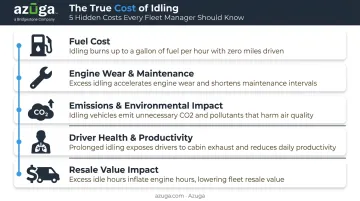
Fuel cost. Multiply hourly burn rate by fuel price and daily idle frequency across your fleet: a truck idling 0.8 gallons an hour for two hours daily adds up fast over hundreds of working days.
Engine wear and maintenance. PACCAR's OEM guidance limits low-speed idling (400-600 RPM) to five minutes due to lubrication risk, while Caterpillar data shows cutting idle share in half can improve fuel economy by up to 4%.
Emissions and environmental impact. Every gallon of fuel burned releases 8.887 kg of CO2 (gasoline) or 10.180 kg (diesel), per EPA's greenhouse gas equivalencies data—none of it moves the vehicle forward.
Driver health and productivity. Extended idling concentrates exhaust and cabin pollutants, an issue flagged by FMCSA research, and burns time without advancing a route or job ticket.
Resale value impact. Idle hours add to total engine hours without adding mileage, so a truck with high hours relative to low mileage can raise buyer suspicion despite a clean odometer.
How to Reduce Idling and Estimate Your Fleet's True Costs
Estimating your fleet's idle cost doesn't require complex modeling. Use this formula
Idle hours/day × fuel burn rate × fuel price × number of vehicles × working days
Worked example: A 25-vehicle HVAC fleet idles an average of 1 hour daily at 0.3 gallons per hour, with fuel priced at $3.50/gallon, across 260 working days
1 × 0.3 × $3.50 × 25 × 260 = $6,825 per year, just from idling.
Driver-Level Actions That Actually Work
- Set a maximum allowable idle time policy (many fleets use a 3-5 minute threshold)
- Train drivers on shutdown habits during loading, waiting, and breaks
- Skip unnecessary warm-up idling; modern engines don't need it
- Flag high-idle settings that aren't tied to safety or required equipment use
Where Telematics Fits In
Manual idle logs miss patterns. A driver might report "a few minutes here and there" without realizing it adds up to an hour a day. This is where GPS fleet tracking platforms like Azuga come in.
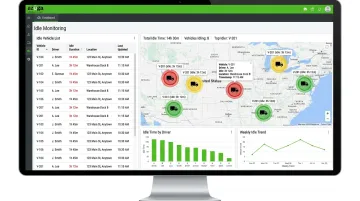
Azuga's Monitor Idling report captures idle duration, location, and proximity to landmarks across the whole fleet. Frequent status pings catch idling events that infrequent polling systems would miss entirely. Fleet managers can see exactly which vehicles and drivers are idling excessively instead of guessing.
Real Azuga customers report measurable savings:
- California UMI saved approximately $12,000 per year in idling reductions alone
- Pest control companies using Azuga Fleet achieved an average 29% reduction in idling duration
- Kitsap Garage Door Company upgraded specifically for "insight into engine idling and fuel used"
Quarterly Fleet Reviews with a dedicated Customer Success Manager keep idling on the agenda every quarter, turning a one-time fix into an ongoing cost-control habit.
Idling Myths vs Reality
Myth: Restarting the engine uses more fuel than letting it idle. Reality: the Department of Energy's consumer guide confirms idling beyond about 10 seconds burns more fuel than shutting off and restarting. Modern starters and batteries are built for frequent restarts.
Myth: Idling is necessary to properly warm up an engine in cold weather. Reality: driving warms a modern engine faster than sitting still. Even in peak winter, limiting warm-up idling to 2-3 minutes before driving off is enough.
Myth: Idling causes less wear on an engine than driving. Reality: idle speeds mean incomplete combustion and poor lubrication circulation. OEM manuals warn about soot buildup and inadequate lubrication during extended low-speed idling, meaning wear per minute can actually be worse at idle than on the road.
Idling fuel consumption varies by vehicle and conditions, but it's rarely negligible. Cutting it down remains one of the simplest ways for fleets to lower fuel costs and extend vehicle life.
Frequently Asked Questions
What is the fuel consumption when idling?
It varies by vehicle type: passenger cars typically burn 0.16 to 0.5 gallons per hour, while trucks and HGVs can burn over a gallon per hour depending on load and accessories.
How many idle hours are normal for 100,000 miles?
There's no universal ratio, but a common fleet rule of thumb treats 1 idle hour as roughly equivalent to 25-30 driving miles. Excessive idle hours relative to mileage often signal inefficient routes or driver habits worth reviewing.
Does idling really waste fuel?
Yes. Any fuel burned while stationary contributes zero distance traveled, making it a pure cost with no operational benefit.
How much fuel does a truck burn idling overnight?
Using the long-haul average of 0.8 gallons per hour, a 10-hour overnight rest period burns roughly 8 gallons, with a realistic range of 6 to 15 gallons depending on climate control use.
Is it bad to let a work truck idle for 10 minutes?
Yes. Ten minutes of idling wastes measurable fuel and adds engine wear from incomplete combustion. Multiply that across a full fleet doing it daily, and the cost climbs fast.
How can fleet managers reduce idling fuel waste?
The most effective combination is driver training, a clear maximum idle time policy, and GPS or telematics-based idle monitoring that flags patterns manual logs would miss.