
Introduction
A delivery van runs a yellow light that's really already red. No collision this time, but the near-miss shows up on a dashcam clip nobody reviews.
Three weeks later, the same driver rear-ends a sedan at a stoplight, distracted by a phone notification.
This scenario plays out across fleets every day. Transportation incidents caused 1,937 worker deaths in 2024, making up 38.2% of all U.S. occupational fatalities, according to the 2024 Bureau of Labor Statistics report.
Without a formal safety program, fleets absorb rising insurance premiums, higher driver turnover, and mounting compliance risk. This guide breaks down the core elements of a fleet safety program, how to structure driver training that sticks, and how modern telematics makes both easier to manage.
Key Takeaways
- Effective programs combine written policy, screening, training, maintenance, and accountability
- Driver training works best as a continuous loop, not a one-time onboarding checklist
- Telematics and dashcams flag risky behavior early, before it becomes a claim
- Strong safety programs cut accidents by up to 38% and reduce speeding citations by 57%, lowering insurance costs
Why Your Business Needs a Fleet Safety Program
Any business that puts employees behind the wheel carries liability exposure, whether you run three trucks or three hundred. Unmanaged risk shows up directly in insurance premiums and legal costs.
The financial stakes are steep. Motor-vehicle workers' compensation claims averaged $91,433 in accident years 2022-23, nearly double the $47,316 average for all workplace injury claims combined, per data reported by the National Safety Council. Vehicle crashes also produce more severe injuries: head, neck, and spine trauma drive costs well above typical workplace incidents.
Beyond the balance sheet, a documented program pays off in less obvious ways
- Retention improves when drivers see the company actively investing in their safety, not just handing them keys
- Morale rises with clear, fairly enforced expectations instead of inconsistent discipline
- Insurance eligibility improves — many commercial auto carriers offer better terms to fleets running structured telematics and safety programs, since documented loss-reduction efforts factor into underwriting decisions
A documented safety program functions as a direct lever on cost, retention, and legal exposure rather than a routine compliance task.
Core Elements of an Effective Fleet Safety Program
A real program has structure. Here's what that looks like in practice.
Written Policies and Driver Rules
Clear, written expectations remove guesswork and support fair enforcement. At minimum, your policy should cover
- Seat belt use on every trip, no exceptions
- Phone and device restrictions while driving
- Speed limit adherence, including scheduling that doesn't force drivers to speed
- Substance use rules covering drugs and alcohol
Policies should also spell out who qualifies as an authorized driver, what disqualifies someone from driving company vehicles, and how citations or incidents get reported. Without this on paper, enforcement becomes arbitrary and defensible liability arguments fall apart.
Driver Screening, Hiring, and Ongoing Monitoring
Screening starts before a driver ever turns the key. Best practice includes
- MVR checks at hiring and again annually, reviewing violations like speeding and reckless or impaired driving
- License verification to confirm active, appropriate credentials
- Background and drug screening before granting driving privileges
Annual reviews alone leave gaps, since a driver can accumulate violations between checks and nobody notices until it's too late. This is where ongoing monitoring earns its place.
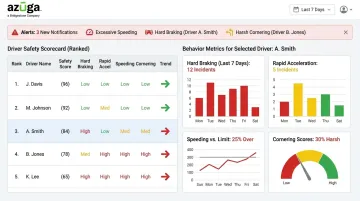
Modern platforms like Azuga consolidate behavior into driver scorecards tracking hard braking, rapid acceleration, speeding relative to posted limits, aggressive cornering, and distracted driving events. Exception-based alerts flag deviations automatically, so managers aren't scrolling through data looking for problems. The scorecard does the flagging for you.
Vehicle Maintenance, Inspections, and Incident Response
Mechanical failure isn't the leading cause of most crashes, but it's far from negligible. FMCSA's Large Truck Crash Causation Study found vehicle factors were the critical reason in 10.1% of truck-involved cases, with brake problems flagged in roughly 27% of two-vehicle truck crashes.
A solid maintenance program includes
- Routine pre- and post-trip inspections
- Daily Vehicle Inspection Reports (DVIRs) covering brakes, tires, lights, and steering
- Preventive maintenance scheduling tied to mileage or engine diagnostics, not guesswork
When an incident does happen, response procedure matters just as much. Document the scene, take photos, and conduct a root-cause review. Documenting incidents protects the company in a liability dispute and prevents the same failure from repeating.
Driver Training: The Foundation of a Safer Fleet
Policies set the rules. Training is what actually changes behavior behind the wheel.
Onboarding and Foundational Training
New drivers need more than a signature on a policy acknowledgment form. Onboarding should include
- A full review of company safety policy and expectations
- Defensive driving fundamentals
- State and local regulation training specific to the routes they'll drive
For new or higher-risk drivers, ride-alongs or supervised trips before solo operation catch bad habits early, when they're easiest to correct.
Ongoing Coaching and Refresher Training
Training that happens once at hiring and never again doesn't hold up. NIOSH research notes that companies with the strongest road-safety records typically run refresher training every 2-3 years, alongside topic-specific sessions on fatigue, distracted driving, severe weather, and cargo securement.
But scheduled refreshers alone aren't enough. A commercial study of 625 drivers across 315 vehicles found that in-cab warnings paired with supervisor video coaching produced a sharp drop in risky driving events. Warning lights alone, without coaching, showed no meaningful improvement over doing nothing at all, according to research published in PMC.
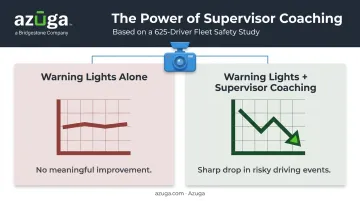
Event-triggered coaching beats generic annual training because it addresses specific behavior right after it happens, not months later in a classroom.
Technology-Enabled and Data-Driven Training
AI dashcams have changed what's possible here. Azuga's SafetyCam AI uses a neural learning network to analyze driver-facing video in real time, automatically tagging distraction events as they happen. Managers see exactly what happened and why, not just that a harsh-braking alert fired.
Gamification adds another layer. Azuga's driver scorecards feed into rewards programs where drivers compete for the best safety record, see their own scores through a mobile app, and earn recognition or incentives for improvement.
One fleet using this approach drove speeding events down to nearly zero with Azuga's SpeedSafe feature. Turning safety into something drivers want to engage with, rather than something imposed on them, changes the culture around it.
Steps to Build and Implement Your Fleet Safety Program
Building the program is one thing. Making it stick is another.
- Form a fleet safety council. Bring together fleet managers, HR, legal, and supervisors to review incidents, enforce policy consistently, and hear driver appeals fairly.
- Set measurable benchmarks. Track fleet data, such as collisions per million miles, citation frequency, and coaching completion rates, against industry norms. Platforms like Azuga pull these metrics automatically, removing the need for manual spreadsheets.
- Secure leadership commitment. Programs stall when they exist only as a binder on a shelf; consistent communication across HR, operations, and drivers keeps them active.
None of this requires a large team. Even a small fleet can rotate these responsibilities among existing staff. What matters is that someone owns follow-through.
How Fleet Technology Simplifies Safety Programs and Driver Training
Technology doesn't replace the fundamentals above. It makes them faster to execute and cheaper to sustain.
Real-time visibility. GPS tracking with high-frequency updates gives fleet managers a live view into speeding, harsh braking, and unauthorized vehicle use. Azuga tracks at 30-second intervals using a plug-and-play OBD-II device drivers can self-install in minutes, no technician visit required.
Liability protection. Dashcam and collision reconstruction technology does more than catch bad behavior. It protects good drivers too. Azuga reports that 70% of accidents are not the fault of the fleet driver — meaning video evidence often exonerates your team rather than incriminating them, which matters when a claim turns into litigation.
Cost transparency. Fleet software capterra.com/resources/fleet-management-software-pricing-report/). Azuga matches packaging to fleet size and the features you select, with no long-term contract required for smaller fleets, making it accessible whether you're running five vehicles or five hundred.
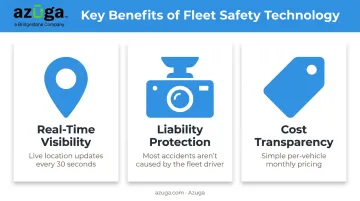
The math tends to work in a fleet's favor. Even modest reductions in accidents, citations, and vehicle wear offset the monthly cost quickly. Factor in the $91,433 average cost of a motor-vehicle workers' comp claim cited earlier, and the case becomes even stronger.
Frequently Asked Questions
What is the most important piece of a fleet safety program?
Consistent driver training paired with strong leadership accountability tends to matter most. Even well-written policies fail without consistent enforcement.
How much does fleet software cost?
Options typically vary based on features like GPS tracking, dashcams, and safety scoring. Azuga matches packaging to fleet size and the features you select.
What are the main elements of a fleet safety program?
The core pillars are written policies, driver screening, ongoing training, vehicle maintenance, and incident response procedures. Skipping any one of them creates a gap the others can't cover.
How often should fleet drivers receive safety training?
Training should happen at onboarding, with annual refreshers at minimum, plus event-based coaching triggered by real driving data like harsh braking or speeding.
Can telematics and dashcams actually reduce fleet accidents?
Real-time visibility combined with targeted coaching changes driver behavior over time. Azuga customers report an average 38% decrease in accidents after adoption.
How many vehicles do you need to start a fleet safety program?
Fleet size doesn't matter. A single company car carries the same liability exposure as a fleet of hundreds, and a formal program benefits both equally.