
It's no coincidence that a 2023 APTA survey of 122 transit agencies found 51% expected a budget shortfall within five years. Meanwhile, many agencies and school districts are still running fleets on manual logs, spreadsheets, and disconnected maintenance records, an approach that makes it nearly impossible to catch a missed inspection or answer a compliance auditor's question in real time.
This guide breaks down what a bus fleet management system does, how it works day to day, and what to look for when choosing one. We'll also look at where a telematics platform like Azuga fits into transit and school bus operations.
Key Takeaways
- GPS tracking, maintenance alerts, compliance, and driver safety unite in one dashboard
- Real-time data cuts accidents, saves fuel, and boosts on-time performance
- Platform choice hinges on ease of use, compliance depth, integrations, and packages matched to fleet needs
- Driver training plus regular data reviews turn a good system into lasting ROI
What Is a Bus Fleet Management System?
A bus fleet is a group of vehicles that one organization operates and maintains for passenger transport. That could mean a citywide transit authority running hundreds of buses, a school district with a dozen yellow buses, or a paratransit service running a handful of accessible vans.
The vehicles differ, but the management challenge stays the same: keeping every vehicle safe, on schedule, and in compliance.
A bus fleet management system pairs hardware with software to centralize that oversight. On the hardware side, that's typically a GPS/OBD device wired into each bus's diagnostics port, sometimes paired with a dashcam. On the software side, it's a dashboard that pulls all that data into alerts, reports, and maps a manager can actually use.
Legacy approach vs. modern platform:
| Legacy Approach | Modern Platform |
|---|---|
| Paper logs, spreadsheets, and a maintenance binder in the shop | Real-time GPS location and diagnostics streamed to one dashboard |
| Drivers self-report incidents or near-misses after the fact | Automatic alerts for maintenance, speeding, and route deviations |
Modern platforms also tie fuel and repair costs directly to each vehicle and driver, something a spreadsheet never captured.
Districts still relying on the old way often only discover a maintenance issue after a bus breaks down mid-route, or catch a driver behavior problem after a complaint rather than before an incident.
Who Uses These Systems?
The dashboard isn't just for the fleet manager's office.
- Transit authority supervisors monitor route adherence and service reliability across the network
- School transportation directors track ridership routes, driver certifications, and inspection schedules
- Maintenance managers get automated alerts when a bus is due for service
- Drivers receive in-cab feedback on speeding, harsh braking, or following distance
System scope varies widely, too. A rural school district with eight buses needs the same core functions as a metro transit authority running 400 vehicles, just at a different scale. Most modern platforms are built to handle both without forcing a district to outgrow the system in a few years.
How Does Bus Fleet Management Work?
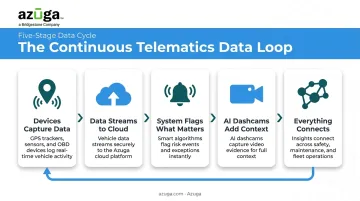
Bus fleet management runs on a continuous loop of data collection, transmission, and action. Here's how that loop plays out in practice
- Devices capture data. A GPS/telematics device installed on each bus records location, speed, and engine diagnostics pulled from the vehicle's onboard computer.
- Data streams to the cloud. That information uploads to a central dashboard, often at high frequency. Azuga's platform, for example, refreshes location data every 30 seconds for near-live tracking.
- The system flags what matters. Automated alerts fire when a bus is due for maintenance, when a driver brakes or accelerates harshly, or when a vehicle drifts outside its geofenced route.
- AI dashcams add context. Road-facing and driver-facing cameras analyze footage for distraction or collision risk, giving supervisors video evidence instead of a driver's word against a passenger complaint.
- Everything connects. Fuel card data, maintenance software, and scheduling tools link back to the same platform, so a manager isn't jumping between five different logins for the full picture.
Why the refresh rate matters: there's no single industry-mandated GPS update interval. Agencies set their own based on dispatch and rider-information needs, and some transit RFPs have specified updates as frequent as every five seconds for real-time arrival predictions.
What matters more than the exact number is whether the data is fast enough for your team's decisions, whether that's rerouting around a closure or confirming a bus location during a parent's phone call.
One technical note worth flagging early: heavy-duty transit buses often run on the J1939 diagnostic protocol rather than standard passenger-vehicle OBD-II. Confirm a system supports the diagnostic standard your specific fleet uses before signing a contract.
Key Benefits of Bus Fleet Management for Public Transport
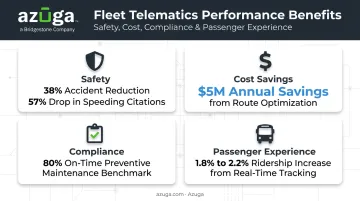
Safety. Real-time driver behavior monitoring (harsh braking, speeding, distraction) gives supervisors data to coach drivers before a habit turns into a collision. Video evidence also settles disputes faster; instead of guessing what happened, a manager pulls the footage.
Azuga's fleet customers have reported average accident reductions of 38% and a 57% drop in speeding citations after adopting GPS and dashcam monitoring, though results vary by fleet size and driving conditions.
Cost savings. Fuel and maintenance are two of the biggest line items in any bus budget, and both respond well to better data. Route optimization alone can deliver real gains: Boston Public Schools cut roughly 50 buses from its 650-vehicle fleet and reported about $5 million in annual savings after applying a route and bell-time optimization algorithm.
Fleet management platforms support similar wins by flagging unnecessary idling, tracking fuel use per vehicle, and scheduling preventive maintenance before small issues become expensive repairs.
Regulatory compliance. Automated inspection scheduling and driver certification tracking take the guesswork out of audit prep. FTA reviews look for agencies maintaining at least 80% on-time preventive maintenance for three consecutive months, a benchmark that's far easier to hit when the system tracks due dates automatically instead of relying on a paper checklist.
Enhanced passenger experience. Riders trust a system they can see. When Chicago Transit Authority rolled out its Bus Tracker real-time arrival tool, researchers linked the deployment to a 1.8% to 2.2% ridership increase on affected routes. Real-time tracking data feeding into rider-facing apps does the same job: it turns "where's my bus?" into a known quantity.
Data-driven planning. Aggregated performance data (safety scores, fuel efficiency, on-time percentage, maintenance costs) gives agencies a factual basis for budget requests and fleet replacement schedules.
FTA data shows buses with a 12-year useful-life benchmark are often kept in service to an average of 15.1 years, and maintenance costs can climb 10-50% beyond that point. Knowing exactly which vehicles cost the most keeps replacement decisions grounded in numbers, not guesswork.
Choosing the Right Bus Fleet Management System
Not every platform built for delivery vans or plumbing trucks handles the specific demands of a bus fleet, things like student ridership, ADA paratransit requirements, and FTA reporting. Use this checklist when comparing options
- Ease of use - can dispatchers, drivers, and maintenance staff navigate the dashboard without weeks of training?
- Packages matched to fleet needs that grows with your fleet - scalable packaging shouldn't require a system overhaul as your fleet grows from 15 buses to 150
- Feature depth - GPS tracking, preventive maintenance alerts, driver certification tracking, and dashcam options should live in one platform
- Integrations - the system should connect to your existing fuel cards, maintenance software, and scheduling tools rather than replacing them
- 24/7 support - fleet issues don't wait for business hours, and neither should your support line
- Data security - confirm how driver and location data is stored, who can access it, and what happens if you switch vendors
Azuga is a useful benchmark for what an accessible platform looks like. Its OBD-II device installs in minutes without a technician visit, and its SafetyCam AI includes collision reconstruction to help resolve liability disputes.
Packaging is flexible for core GPS and safety features, with more advanced plans layering in high-frequency tracking and video.
One caveat: Azuga doesn't currently publish a dedicated school-bus or transit package. Agencies evaluating it, or any vendor, should confirm compliance features like student ridership tracking or ADA reporting are available through a customized setup rather than assuming they're bundled in.
Best Practices for Managing a Bus Fleet
Buying the software is the easy part. Getting full value out of it takes process changes too.
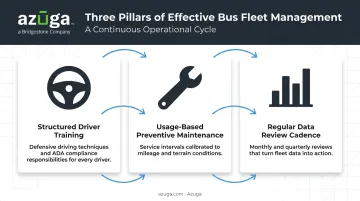
Invest in structured driver training. Training should cover more than how to operate the vehicle
- APTA's recommended practice for transit operators includes defensive driving, ADA responsibilities, vehicle familiarization, and emergency response
- NHTSA's in-service curriculum for school bus drivers uses nine similar lesson modules
- Telematics data pinpoints exactly which drivers need coaching on which skill
Build a preventive maintenance program around real usage, not just the calendar. Manufacturer guidelines are only a starting point. These factors also affect when a bus actually needs service
- Mileage accumulated along each route
- Route terrain and grade
- Idle time between stops
Feed telematics data into your maintenance schedule so alerts trigger based on how a vehicle is used, not just how many months have passed.
Review performance data on a regular cadence. Safety scores, fuel efficiency, and on-time percentage only tell a story if someone reviews them regularly. Set a monthly or quarterly cadence where fleet managers can
- Adjust routes based on performance trends
- Retrain drivers flagged by low safety scores
- Flag vehicles for early replacement
A system generating alerts nobody reads isn't worth much. The real return comes from acting on what the data shows.
Frequently Asked Questions
What is a bus fleet?
A bus fleet is a group of buses (transit, school, or shuttle vehicles) operated and maintained under one organization for passenger transport. Scope can range from a handful of school buses to hundreds of transit vehicles across a city.
How does fleet management work?
GPS and telematics devices installed on each bus capture location, speed, and engine diagnostics, and stream that data to a cloud dashboard. From there, the system generates maintenance alerts, tracks driver behavior, and flags issues automatically.
What features should I look for in bus fleet management software?
Look for GPS tracking, preventive maintenance alerts, compliance and certification tracking, and driver safety monitoring as the essentials. Dashcam integration and fuel card connections add further value for larger fleets.
How much does bus fleet management software typically cost?
Azuga's plans, for example, use packages matched to fleet needs for core tracking and safety features.
Can bus fleet management systems integrate with existing school or transit software?
Most modern platforms integrate with fuel cards, maintenance systems, and scheduling or dispatch software. Confirm specific integrations with any vendor before purchasing, since compatibility varies by platform.
How does GPS tracking improve bus safety?
Real-time location and driver behavior data let supervisors spot risky patterns, like harsh braking or speeding, before they cause an incident. It also speeds up incident response and provides evidence for investigations.