
Introduction
Most crashes come down to one thing: driver error. NHTSA's analysis of national crash data found that drivers were assigned the critical reason (the last event in the chain leading to a crash) in 94% of examined crashes.
That's a staggering figure, even accounting for the many other factors that contribute to any collision.
Here's where confusion creeps in. "Driver monitoring system" can mean two very different things. Automakers like Toyota and Cadillac build camera-based alertness monitors into their vehicles. Separately, businesses use fleet telematics platforms to track how employees drive company vehicles.
This guide focuses on the latter: fleet driver behavior monitoring systems. We'll cover what they are, how they work, the benefits they deliver, and how to pick the right one for your operation.
Key Takeaways
- Tracks speeding, harsh braking, and other risky habits via GPS, telematics, and onboard sensors
- Cuts accidents by up to 38%, curbs speeding citations by 57%, and lowers fuel, insurance, and compliance costs
- Combines real-time GPS, AI dashcams, and driver scorecards into one platform
- Balances easy installation, packages matched to fleet needs, and access to 75+ third-party integrations
What Is a Driver Behavior Monitoring System?
A fleet driver behavior monitoring system is a combination of hardware and software that tracks how employees actually drive: speeding, harsh braking, rapid acceleration, aggressive cornering, and more. The goal is straightforward: catch risky habits early, coach drivers before those habits turn into accidents, and give fleet managers hard data instead of guesswork.
This is different from the driver monitoring systems built into consumer vehicles. OEM systems, like the ones in Lexus or Cadillac models, use interior cameras to watch the driver's eyes and face, warning them if they seem drowsy or distracted. They're designed for one vehicle and one driver.
Fleet systems work the opposite way. They're aftermarket devices installed across an entire fleet, feeding data to a central dashboard that a safety manager or dispatcher can review for every vehicle at once.
Core Components of a Fleet Driver Behavior Monitoring System
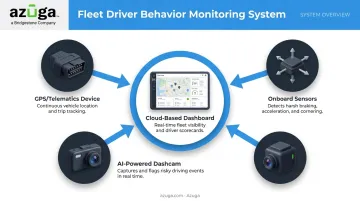
A typical setup includes
- GPS/telematics device: usually a plug-and-play OBD-II unit that taps into the vehicle's onboard computer for location, speed, and diagnostic data
- Onboard sensors: accelerometers and motion sensors that detect harsh braking, rapid acceleration, and hard cornering the instant they happen
- AI-powered dashcams (optional): dual-facing cameras that capture both the road ahead and the driver's cabin, adding video context to flagged events
- Cloud-based dashboard: the software layer where managers view scores, run reports, and set up alerts
Azuga's version of this hardware, the Azuga Tracker, plugs directly into a vehicle's OBD-II port and can be installed by the driver in minutes, with no technician visit required. Once it's in, it starts pulling data on everything from idle time to diagnostic trouble codes, not just speed and location.
How Does a Driver Behavior Monitoring System Work?
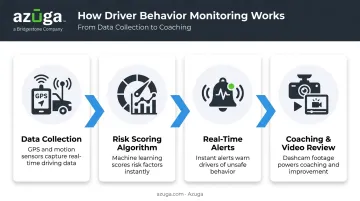
Once installed, the device continuously gathers speed, location, and motion data, feeding it to the cloud in near real time. The frequency of that data matters more than most fleet managers realize. A system that only checks in every few minutes will miss the exact moment a driver slammed the brakes; one that reports every 30 seconds catches it.
Azuga's CompleteFleet plan uses this kind of high-frequency tracking, giving managers a far more accurate picture of what's happening on the road than older, batch-upload systems ever could.
Data Analysis and Driver Scoring
Raw GPS and sensor data isn't useful on its own. Software algorithms convert it into a driver risk score based on the frequency and severity of unsafe events: how often a driver speeds, how hard they brake, and whether cornering behavior is a pattern or a one-off.
That score does two things
- Benchmarks drivers against each other, so managers can see who's consistently safe and who needs attention
- Flags drivers for coaching before a bad habit becomes an accident
At Air Engineers, for example, more than two or three harsh driving incidents in a single week triggers an automatic investigation. That's the score doing its job, turning a vague concern into a specific, actionable trigger.
Alerts, Coaching, and Video Evidence
When risky behavior happens, two things occur almost simultaneously. The driver gets an in-cab alert for hard braking, quick acceleration, or aggressive cornering, so they can self-correct immediately. The fleet manager gets a notification on their dashboard or app.
For fleets running AI dashcams, there's a third layer. The camera system's neural learning network analyzes driver-facing video to detect distraction events, like phone use, tagging the footage so managers understand why an event happened, not just that it did.
This footage serves two key functions
- Coaching: shows a driver exactly what happened, rather than relying on a number alone
- Collision reconstruction: determines fault after a crash and protects drivers from unwarranted liability claims
Types of Driver Monitoring Technology
Not all driver monitoring falls into the fleet telematics category. Three distinct types exist: GPS/telematics-based systems, camera-based OEM systems, and mobile app-based monitoring.
GPS/telematics-based systems, like Azuga's platform, are the standard for commercial fleets. An OBD-II device tracks location, speed, and driving events, sending everything to a cloud dashboard.
Camera-based OEM systems are built directly into vehicles by manufacturers to monitor driver alertness rather than fleet-wide behavior
| Manufacturer | System | Camera/Sensor Location |
|---|---|---|
| Toyota | Pre-crash driver monitoring | Steering column |
| Cadillac | Driver Attention Assist | Steering-wheel light bar |
| BMW | Highway Assistant | Instrument cluster |
| Ford | BlueCruise | Steering column or instrument panel (varies by model) |
Mobile app-based monitoring uses a smartphone's built-in GPS and accelerometer instead of hardware. It's a lightweight option, often favored by parents who want visibility into a teen driver's habits without installing anything in the car.
Key Benefits of Driver Behavior Monitoring for Fleets
The case for driver monitoring isn't theoretical. It shows up in accident rates, insurance premiums, and the day-to-day cost of running vehicles.
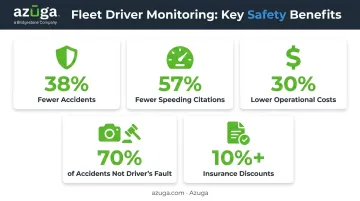
Reduced accidents. Catching speeding and harsh braking early prevents small habits from turning into collisions. Azuga customers have reported an average 38% decrease in accidents after adopting behavior monitoring.
Fewer traffic violations. Drivers who know they're being monitored, and coached based on that data, tend to slow down. Azuga fleets have seen speeding citations drop by 57%.
Lower operational costs. Better driving habits mean less wear on brakes and tires, and less fuel burned. The U.S. Department of Energy notes that real-time feedback and behavior monitoring can lower fuel use by 10% to 25%. Azuga customers report average annual savings of $9,462 and an overall operational cost reduction of 30%.
Stronger compliance and accountability. Monitoring reinforces both traffic law and internal safety policy, giving businesses a documented safety record if regulators or insurers come asking.
Driver exoneration. Azuga's SafetyCam AI with Collision Reconstruction has shown that roughly 70% of accidents involving monitored drivers weren't actually their fault, providing critical evidence for avoiding unfair claims and costly litigation.
Data-backed insurance negotiations. Diamond Engineering used its Azuga data to negotiate a 10%+ insurance premium discount by showing their carrier real driving behavior, not estimates. That's the shift monitoring enables: coaching conversations backed by data instead of hunches.
How to Choose the Right Driver Behavior Monitoring System
Not every telematics platform fits every fleet. A few factors separate the systems that get adopted from the ones that end up in a drawer.
- Ease of installation. Choose a self-installable OBD-II device you can plug in within minutes, since a technician visit adds downtime and cost before you see any benefit.
- Pricing and scalability. Fleet software pricing varies by features and fleet size, so confirm it scales cleanly from five vehicles to five hundred. Azuga matches packaging to fleet size and the features you select.
- Integrations and support. Confirm compatibility with your fuel card and existing software — Azuga's marketplace alone offers 75+ integrations like Fleetio and ServiceTitan, plus 24/7 support for breakdowns.
Frequently Asked Questions
What does a Driver Monitoring System do?
It tracks driver actions like speeding, braking, and location to improve road safety. In a fleet context, it also generates driver scores and enables data-backed coaching sessions.
How can fleet managers monitor driver behavior in real time?
Fleet managers use GPS telematics platforms like Azuga to track speed, harsh braking, and location with instant alerts. AI dashcams add video evidence for coaching and incident review.
What vehicles have a Driver Monitoring System?
Many modern vehicles from Toyota, Lexus, Cadillac, BMW, and Ford include built-in camera-based systems. Any vehicle, however, can be fitted with an aftermarket fleet telematics device.
Where is the Driver Monitoring System located?
OEM camera-based systems are usually mounted on the dashboard or steering column. Fleet telematics devices plug directly into the vehicle's OBD-II port, typically found under the dashboard.
How much does a driver behavior monitoring system cost for a fleet?
Azuga matches packaging to fleet size and the features you select for a comprehensive GPS and safety platform.
Can driver behavior monitoring help lower insurance premiums?
Yes. Documented safety improvements and reduced accident or violation rates give fleets real leverage when negotiating with insurers. Fleets using Azuga have seen accident rates drop by 38% on average, a track record that supports meaningful premium discounts.