
FMCSA regulations touch nearly every part of a fleet's operation: who's behind the wheel, what condition the vehicle is in, how many hours a driver has logged, and whether every document is where it should be. Rules change, deadlines slip, and one overlooked detail can cascade into an out-of-service order or a downgraded safety rating.
This guide breaks down the five core pillars of DOT compliance, what non-compliance actually costs, and how modern fleet technology — GPS tracking, dashcams, and automated alerts — takes much of the manual burden off your plate.
Key Takeaways
- DOT compliance rests on five pillars: driver qualification, maintenance, HOS, drug testing, and CSA scoring
- Violations carry real costs, from daily recordkeeping fines to six-figure repeat-offense penalties
- Centralized digital recordkeeping speeds audits and catches compliance gaps early
- Telematics and dashcams automate the monitoring and documentation FMCSA requires
What Is DOT Fleet Compliance and Why It Matters
DOT fleet compliance means meeting the safety, operational, and documentation standards that the Department of Transportation sets and the Federal Motor Carrier Safety Administration (FMCSA) enforces for any company running commercial motor vehicles. The two terms get used interchangeably, but they're not the same thing.
- DOT is the cabinet-level federal department.
- FMCSA is the agency within DOT that writes and enforces the specific rules covering trucks, buses, and their drivers.
Compliance isn't limited to long-haul trucking. Under 49 CFR 390.5, a vehicle qualifies as a commercial motor vehicle (CMV) if it meets any of these thresholds
| CMV Trigger | Threshold |
|---|---|
| Weight | 10,001 lbs or more (GVWR/GCWR) |
| Compensated passengers | More than 8, including driver |
| Non-compensated passengers | More than 15, including driver |
| Hazmat | Any amount requiring placarding |
That means plumbing vans, electrical service trucks, and landscaping crews often fall under FMCSA rules without realizing it.
The financial stakes are steep. Under the current federal penalty schedule, a motor carrier can face up to $19,246 per violation for non-recordkeeping issues under Parts 382, 385, or 390-399, and daily penalties for missing or falsified records add up fast.
Compliance also demands continuous attention rather than a single filing. Licenses expire, medical certificates lapse, and inspection windows close whether or not you're paying attention.
The 5 Core Pillars of DOT Fleet Compliance Requirements
When fleet managers ask "what are fleet requirements," FMCSA's answer breaks into five interconnected areas. Auditors and roadside inspectors evaluate all five, and weakness in one often signals weakness in the others.
Driver Qualification Files (DQF)
Every driver needs a complete file containing
- A valid CDL matched to the vehicle being operated
- A current medical certificate
- An annual Motor Vehicle Record (MVR) review, completed every 12 months
- Employment and safety history verification covering the prior three years
Incomplete DQFs, particularly missing documentation under Section 391.51, remain among the most commonly flagged issues during FMCSA compliance reviews.
Hours of Service (HOS) and ELD Compliance
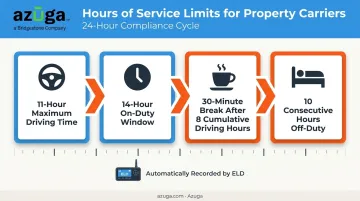
HOS rules exist to reduce fatigue-related crashes. For property carriers, the limits are
- 11 hours maximum driving time
- 14-hour on-duty window before driving must stop
- 10 consecutive hours off-duty before the next shift
- 30-minute break after 8 cumulative driving hours
FMCSA-registered Electronic Logging Devices (ELDs) must record duty status automatically. That data, along with supporting documents, needs to be retained for six months and produced on request during a roadside stop or audit.
Vehicle Maintenance and DVIRs
Drivers must complete a Driver Vehicle Inspection Report (DVIR) at the end of each day, flagging any safety-affecting defects. Carriers must repair those defects, or certify that repair wasn't necessary, before the vehicle goes back out. On top of daily DVIRs, every CMV needs a passing annual inspection, with the report kept on file for 14 months.
Unresolved defects are a direct path to an out-of-service order. CVSA's 2025 International Roadcheck found an 18.1% vehicle out-of-service rate, driven largely by brake system and tire violations. These are exactly the issues a thorough DVIR process is meant to catch before a vehicle leaves the yard.
Drug and Alcohol Testing / Clearinghouse
Carriers must conduct testing across six categories: pre-employment, random, post-accident, reasonable suspicion, return-to-duty, and follow-up. Every employer of CDL drivers also has to
- Run a full pre-employment Clearinghouse query for new hires
- Query every active driver at least once every 12 months
- Report violations, including refusals and confirmed positives, within three business days
As of early 2026, FMCSA Clearinghouse data showed over 200,000 CDL holders sitting in prohibited status. That's a reminder of how many drivers are one missed query away from being dispatched illegally.
CSA Score (Compliance, Safety, Accountability)
FMCSA scores carriers across seven BASIC categories: Unsafe Driving, Crash Indicator, HOS Compliance, Vehicle Maintenance, Controlled Substances/Alcohol, Driver Fitness, and Hazardous Materials Compliance. Crossing a threshold percentile doesn't automatically trigger a fine, but it does prioritize your fleet for roadside inspections and investigations, and insurers frequently use CSA data to set premiums.
Documentation, Recordkeeping and Audit Readiness Best Practices
Retention periods vary by record type, and getting them wrong is its own compliance risk
- HOS logs and ELD data: 6 months
- DVIRs and repair certifications: 3 months
- Complete DQF: duration of employment plus 3 years
- Annual MVR and medical evidence: 3 years
- Annual inspection reports: 14 months
Fleets relying on paper files or scattered spreadsheets often can't locate the right document fast enough when an auditor asks for it. To an FMCSA investigator, "we can't find it" reads the same as "it doesn't exist."
Centralize everything. Driver files, vehicle records, testing results, and incident reports belong in one searchable digital system. Platforms already storing your ELD and driver safety data, such as Azuga, can double as this central repository. When a compliance review request comes in, you need minutes, not days, to pull a complete file.
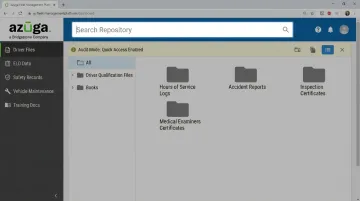
Schedule internal mock audits quarterly. Pick a handful of driver files and vehicles at random, and check them against the retention table above. This catches gaps, like an expired medical card or a missing annual MVR review, before an FMCSA investigator does.
Consequences of Non-Compliance: Fines, Penalties and Business Risk
The dollar amounts here are not theoretical. Under the current federal FMCSA civil penalty schedule:
| Violation Type | Maximum Penalty |
|---|---|
| Missing/incomplete record | $1,584 per day, up to $15,846 |
| Knowing falsification | $15,846 |
| Motor carrier non-recordkeeping violation | $19,246 per violation |
| Clearinghouse (Part 382 Subpart G) violation | $7,155 per violation |
| Operating after final Unsatisfactory rating | Up to $34,116 per day |
Fines are just the starting point. Non-compliance also brings:
- Vehicle downtime from out-of-service orders, which stalls deliveries and burns labor hours
- Higher insurance premiums, since carriers increasingly price policies against CSA data
- Loss of operating authority for carriers that accumulate an Unsatisfactory safety rating and fail to correct it
There's a reputational cost too. Enterprise shippers and government contracts often screen bidders' safety history before awarding work. A poor compliance record can close doors long before any fine hits your bank account.
How Fleet Technology Simplifies DOT Compliance
Manually tracking HOS, mileage, driver behavior, and inspection deadlines across a fleet of any real size is a losing battle. This is where telematics earns its keep.
GPS fleet tracking automates the data collection DOT compliance depends on: trip logs, mileage by state for IFTA reporting, and continuous driver behavior monitoring. No one has to remember to log it manually.
Azuga, for example, offers a plug-and-play OBD-II device that a driver can self-install in minutes, with no technician visit required. Once it's plugged in, it starts feeding location data, engine diagnostics, and driving behavior straight into a fleet dashboard at high-frequency, 30-second intervals. That's far tighter than the periodic pings older systems rely on.
On the safety side, Azuga SafetyCam AI with Collision Reconstruction captures road- and driver-facing footage and uses that data to reconstruct what happened during a collision. That documentation helps fleets
- Support driver coaching and retraining records with real footage, not just secondhand accounts
- Push back against inflated liability claims with objective evidence
- Reduce litigation exposure when fault is disputed
Prevention matters just as much as documentation after the fact. Real-time in-cab alerts for hard braking, speeding, rapid acceleration, and aggressive cornering give drivers a chance to self-correct before a bad habit becomes a violation. Since Unsafe Driving is one of the seven CSA BASICs, cutting down these events at the source translates directly into a better score, well beyond simply safer roads.
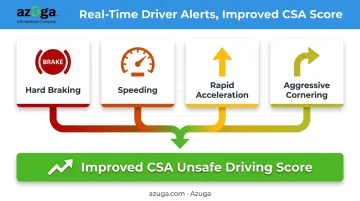
Automated alerts around maintenance schedules and diagnostic trouble codes also chip away at the administrative load described earlier, flagging issues before they turn into an unresolved DVIR defect sitting on a truck at roadside.
Frequently Asked Questions
What are fleet requirements?
Fleet requirements under FMCSA cover five areas: driver qualification files, vehicle maintenance and inspection, hours of service/ELD compliance, drug and alcohol testing, and CSA safety scoring. All five apply to any fleet operating CMVs.
What are the 5 pillars of fleet management?
General fleet management pillars (acquisition, maintenance, driver management, cost control, and compliance) are broader operational categories, distinct from the five DOT-specific compliance pillars covered in this guide, though compliance overlaps with several of them.
What is DOT compliance in trucking?
DOT compliance in trucking means meeting FMCSA's safety and operational standards for commercial vehicles and drivers, covering everything from driver files to vehicle inspections to hours-of-service logging.
What happens if my fleet fails a DOT audit?
A failed audit can result in civil penalties, a Conditional or Unsatisfactory safety rating, and a required corrective action plan. Repeated failures or an uncorrected Unsatisfactory rating can lead to loss of operating authority.
What is a CSA score and why does it matter?
CSA scores rank carriers across seven BASIC categories based on safety performance. Higher percentiles signal worse relative safety, which increases roadside inspection frequency and can raise insurance premiums.
How often should fleet compliance records be reviewed?
Check inspection reports and HOS logs daily or weekly. Run a full internal audit of driver files, testing records, and vehicle documentation at least quarterly to catch gaps before an official review.