
For fleet managers and small business owners in construction, HVAC, plumbing, and trucking, this shift solves a real headache. Most trades businesses only find out a driver is risky after a citation, a fender-bender, or a spike in insurance premiums. By then, the damage is done.
This article breaks down what a driving score actually is, how it's calculated, what counts as "good" in 2026, and how businesses use it to cut accidents and lower insurance costs before problems escalate.
Key Takeaways
- A driving score is a 0-100 rating based on speed, braking, acceleration, and phone use
- 80+ is "good" in 2026; 90-100 is Excellent, and below 70 signals high risk
- AI dashcams now detect distraction and phone use, not just harsh-driving events
- Score-based coaching quickly reduces harsh-driving events after rollout
- Scoring 92+ can lower insurance rates, boost safety bonuses, or reduce liability
What Is a Driving Score?
A driving score is a standardized numeric rating, typically on a 0-100 scale, generated from telematics data that reflects how safely someone operates a vehicle over time. It's not a one-time grade. Scores update continuously as new driving data flows in.
The technology behind it is straightforward. OBD-II devices plug into a vehicle's diagnostic port and pull engine and speed data. GPS tracks location and speed in real time. Accelerometers measure g-force, catching hard stops, sharp turns, and aggressive acceleration the moment they happen. Together, these sensors generate the raw events that feed a scoring algorithm.
Personal Score vs. Fleet Driver Score
Not every driving score serves the same purpose. There are two distinct types
- Personal/insurance driving score: used for usage-based insurance pricing and car-sharing rate adjustments, tied to an individual policyholder
- Fleet driver safety score: used by employers to coach commercial drivers, manage liability, and negotiate group insurance rates
Four groups rely on these scores in 2026
- Insurers price risk more precisely using behavior data instead of static demographics
- Employers and fleets use scores to coach drivers and reduce liability exposure
- Rental companies protect vehicles by flagging risky renters
- Gig-economy platforms increasingly screen drivers using similar scoring logic
Why 2026 Scoring Looks Different
Older scoring models leaned almost entirely on accelerometer data. In 2026, scores increasingly blend motion-sensor inputs with AI dash camera footage, catching phone use and distraction that accelerometers simply can't detect.
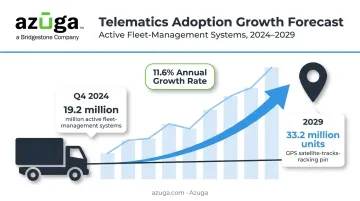
This shift tracks with how fast telematics adoption has grown. North American commercial fleets had roughly 19.2 million active fleet-management systems deployed as of Q4 2024, and Berg Insight forecasts that number will reach 33.2 million by 2029, an 11.6% annual growth rate. Driving scores are no longer a niche fleet tool. They're becoming standard operating procedure.
How Are Driving Scores Calculated?
Every scoring algorithm tracks a similar set of core behaviors
- Speeding — how far over posted limits and how often
- Harsh braking and harsh acceleration — sudden g-force spikes
- Harsh cornering — sharp lateral movement
- Idling — excessive engine time without movement
- Seatbelt use — compliance detected via sensor or video
- Phone use and distraction — increasingly caught by AI dashcams
Each metric maps to a specific sensor. Accelerometers capture g-force for braking and cornering events. GPS handles speed and location. AI-enabled dashcams, like Azuga's SafetyCam, add the layer older systems missed entirely: distraction detection through driver-facing video analysis.
Not all events count equally. A harsh-braking event at 65 mph deducts more points than a minor stop at 25 mph. Weighting reflects severity, and many platforms allow that weighting to be adjusted by industry or role.
Most platforms use one of two scoring mechanics
- Deduction-based — start at 100 points and subtract based on flagged events
- Banded — categorize a rolling score into risk tiers (for example, 0-40, 41-80, 81-100)
Update frequency matters more than most people assume. Systems using near real-time GPS pings produce more responsive scores than platforms running daily or weekly batch updates. Azuga's platform, for instance, tracks at 30-second intervals, giving fleet managers a much tighter feedback loop than legacy systems checking in once a day.
Keep in mind: because every provider uses a proprietary algorithm, a score from an insurer's app isn't directly comparable to a score from fleet management software. An 85 on one platform doesn't automatically equal an 85 on another.
What Is a Good Driving Score in 2026?
| Score Range | Rating | What It Means |
|---|---|---|
| 90-100 | Excellent | Minimal harsh-driving events; eligible for top-tier discounts and recognition |
| 80-89 | Good | Solid performance; occasional coaching may help |
| 70-79 | Moderate Risk | Warrants closer monitoring and targeted coaching |
| Below 70 | High Risk | Requires immediate intervention and review |
So, what is a good driving score? 80 or higher on a 0-100 scale is the widely accepted benchmark across insurers and fleet platforms in 2026.
What does a 92 driving score mean, specifically? It sits solidly in the Excellent band. That indicates very few harsh-driving events and often qualifies a driver for insurance discounts, safety bonuses, or public recognition within a fleet.
"Good" isn't fixed, though. Context changes what's achievable:
- School transportation fleets often set a 90+ floor, given the stakes involved
- Highway-heavy trucking fleets may accept 75+, since long-haul routes naturally generate more speed-related events even with careful drivers
- Most other commercial fleets target the 80+ benchmark as their standard baseline
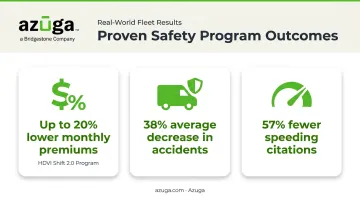
Insurance impact backs this up. HDVI's Shift 2.0 program lets trucking fleets reduce premiums monthly by improving safety scores, with savings of up to 20%. Azuga fleets see similar payoffs: customers using its driver safety platform report accident reductions of 38% on average and 57% fewer speeding citations, turning safety-score gains directly into lower claims costs.
The broader trend in 2026: insurers and fleet customers are increasingly standardizing around 80+ as a pass/fail threshold for program eligibility and preferred-vendor status, even without a single universal industry standard behind it.
Why Driving Scores Matter for Your Business
The cost impact is direct. Businesses using Azuga's platform have reported measurable safety gains after adopting score-based coaching
- 38% decrease in accidents on average
- 57% reduction in speeding citations
Fewer incidents mean fewer claims, lower premiums, and less vehicle wear over time.
Liability is where scores prove their real value, though. A score alone tells you something went wrong, but video evidence tells you who was actually at fault.
Most fleet drivers involved in collisions aren't the ones who caused them — Azuga reports that 70% of accidents aren't the fault of the fleet driver. Pairing a driving score with SafetyCam AI and Collision Reconstruction gives fleet managers the footage and event data needed to prove that in a claims dispute, potentially preventing costly litigation.
There's a trust dimension too. Drivers who feel unfairly blamed for incidents tend to disengage or quit. Transparent scoring changes that dynamic
- Drivers see the same data managers see, removing the "black box" feeling
- Consistent criteria reduce disputes over penalties
- Recognition programs built on scores reward good behavior instead of only punishing bad behavior
That transparency reduces turnover tied to perceived unfair treatment, which matters in industries already struggling to retain qualified drivers.
How to Improve a Driving Score
Individual habits move the needle fastest
- Maintain safe following distance to avoid last-second hard braking
- Ease into stops instead of braking abruptly
- Obey posted speed limits, even on familiar routes
- Minimize after-hours or personal-use trips in company vehicles
- Avoid phone use while driving, now a top-flagged event by AI dashcams
Fleet managers accelerate results by making performance visible and consistent
- Publish scores through a driver app or leaderboard so drivers know exactly where they stand
- Run weekly coaching sessions targeted at bottom-quartile drivers rather than the whole fleet
- Gamify performance with rewards, team competitions, or a monthly recognition program
Coaching structure only works if feedback arrives fast. Real-time feedback beats delayed reporting. Azuga's high-frequency 30-second interval tracking, paired with in-app alerts, lets drivers self-correct in the moment instead of learning about a mistake in a report three weeks later.
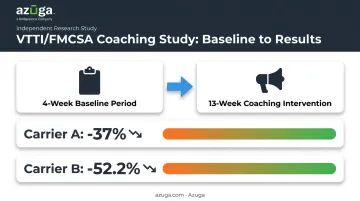
The evidence for coaching programs is strong. A VTTI study funded by FMCSA tracked commercial drivers through a 4-week baseline period followed by a 13-week coaching intervention. Recorded harsh-driving events dropped 37% at one carrier and 52.2% at another once feedback and coaching were introduced. These are measurable results from a controlled, FMCSA-funded study.
Frequently Asked Questions
What is a good driving score?
Most insurers and fleet platforms consider 80+ on a 0-100 scale to be good, with 90+ rated excellent. Exact thresholds vary slightly depending on the provider and fleet type.
What does a 92 driving score mean?
A 92 falls in the Excellent band. It reflects very few harsh-driving events and often qualifies a driver for insurance discounts or safety recognition programs.
How is a driving score calculated?
Scores draw on telematics data covering speeding, harsh braking, acceleration, cornering, idling, and increasingly AI-detected distraction. The system weighs these events by severity and rolls them into a single number.
Can a driving score affect my insurance rates?
Yes. Insurers use driving scores for usage-based insurance pricing, and higher scores typically unlock lower premiums at renewal, particularly in commercial trucking products.
How can I improve my driving score quickly?
Focus on consistent speed control, smooth braking, and avoiding phone distraction. Reviewing real-time feedback from a driver app helps you self-correct faster than waiting for a weekly report.
What's the difference between a personal driving score and a fleet driver score?
Insurers typically use personal scores for individual policy pricing, while employers use fleet driver scores internally for coaching, compliance, and liability management.