
For individual drivers, the risks are personal: reduced visibility, fatigue, and impaired drivers on the road all working against you at once. For businesses running vehicles after dark, such as trucking fleets, HVAC crews, and towing companies, the stakes multiply fast. A single nighttime crash can mean a totaled vehicle, a liability claim, and days of lost productivity.
This guide covers why night driving carries so much extra risk, the habits that actually reduce it, hazards most drivers overlook, and how fleet-based businesses can extend safety practices across every driver on the road after dark.
Key Takeaways
- Nighttime driving carries 3x the fatality rate per mile versus daytime driving
- Reduced visibility, fatigue, and impaired drivers make darkness the riskiest driving window
- Cleaning headlights, slowing down, and taking fatigue breaks cut risk immediately
- Fleet businesses use GPS tracking and AI dashcams to coach night-shift drivers at scale
Why Is Night Driving More Dangerous?
Human eyes simply aren't built for driving 60 mph in the dark. Depth perception, color recognition, and peripheral vision all decline once the sun sets, and older drivers lose contrast sensitivity even faster than younger ones. Headlights help, but they can't fully replace daylight.
The Visibility and Stopping-Distance Gap
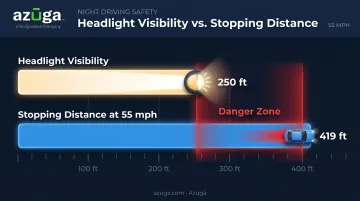
Low-beam headlights typically illuminate about 250 feet of road ahead, per the Florida CDL Handbook. That sounds like plenty, until you consider that a vehicle traveling 55 mph needs at least 419 feet to come to a complete stop under ideal conditions.
That's a real gap between what you can see and what you need to safely react. Drive faster than your headlights allow you to see, and you're "overdriving your headlights," a mistake that leaves zero margin for a deer, a stalled car, or a pedestrian.
Fatigue and the Body Clock
Humans are biologically wired to feel drowsy overnight. NHTSA has long identified midnight to 6 a.m. as a peak window for drowsy-driving crashes. AAA's more recent modeling points to 11 p.m. to 2:59 a.m. as the period with the highest number of fatal drowsy crashes.
It's more common than most drivers admit. In an AAA Foundation survey, 41% of drivers said they'd fallen asleep or nodded off behind the wheel at least once, and 11% had done so in the past year alone.
Impaired and Erratic Drivers
Even sober, well-rested drivers face risk from everyone else on the road. Among drivers in fatal 2022 crashes, NHTSA data shows that 30% were alcohol-impaired at night, compared to just 10% during the day. That same analysis found weekend nights carry even higher impairment rates than weekdays.
Defensive driving becomes non-negotiable after dark, regardless of your own sobriety or alertness. You're sharing the road with a much higher share of drivers who shouldn't be on it.
Essential Tips for Safe Night Driving
Safe night driving comes down to three things working together: a vehicle that's ready for low light, driving habits adjusted for reduced visibility, and honest fatigue management.
Get Your Vehicle Ready
Dirty or misaligned headlights scatter light instead of focusing it, which worsens glare for you and oncoming drivers. Before any night drive
- Clean headlight lenses and windshield (inside and out), since grime reduces light output
- Check headlight alignment if your beams seem dim or uneven
- Dim dashboard and infotainment screen brightness to reduce eye strain when shifting focus between the cabin and dark road
- Replace wiper blades that streak, since streaks scatter oncoming headlights across your windshield
Adjust How You Drive
Small technique changes make an outsized difference at night.
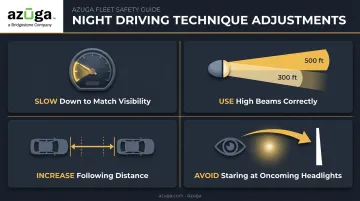
- Slow down to match your visibility: if you can't stop within the distance your headlights show you, you're going too fast
- Use high beams on open, unlit roads, but dim them within 500 feet of oncoming traffic and 300 feet when following another vehicle
- Increase following distance beyond your usual daytime gap to compensate for slower reaction times
- Avoid staring at oncoming headlights, glancing toward the right edge line instead to keep your night vision intact
Manage Fatigue Proactively
No amount of coffee replaces sleep. Before a long night drive, aim for 7+ hours of sleep, and take a break every two hours on extended trips. If you feel yourself yawning repeatedly or drifting in your lane, pull over immediately. Pushing through drowsiness is how microsleeps turn into crashes. Fleets can add another layer of protection with tools like Azuga's SafetyCam AI dashcams, which flag drowsy-driving cues in real time so managers can step in before fatigue turns into an incident.
Hazards Unique to Nighttime Driving
Some risks only show up after dark, and they catch even experienced drivers off guard.
Wildlife collisions spike heavily during dusk and dawn, especially in the fall. Deer-strike claim frequency in November typically runs more than twice the annual average, according to IIHS/HLDI data. If an animal darts into your path, brake firmly and stay in your lane — swerving often causes worse crashes than the strike itself.
Beyond animal strikes, rural two-lane highways carry an equally serious risk. Oncoming glare, no center lighting, and unpredictable shoulders make these roads disproportionately dangerous at night. Choose a better-lit route when one's available, even if it adds a few minutes.
Route choice won't prevent every risk; mechanical trouble can still strand you after dark.
If you break down at night:
- Pull completely off the roadway, clear of traffic
- Turn on hazard lights and set out flares or reflective triangles if you have them
- Stay inside the vehicle with your seatbelt on unless it's unsafe to do so
- Stand well away from the road if you must exit
Common Night Driving Mistakes to Avoid
Even cautious drivers fall into these habits without realizing the risk they're adding.
- Skipping headlight and windshield cleaning: assuming visibility is "good enough" lets small grime buildup turn into a real blind spot.
- Ignoring early fatigue signs — yawning and lane drifting are warnings that AI dashcams can catch early, not inconveniences to push through.
- Flashing high beams back at oncoming glare: retaliating blinds both drivers and raises everyone's risk instead of solving anything.
How Fleet Businesses Can Reduce Night Driving Risk
Individual awareness only goes so far when you've got a dozen, fifty, or five hundred drivers on the road after dark. Construction crews, HVAC technicians, tow operators, and utility fleets all need visibility into driver behavior at scale, not just a policy memo about "drive safe."
GPS tracking closes the visibility gap. Azuga's high-frequency tracking updates vehicle locations every 30 seconds under its CompleteFleet plan, giving dispatchers a near-real-time view of routes, speed, and idle time during overnight shifts. That granularity matters when a speeding event or an unplanned stop needs attention immediately, not an hour later.
AI dashcams add a layer that standard tracking can't match. Azuga SafetyCam AI uses a dual-facing HD camera and a neural learning network to flag distraction events during risky driving incidents, then tags the likely cause so managers can coach against it.
When an incident happens, this technology delivers
- Collision Reconstruction footage that gives fleets objective evidence to review
- Documentation proving 70% of accidents are not the fault of the fleet driver, per Azuga's data
- Evidence that helps fleets avoid costly litigation disputes
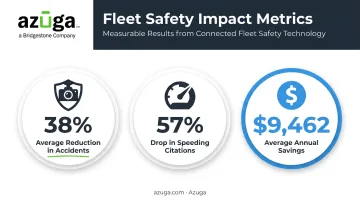
Beyond dashcam footage, driver scoring turns data into coaching, not just monitoring. Businesses using Azuga's behavior tracking and coaching tools report measurable results
- 38% average reduction in accidents
- 57% drop in speeding citations
- Roughly $9,462 in average annual savings from combined route and maintenance efficiencies
For night-shift operations, that combination of tracking, video evidence, and coaching addresses the exact risk factors this article covers: reduced visibility, fatigue-driven mistakes, and unpredictable drivers sharing the road.
Conclusion
Night driving safety comes down to compensating for what you can't see, managing fatigue honestly, and staying alert to everyone else's mistakes. None of these habits are complicated. What matters is treating them as routine for every night drive, not just the long ones.
For fleet operators, that same discipline scales across an entire team with Azuga's GPS tracking, AI dashcams, and driver coaching tools, turning individual good habits into a measurable, company-wide safety standard.
Frequently Asked Questions
Is it statistically safer to drive at night?
No. Night driving is statistically more dangerous per mile driven, even though far less traffic is on the road. NHTSA data shows the nighttime fatality rate runs roughly three times the daytime rate.
What is the biggest hazard in night driving?
Reduced visibility combined with driver fatigue is the leading contributor. Headlights only show 250-500 feet ahead, often less than the distance needed to stop, while fatigue slows reaction time further.
What are 5 tips for driving at night?
- Clean your headlights and windshield for maximum visibility
- Reduce speed to match how far your headlights reach
- Avoid staring directly at oncoming headlights
- Dim your dashboard and interior lights
- Manage fatigue with breaks and adequate sleep beforehand
How can I stop feeling drowsy while driving at night?
Caffeine and fresh air can offer short-term relief, but they don't fix real drowsiness. The only reliable fix is pulling over and resting or switching drivers if possible.
Are high beams safe to use on all roads at night?
High beams work well on open, low-traffic roads with no oncoming vehicles. Dim them within 500 feet of oncoming traffic and 300 feet when following another vehicle to avoid blinding other drivers.
How can fleet businesses reduce night-driving risk across multiple drivers?
GPS tracking, AI dashcams, and driver behavior scoring give real-time visibility beyond a written policy alone. Azuga's SafetyCam AI and 30-second tracking make night-shift safety practical to monitor and improve at scale.