
Here's the tension nobody's fully solved: most drivers and business owners don't know what data their vehicle collects, who can see it, or whether tracking their own vehicle is even legal in their state. Some of this confusion is fueled by social media claims about 2027 "kill switches" that aren't accurate.
This guide breaks down the real technology in use today, the privacy risks it creates, how to spot unwanted tracking, and how businesses can run transparent monitoring programs instead of covert surveillance.
Key Takeaways
- Vehicle surveillance ranges from covert GPS stalkerware to proposed federal monitoring rules.
- Major risks include undisclosed data sharing with insurers and unclear data ownership rules.
- Employers must follow state-specific notice and consent laws before tracking vehicles.
- Physical inspections, tracker-detection apps, and account audits identify unauthorized devices.
- Transparent platforms like Azuga prioritize accountability over covert monitoring.
What Is Vehicle Surveillance? Understanding the Technology
Vehicle surveillance covers any technology that monitors a vehicle's location, a driver's behavior, or a vehicle's physical condition. That definition stretches from a $30 stalkerware tracker hidden under a bumper to enterprise fleet telematics platforms managing thousands of trucks.
GPS tracking devices come in two main flavors: plug-in units that connect through the OBD-II port, and hardwired trackers wired directly into a vehicle's electrical system. Businesses use these for fleet management, while individuals (sometimes without consent) use the same hardware for personal tracking.
Dashcams and driver-facing cameras have also evolved. Many now use AI to detect distraction or fatigue in real time. But adoption of direct driver-monitoring systems, meaning cameras that actually watch the driver's eyes and head position, remains limited.
Consumer Reports tested 17 active-driving-assistance systems in 2023 and found only two, Ford BlueCruise and GM Super Cruise, met its criteria for adequate direct monitoring. That's a system-review count, not a claim about how many new cars on the road have this feature.
The Federal Push: HALT Act and the 2027 Myth
The Infrastructure Investment and Jobs Act directed NHTSA to develop a passive impaired-driving prevention standard. NHTSA published an Advance Notice of Proposed Rulemaking in January 2024, not a final rule. As of mid-2026, the agency's own rulemaking docket still lists the effort in the prerule stage, with comment analysis marked as an estimated action for later that year.
There's no finalized 2027 mandate, and no NHTSA document uses the phrase "kill switch." The rulemaking discusses possible responses like an ignition interlock or reduced-speed mode, but nothing has been selected. Treat 2027 headlines with caution until NHTSA issues an actual proposed rule.
Other surveillance forms drivers rarely think about include
- License plate readers (ALPR): fixed or vehicle-mounted cameras that log plates, time, and location without needing anything installed in your car
- Manufacturer-collected telematics: data your car sends to the automaker, often bundled into connected-services agreements
- Insurer-linked apps: voluntary programs that trade driving data for pricing discounts
Fleet Surveillance vs. Personal Vehicle Surveillance
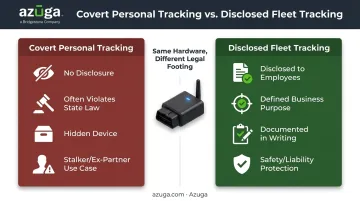
Consent draws the legal line, not the hardware. Covert personal tracking, like a stalker or estranged partner planting a GPS unit, involves no disclosure and often violates state law. Business fleet tracking, when done correctly, is disclosed to employees, tied to a defined business purpose such as safety or liability protection, and documented in writing. Same technology, completely different legal footing.
Privacy Risks Associated With Vehicle Surveillance
Connected vehicles generate enormous amounts of data. Where that data goes is the real privacy problem.
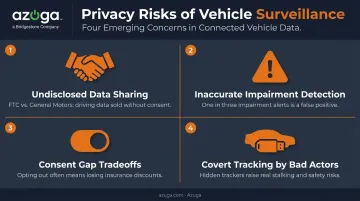
Data Sharing You Didn't Agree To
The FTC's case against GM and OnStar is the clearest example on record. Regulators alleged the companies used a misleading enrollment process and shared precise geolocation and driving behavior, including speeding and hard-braking events, with consumer-reporting agencies without informed consent. The FTC finalized its order in January 2026, which now bans GM from disclosing this data to reporting agencies for five years and imposes consent requirements lasting two decades.
When Vehicle Data Gets It Wrong
Beyond who sees your data, there's a separate problem: whether the data itself can be trusted. Impairment-detection technology sounds reassuring until you consider the math. NHTSA itself has acknowledged that even a system running at 99.9% accuracy could still generate millions to tens of millions of incorrect interventions against sober drivers each year. The agency has also cited research where drowsy drivers were flagged as alcohol-impaired despite having no alcohol in their system. That's not a rounding error. It's a system that could stop or limit a vehicle based on a false read.
The same blind spot shows up in court. Vehicle-generated data increasingly appears in DUI cases and crash litigation, and event data recorders can reveal speed, braking, and steering inputs before a collision. But data tells you what happened, not why. Courts have already pushed back on how this evidence gets collected: one Florida appeals case suppressed EDR data pulled without a warrant, citing a driver's reasonable expectation of privacy.
The Consent Gap: What You Actually Lose by Opting Out
These accuracy concerns might make opting out sound appealing, but it comes with its own tradeoffs. Declining data sharing can disable certain paid features
- Usage-based insurance discounts tied to continuous telematics
- Sensor-dependent crash notification in some manufacturer apps
- Stolen-vehicle recovery services that depend on live location data
That said, don't assume opting out cancels everything. Ordinary roadside assistance and UBI enrollment are usually separate terms, so check your specific policy rather than assuming a blanket trade-off.
Covert Tracking by Bad Actors
Separate from all of the above is unauthorized tracking planted by stalkers, disgruntled ex-partners, or corporate competitors. This isn't a gray area. Several states, Texas among them, make it a criminal offense to install a tracking device on someone else's vehicle without consent.
How to Tell If Your Vehicle Is Being Watched or Tracked
Suspecting a hidden tracker feels unsettling. Here's how to check systematically.
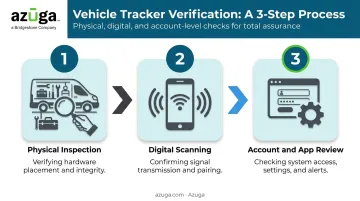
Physical inspection comes first
- Check the OBD-II port (usually under the dashboard) for unfamiliar plugged-in devices
- Look under the vehicle chassis for small magnetic boxes, often near wheel wells or the trunk area
- Inspect wiring near the dashboard, glove box, or under seats for anything that doesn't match factory wiring
- Examine the trunk liner, spare tire well, and rear bumper area, common hiding spots for battery-powered trackers
Digital scanning adds another layer
- RF detectors can pick up transmitting signals, though they won't catch dormant or store-and-forward devices
- Android's Unknown Tracker Alerts (Settings > Safety & emergency) scan for supported Bluetooth trackers
- iPhone users can review Settings > Privacy & Security > Location Services to see which apps have access
Neither method alone is foolproof. A clean RF scan doesn't guarantee your car is clear if the device isn't actively transmitting.
Account and app review matters just as much as hardware checks. Go through your infotainment system's linked accounts, active subscriptions, and data-sharing permissions. It's common to find a previous owner's account, a dealership demo profile, or a data-sharing toggle you never actively enabled.
How to Monitor Your Car While Parked (The Legitimate Use Case)
Not all vehicle monitoring is a privacy threat. Watching your own parked car is a legitimate, useful application of the same underlying technology
- Dashcam parking mode: records automatically when motion or impact is detected near the vehicle
- Smartphone-based GPS trackers: send alerts if the car moves without authorization
- Fleet telematics apps, like Azuga's platform: notify managers of unexpected movement, ignition events, or geofence breaches, even for a single parked vehicle
This is the flip side of every concern above. Same hardware, but disclosed, intentional, and controlled by the vehicle's owner.
Is Vehicle Tracking Legal? Compliance for Business Fleets
Tracking a company-owned vehicle is legal in most U.S. states. But "most" isn't "all," and the details vary enough that a one-size-fits-all policy will fail somewhere.
Consider four states side by side
| State | Requirement | Scope Note |
|---|---|---|
| New Jersey | Written notice required before using a tracking device in an employee vehicle | Notice-based, not consent-based |
| California | Advance notice required, but only for alternative digital plate devices under AB 984 | Not a blanket GPS-tracker rule |
| Texas | No employee-notice requirement for employer-owned vehicles; unauthorized tracking of others' vehicles is a criminal offense | Ownership matters |
| Connecticut | Prior written notice required for electronic monitoring, generally tied to premises-based monitoring | Doesn't explicitly name off-site GPS fleet tracking |
Given that patchwork, here's what a defensible fleet tracking program actually needs
- A written GPS tracking policy stating what's collected, why, and how long it's retained
- Signed employee acknowledgment forms, even in states without a strict legal requirement
- Clear tracking-hours definitions that address personal or off-duty vehicle use directly, rather than leaving it ambiguous
- A documented review process for who can access tracking data and under what circumstances
Covert, undisclosed tracking might feel simpler to implement, but it carries real liability exposure and erodes driver trust the moment it's discovered. Transparent programs do the opposite.
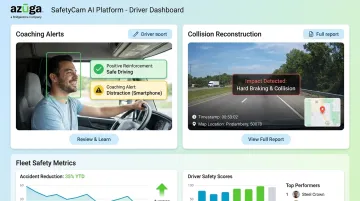
Azuga's approach reflects this distinction. Its plug-and-play OBD-II GPS devices are installed with driver awareness built in, not hidden. The SafetyCam AI platform, paired with Collision Reconstruction, uses driver-facing video to coach behavior and, when accidents happen, to help exonerate drivers who weren't at fault.
According to Azuga's customer data, fleets using this approach see accidents drop by an average of 38%, and Collision Reconstruction footage shows that 70% of recorded accidents weren't the fleet driver's fault. Those results come from transparent monitoring, not concealment.
Protection Strategies for Drivers and Businesses
Whether you're an individual driver or running a fleet, the fixes are practical and straightforward.
For individual drivers:
- Review data-sharing settings through your manufacturer's app or owner portal, most allow granular control over what's shared
- Consider opting out of usage-based insurance programs if continuous telematics tracking makes you uncomfortable, but confirm which specific features it affects first
- Ask your manufacturer how long location and driving data is stored, and whether it's shared with insurers or third parties
For fleet businesses:
- Put your monitoring policy in writing and explain the why: safety, cost control, liability protection
- Choose providers offering encrypted storage and limited third-party data sharing, and ask vendors directly about their security certifications
- Set customer-controlled sharing so insurers only see fleet data when you choose to send it, such as when negotiating a premium discount
For everyone: run periodic audits. Check every device, app, and subscription active on personal and company vehicles at least twice a year. Confirm only authorized systems are running, and remove anything you don't recognize.
Frequently Asked Questions
How do you tell if your car is bugged or tracked?
Check the OBD-II port and undercarriage for unfamiliar devices, then use an RF detector or tracker-detection app to scan for transmitting signals. Neither method alone is guaranteed, so combine physical inspection with digital scanning.
How can I monitor my car while parked?
Dashcam parking mode, smartphone GPS trackers, and commercial fleet telematics platforms like Azuga all offer legitimate ways to watch a parked vehicle. Each sends alerts for unexpected movement, impact, or ignition events.
How to spot a surveillance car?
Most "surveillance" concerns actually involve a tracking device on your own vehicle, not an external surveillance car. Genuine mobile ALPR units use visible external camera arrays; repeated sightings of the same vehicle are usually coincidence, not active surveillance.
Is it legal for an employer to track a company vehicle without telling the driver?
Legality varies by state. Several states, including New Jersey, require written notice before tracking employee vehicles, while others have no explicit requirement. Disclosed tracking policies, like the driver notification features built into fleet platforms such as Azuga, reduce legal risk regardless of the applicable state law.
Will all new cars have mandatory surveillance technology by 2027?
No. NHTSA has not finalized a rule as of its latest rulemaking agenda, and no "kill switch" mandate currently exists despite viral social media claims. The rulemaking remains in the prerule, comment-review stage.
Can insurance companies access data from my car's tracking system?
Some automakers have shared telematics data with insurers or consumer-reporting agencies, sometimes without clear consumer consent, as seen in the FTC's case against GM and OnStar. Check your vehicle's privacy settings and opt-out options directly with your manufacturer.