
For fleet-owning businesses, this shift raises real questions. Which connectivity actually matters for safety and compliance? What's marketing fluff versus something that saves money?
This article breaks down how connected vehicles work, the different types of connectivity, and what it all means when you're running trucks, vans, or service vehicles for a living.
Key Takeaways
- Sensors, telematics hardware, and cellular/cloud links let vehicles share real-time data on the road
- V2V, V2I, and full V2X connectivity extend awareness beyond the vehicle to infrastructure and traffic
- Safer driving, lower fuel and maintenance costs, and predictive breakdown alerts are the core payoffs
- Fleet GPS telematics cut accidents, citations, and litigation exposure with driver and vehicle data
What Is a Connected Vehicle?
A connected vehicle is any vehicle equipped with technology that lets it communicate with other vehicles, road infrastructure, or the internet. The U.S. Department of Transportation frames this around vehicle-to-everything (V2X) communication used for safety and traffic efficiency (USDOT, 2020).
"Connected car" vs. "connected vehicle": the terms get used interchangeably, but they mean different things
- Connected car: Consumer-facing term for passenger vehicles with entertainment, navigation, and safety features
- Connected vehicle: Broader term for commercial trucks, vans, and fleet equipment with built-in or retrofitted communication technology
Examples include OnStar-equipped GM vehicles, Tesla's built-in connectivity, and commercial vehicles with aftermarket OBD-II trackers. That last category matters most for fleets.
You don't need new trucks to get connected. A plug-in device does the job. Azuga's OBD-II tracker works in any vehicle built after 1996, when the OBD port became standard.
How Does a Connected Vehicle Work?
Connected vehicles run on three layers working together: sensors that collect data, a telematics unit that processes it, and a connectivity path that moves it to the cloud.
Sensors Collect the Data
Onboard sensors — GPS, accelerometers, cameras — continuously capture speed, location, braking patterns, and driver behavior. This is the raw material everything else depends on.
Telematics Processes and Transmits It
The telematics unit acts as the vehicle's hub. It processes sensor data and enables two-way communication using
- Cellular networks — the primary method for most fleet telematics
- Wi-Fi — used for some data syncing and updates
- Bluetooth — connects nearby devices like phones or asset beacons
Most commercial fleet platforms rely on this same mix of 4G/LTE, Wi-Fi, and Bluetooth Low Energy to keep vehicles online in the field.
Three Connectivity Models
- Embedded — built into the vehicle at the factory (Tesla, OnStar)
- Tethered — relies on a connected smartphone for data transmission
- Hotspot-based — vehicle acts as its own Wi-Fi access point
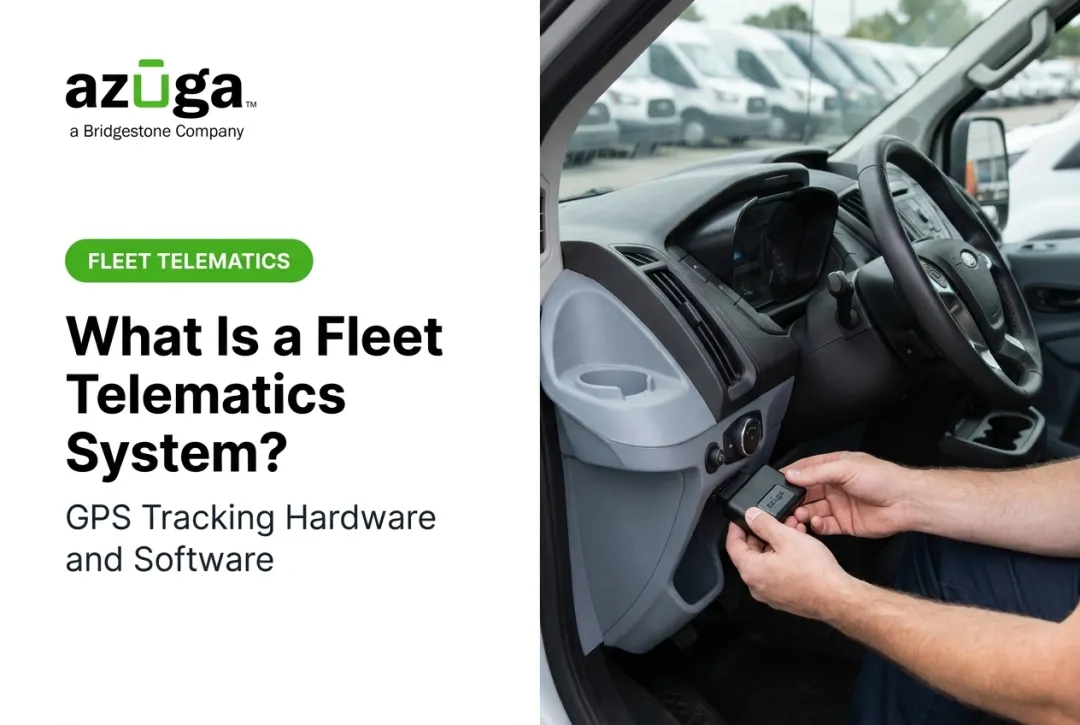
For fleets, the practical answer is usually none of the above — it's plug-and-play retrofit. An OBD-II device installs in the diagnostic port in under 20 seconds, with no hardwiring or shop visit required.
That is how older trucks, vans, and equipment become connected without buying new vehicles. Azuga's device automatically recognizes the vehicle's protocol and wakes or sleeps with the ignition, so there is no manual toggling.

Types of Connected Vehicle Systems and Communication
USDOT groups vehicle communication into a few core categories (USDOT, 2019)
| Type | What It Does |
|---|---|
| V2V | Vehicles share speed, location, and hazard data directly with each other |
| V2I | Vehicles communicate with traffic signals, toll booths, road infrastructure |
| V2P | Vehicles detect and alert for pedestrians nearby |
| V2C | Vehicle data flows to cloud platforms for storage and analysis |
| V2X | The umbrella term combining all the above |

Regulators are actively investing here. USDOT awarded $60 million in cooperative agreements in Fall 2024 to deploy V2X projects across Arizona, Texas, and Utah (USDOT ITS, 2024).
Consumer and commercial uses pull the same stack in different directions
- Passenger cars: entertainment, navigation, and convenience
- Fleet telematics: compliance, safety scoring, and accountability
Different priorities, same underlying technology.
Examples of Connected Vehicle Services and Applications
Connected vehicle tech shows up in everyday features and specialized fleet tools alike
- Advanced navigation with real-time traffic rerouting
- Remote diagnostics flagging maintenance issues before breakdowns
- Usage-based insurance tied to actual driving behavior
- Automatic crash notification for emergency response
- Geofencing that triggers alerts when vehicles enter or leave job sites
- Route optimization for planning efficient stops
- Dashcam-based collision reconstruction using AI-tagged video evidence
Kitsap Garage Door Company switched to Azuga's OBD-II-connected platform for exactly this mix of features. Beyond location tracking, they gained visibility into fuel usage, hard braking, and idling, plus reliable customer ETAs and payroll validation through GPS time-card data.
President John Ramer cited strong ROI, with benefits showing up almost immediately.
Benefits of Connected Car and Vehicle Systems
Safety Gains Are Measurable
Telematics-based coaching programs produce real results. An FMCSA field study found sleeper-cab drivers saw a 55% reduction in less-severe unsafe driving events and a 60% reduction in more severe events after telematics monitoring paired with driver feedback (FMCSA, 2014).
Azuga customers report similar outcomes:
- 38% average decrease in accidents
- 57% reduction in speeding citations
- Harbro cut yearly accidents from 18–20 to 4 after adopting telematics in 2017

Cost Savings Add Up
Connected systems cut everyday fleet spend in three places
- Optimized routes lower fuel burn and idle time
- Predictive maintenance catches problems before they turn into major repairs
- Azuga customers report $9,462 in average annual savings
Compliance Gets Easier
For regulated fleets — trucking especially — connected vehicle data directly supports FMCSA requirements: electronic logging, Hours of Service tracking, and DVIR reporting. Construction fleets lean on the same data for driver accountability.
Exoneration Protects Fleets From Litigation
Safety and compliance data also protect fleets when a claim lands. Collision reconstruction footage can prove fault, or innocence, quickly.
NHTSA data shows that 70% of commercial-vehicle accidents involving a passenger car were not the fault of the commercial driver. Azuga's SafetyCam AI with Collision Reconstruction uses dual-facing dashcam video and AI-tagged distraction events to build that evidence, so fleets can avoid costly litigation and settle claims faster.

Real-Time Visibility for Distributed Teams
Fleet managers overseeing drivers across multiple job sites get live location and behavior data instead of waiting on end-of-day reports. That visibility helps dispatchers reassign work, respond to delays, and coach risky driving while the shift is still underway.
Challenges and the Future of Connected Vehicle Technology
Connected vehicle technology still has real constraints to clear as more fleets depend on always-on data.
Security and privacy sit at the top of that list. NHTSA recommends accountable leadership, lifecycle risk assessments, and documented incident-response plans as more vehicle data moves through cloud systems (NHTSA, 2022). On the privacy side, the FTC has flagged unexpected secondary uses of car data as an ongoing issue since its 2018 connected-cars workshop.
Connectivity reliability is another practical limit. Rural and low-network areas can create gaps in fleet tracking data. Integration partnerships help close some of those gaps. Azuga's VOYOLink connection, for example, shares diagnostic codes and maintenance alerts with a network of over 36,000 repair shops, keeping fleets tied to service resources even off the beaten path.
The next wave is already taking shape
- Three nationwide 5G networks now cover 332 million people in the U.S. (CTIA)
- V2X links support adaptive traffic systems and nearer-term autonomous driving
- Fleet platforms keep adding repair-shop and TMS integrations that hold up in the field
Construction, HVAC, utilities, and trucking businesses are adopting connected platforms because the returns are measurable. Fewer accidents, tighter maintenance control, and real-time visibility make the investment practical.
Frequently Asked Questions
How does a connected car work?
Onboard sensors capture speed, location, and driver behavior data. A telematics unit processes this data and transmits it over cellular networks, Wi-Fi, or Bluetooth to the cloud for analysis and reporting.
What cars are connected vehicles?
Most new vehicles from major automakers ship with embedded connectivity as standard. Older vehicles can be retrofitted using aftermarket OBD-II devices, which work in vehicles built after 1996.
What is a connected vehicle device?
A connected vehicle device is typically a telematics or OBD-II unit that plugs into the diagnostic port, adding GPS tracking, diagnostics, and data transmission without factory-installed hardware.
What are the different types of connected car systems?
The main categories are V2V (vehicle-to-vehicle), V2I (vehicle-to-infrastructure), V2P (vehicle-to-pedestrian), and V2C (vehicle-to-cloud). V2X is the umbrella term covering all of them.
What are examples of connected services?
Examples include real-time navigation, remote diagnostics, usage-based insurance, automatic crash notifications, and fleet-specific tools like geofencing and route optimization.
What are the benefits of connected car systems?
Key benefits include improved safety through real-time hazard alerts, lower fuel and maintenance costs, and better compliance tracking. For fleets, added benefits include collision exoneration and real-time driver visibility.