
Many companies still rely on manual logs, radio check-ins, or a phone call to figure out where a truck or a generator is. That approach breaks down fast once a fleet grows past a handful of vehicles.
IoT asset tracking gets described in technical terms — sensors, GPS, RFID, cellular networks. But the real value shows up in simpler ways: fewer lost tools, faster dispatch, lower fuel bills. This article breaks down what IoT asset tracking actually is and the measurable benefits it delivers.
Key Takeaways
- IoT asset tracking connects equipment and vehicles to a platform using GPS, cellular, RFID, or Bluetooth
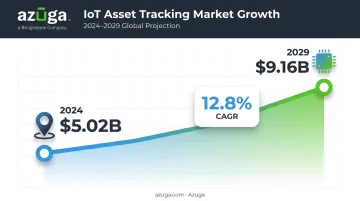
- IoT asset tracking market is projected to grow from $5.02 billion in 2024 to $9.16 billion by 2029
- Businesses use it to gain real-time visibility, deter theft, and cut fuel, labor, and maintenance costs
- Benefits compound only when tracking data gets reviewed and acted on, not just collected and ignored
What Is IoT Asset Tracking?
IoT asset tracking uses connected sensors or tags attached to physical assets. These devices transmit real-time location and condition data to a central software platform, where managers can see it on a dashboard or app.
It shows up across many industries
- Fleet vehicles in trucking, HVAC, plumbing, and electrical services
- Construction equipment like excavators, generators, and skid steers
- Tools and small equipment on job sites
- Containers and trailers moving between locations
- Utility and waste management assets spread across service territories
IoT asset tracking goes beyond simply pinpointing an asset's location. It helps managers make faster decisions: who to dispatch, whether equipment is being misused, when a machine needs maintenance, and where money is leaking out of daily operations.
MarketsandMarkets values the global IoT-based asset tracking and monitoring market at $5.02 billion in 2024, projecting growth to $9.16 billion by 2029, a 12.8% CAGR that reflects how many businesses are moving past manual tracking methods.
Key Advantages of IoT Asset Tracking
These advantages tie directly to metrics businesses already track: fuel cost, utilization rates, theft losses, and response time. Here's how each one plays out operationally.
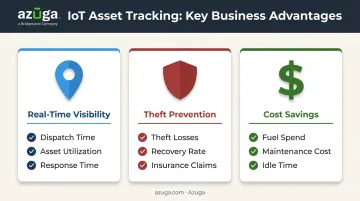
Real-Time Visibility and Operational Control
This means continuous, live insight into where every vehicle or asset sits and what condition it's in. GPS and cellular-enabled trackers transmit location at set intervals. Azuga's devices, for example, ping every 30 seconds, the highest frequency available on its platform. That removes the need for phone calls or manual check-ins to find a truck or crew in the field.
Why this matters:
Real-time data eliminates guesswork in dispatch and scheduling. Instead of guessing which technician is closest to an emergency call, a dispatcher sees exact positions and routes the nearest available vehicle immediately.
A 2024 industry survey found that 62% of fleet professionals rated GPS tracking extremely or very beneficial for daily operational efficiency, and 46% reported achieving their routing-optimization goals. Respondents in that same survey reported average cost reductions of 16% each for fuel, labor, and maintenance.
KPIs impacted:
- Dispatch time
- Asset utilization rate
- Average response time
- Fuel cost per job
This advantage delivers the biggest payoff for businesses with dispersed field teams and time-sensitive calls: think HVAC, plumbing, and electrical dispatch, where a 20-minute delay can mean a missed service window or an unhappy customer.
Theft Prevention, Asset Recovery, and Risk Reduction
This advantage centers on detecting unauthorized asset movement before losses escalate. Geofencing draws a virtual boundary around a job site, yard, or facility. When an asset crosses that boundary, or moves outside business hours, the system fires an instant alert.
Why this matters:
Faster detection shrinks the window between loss and discovery, which directly improves recovery odds. CargoNet recorded 3,594 cargo-theft events across the U.S. and Canada in 2025, estimating $725 million in total losses. The average reported event value climbed 36% year-over-year to nearly $274,000.
Azuga customer All-Lift reported complete elimination of unauthorized vehicle use after adopting ignition on/off monitoring. Employees stopped taking company vehicles off-hours once they knew activity was being tracked.
Triton Air took a similar approach, setting up after-hours geofence alerts around each technician's home address to flag unexpected movement without requiring anyone to actively watch the platform.
KPIs impacted:
- Theft-related losses
- Asset recovery rate
- Insurance claim frequency
This matters most for high-value mobile equipment left unattended overnight or parked on unmanned job sites, exactly the conditions where theft is easiest and detection is slowest without connected monitoring.
Cost Savings and Operational Efficiency
This advantage comes from turning tracking data into fewer wasted dollars on fuel, maintenance, and labor. Route optimization cuts unnecessary mileage. Idle-time monitoring flags trucks burning fuel while parked. Usage-based maintenance scheduling catches problems before they become expensive breakdowns.
Why this matters:
Small per-asset savings add up fast across a full fleet. Azuga's benchmark data shows customers reducing operational costs by up to 30% and saving an average of $9,462 annually through better fleet cost management, a real-world illustration of how these small efficiencies compound.
That connects directly to more accurate budgeting. When you know actual fuel spend, maintenance cost per asset, and idle time by vehicle, total cost of ownership stops being a guess and becomes a number you can plan around.
KPIs impacted:
- Fuel spend
- Maintenance cost per asset
- Idle time
- Total cost of ownership
The impact is greatest for larger fleets or asset-heavy operations, such as trucking, waste management, and utilities, where margins are thin and even a few percentage points of savings translate into real budget headroom.
What Happens When IoT Asset Tracking Is Missing or Ignored
Skip connected tracking, and the consequences show up gradually, then all at once. Here's what typically happens
- Inconsistent records: manual logs and phone-based check-ins produce gaps and errors that compound over time
- Higher error rates in billing, maintenance scheduling, and inventory counts
- Reactive firefighting, where breakdowns, theft, and missing tools get discovered only after they've already disrupted a job or a schedule
- Rising costs from fuel waste, avoidable repairs, and equipment that's never recovered after going missing
- Scaling problems — as fleet size grows, it becomes nearly impossible to delegate oversight without real data behind it
None of these issues announce themselves loudly at first. A missing tool here, a fuel bill that's slightly higher than expected there. The problem is they stack, and by the time the pattern is obvious, the cost has already been paid.
How to Get the Most Value from IoT Asset Tracking
Tracking devices only pay off when businesses use them consistently and act on what the data shows. A few practices separate the companies that see real ROI from those that don't:
- Apply it across the full asset base: tracking only your highest-value trucks while ignoring smaller equipment leaves blind spots exactly where theft and misuse tend to happen
- Review data regularly: check dashboards on a set schedule to catch trends like rising idle time or after-hours movement before they become expensive
- Act on the insights: adjust routes, retire chronically underperforming assets, or update maintenance schedules based on what the data actually shows
- Choose easy-to-deploy hardware: hardwired, battery-powered, and Bluetooth beacon asset trackers remove the installation barrier that stalls adoption and gets fleets generating usable data in minutes instead of days
Treating asset tracking as a one-time setup caps its value. Building it into weekly operations is what delivers the full ROI.
Conclusion
The real value of IoT asset tracking comes from the control and clarity it brings to daily operations, not the technology itself. Fewer lost tools. Faster dispatch decisions. Lower fuel bills that match your budget projections.
Visibility, security, and cost savings all compound over time, but only when someone actually reviews the data and adjusts operations accordingly. Treat IoT asset tracking as an ongoing operational practice, not a one-time purchase, and the returns keep growing the longer you use it.
Frequently Asked Questions
What is asset tracking in IoT?
IoT asset tracking uses connected sensors and tags to monitor the real-time location and condition of physical assets through a software platform. It covers vehicles, equipment, tools, and containers.
What technologies are used in IoT asset tracking?
Common connectivity options include GPS, cellular, RFID, Bluetooth, and LPWAN (Low-Power Wide-Area Network). Businesses choose based on range needs and use case — cellular for wide-area vehicle tracking, Bluetooth for smaller job-site tools.
How is IoT asset tracking different from GPS fleet tracking?
GPS fleet tracking is a subset of IoT asset tracking focused specifically on vehicles. Broader asset tracking can also cover tools, trailers, containers, and equipment that don't produce vehicle engine data.
Which industries benefit most from IoT asset tracking?
Field-service and fleet-heavy industries see the strongest results: construction, HVAC, plumbing, electrical, trucking, and utilities. These sectors run dispersed teams where visibility directly affects response time and cost.
How much does IoT asset tracking cost?
Azuga matches packaging to fleet size and selected features, with higher tiers adding capabilities like 30-second location updates and dashcam integration.
Is IoT asset tracking data secure?
Reputable platforms transmit encrypted data over secured internet connections and apply access controls to limit who can view location and usage information. Ask any vendor for their specific security documentation before committing.