
Introduction
Picture this: your dispatcher builds what looks like a tight, efficient route. Then a driver gets stuck at a rail crossing, misses a customer's two-hour delivery window, and racks up 40 minutes of unplanned overtime. Multiply that across a fleet, and "efficient" starts to feel like a joke. Poor routing decisions like these can inflate fleet operating costs by up to 30%.
Fleet route optimization is the process of using data and algorithms to sequence stops and assign vehicles in the most cost-efficient way possible, given real-world constraints. It matters for any business running multiple vehicles, whether you're pouring concrete, fixing HVAC units, or hauling freight.
Here's the problem: most fleet managers use "route optimization" as a catch-all term for GPS navigation. It's not the same thing. This guide breaks down how true optimization works, where it's used, and when a simpler tool will do the job just fine.
Key Takeaways
- Route optimization balances time windows, vehicle capacity, and driver hours, not just the shortest path
- It cuts fuel costs, vehicle wear, and overtime while improving on-time performance
- Real-time GPS and telematics data are the foundation optimization software runs on
- Advanced optimization isn't for every fleet; knowing when to skip it matters too
What Is Fleet Route Optimization?
Fleet route optimization sequences stops and assigns vehicles or drivers to minimize total operational cost, meaning fuel, labor, and time, while still meeting delivery or service requirements.
The goal isn't the mathematically shortest route. It's the most efficient feasible route given everything working against you: traffic, time windows, driver hours, and vehicle capacity.
How It Differs From GPS Navigation
Standard GPS navigation solves one problem: point A to point B for a single vehicle. Fleet route optimization solves a much bigger puzzle. It handles multiple vehicles, multiple stops, and competing constraints all at once.
Route Planning vs. Route Optimization
These terms get used interchangeably, but they're not the same. Route planning selects the order in which stops happen, while route optimization is the algorithm underneath that makes that sequence cost-efficient. One answers what order stops occur in; the other answers why that order is the cheapest option.
Here's why software is non-negotiable at scale: even a fleet with 10 vehicles and 20 stops generates a staggering number of possible route combinations. Researchers at MIT note that these solution sets grow too large to search exhaustively, which is why practical routing systems rely on heuristic algorithms that find "good-enough" solutions rather than a guaranteed perfect one. No dispatcher, however experienced, can out-calculate that by hand.
Why Fleet Route Optimization Matters for Modern Fleets
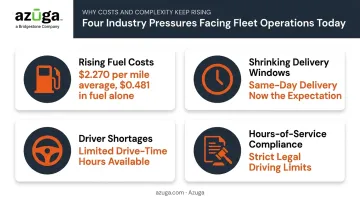
Several pressures are pushing fleets toward optimization software, and none of them are going away.
- Fuel costs remain a top-line expense, with per-mile operating costs reaching $2.270 per mile in 2023 according to the American Transportation Research Institute, including $0.481 per mile in fuel alone.
- Delivery and service windows keep shrinking, driven by customer expectations set by same-day delivery norms.
- Driver shortages mean every hour of drive time needs to count.
- Hours-of-service compliance adds hard legal limits to how routes can be built.
Small mileage reductions compound fast at that scale, and the gaps show up quickly without optimization software.
What Goes Wrong Without It
Fleets running on manual dispatch or basic navigation tend to see
- Wasted mileage from poorly sequenced stops
- Missed appointment windows and frustrated customers
- Driver overtime that erodes margins
- Rushed, unsafe driving from drivers trying to catch up
Visibility Comes First
You can't optimize what you can't measure. Real-time vehicle location and driver behavior data are the raw material optimization engines depend on.
This is where GPS fleet tracking earns its place. Azuga's tracking platform updates vehicle location at 30-second intervals, feeding live data directly into routing and dispatch decisions.
On average, Azuga customers report a 30% reduction in operational costs, a 38% drop in accidents, and a 57% reduction in speeding citations. These numbers show what happens when tracking and routing work together.
This isn't limited to delivery fleets, either. HVAC, plumbing, electrical, and landscaping businesses increasingly treat route optimization as standard practice, since technician utilization directly drives revenue in service fleets.
How Fleet Route Optimization Works
At a high level, the process ingests stop data, constraints, and live conditions, runs it through an optimization engine, and outputs a sequenced route plan ready for dispatch.
Inputs typically include:
- Stop locations and time windows
- Vehicle capacity and equipment limits
- Driver shift limits and hours-of-service rules
- Service durations at each stop
- Skill or certification requirements
The engine itself doesn't brute-force every possibility. It runs heuristic algorithms that test and refine thousands of combinations in seconds to land on a near-optimal, feasible plan. Dispatchers still stay in control, locking in priority stops or adjusting constraints as needed.
The system re-optimizes whenever new information (a traffic jam, a cancellation, a new order) comes in.
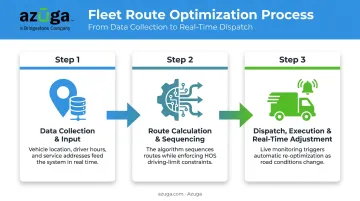
Step 1: Data Collection and Input
This step gathers real-time vehicle location, driver hours, service addresses, and operational constraints. Plug-and-play GPS devices, like Azuga's OBD-II tracker, make this setup simple. The device plugs into a vehicle's OBD port and transmits data within roughly 20 seconds, no wiring or technician visit required.
Step 2: Route Calculation and Sequencing
The optimization engine processes every input and constraint at once. It factors in rules like the 11-hour driving limit and 14-hour duty window that FMCSA sets for property-carrying drivers to generate the most cost-efficient, feasible sequence per vehicle.
Step 3: Dispatch, Execution, and Real-Time Adjustment
The system pushes routes to drivers' devices. The system then monitors execution, flags delays to dispatchers, and re-optimizes automatically when conditions shift mid-day.
Where Fleet Route Optimization Is Applied & What Affects Its Results
Route optimization shows up across a wide range of operations
- Delivery and distribution fleets
- Service fleets and trade businesses (HVAC, electrical, plumbing)
- Waste management and collection routes
- Utility and telecom service calls
- Trucking and logistics networks
Across these operations, common triggers for re-running optimization include daily dispatch planning, a new order coming in mid-shift, a last-minute cancellation, or seasonal spikes in volume.
Once triggered, results vary widely based on a handful of factors
- Quality of address and stop data (garbage in, garbage out applies here)
- Real-time conditions like traffic, weather, and road closures
- Vehicle capacity, mixed fleet types, and equipment constraints
- Fleet scale, since a setup that works for 10 vehicles may not hold up at 500
- Driver compliance factors, including mandatory breaks and hours-of-service limits
Common Misconceptions & When Optimization May Not Be the Right Fit
Misconception: Optimization always finds the shortest route.** It finds the shortest feasible route. Time windows, driver hours, and capacity limits often make the absolute shortest path impossible to run.
Misconception: "AI-powered" routing guarantees a perfect answer.** Software uses approximation methods, not a guaranteed mathematical optimum. It's built to find a very good answer fast, not to prove it's the best possible one.
Route thrash is a real risk: re-optimizing too frequently can backfire, causing drivers to lose trust in plans that keep shifting under them. Stability matters almost as much as raw efficiency.
When full optimization software may not be necessary:
- Very small fleets running fixed, simple daily routes
- Operations where basic GPS tracking plus manual planning still covers current stop volume
- Businesses where drivers rely on established local knowledge for routine, low-variability stops
That said, most businesses outgrow manual planning faster than they expect. As stop counts and service windows grow, the math gets complicated quickly, and that's exactly when automated optimization starts paying for itself.
Frequently Asked Questions
What is fleet route optimization?
It's the process of using data and algorithms to sequence stops and assign vehicles or drivers in the most cost-efficient way possible. The process accounts for real-world constraints like time windows and vehicle capacity.
What is the difference between route planning and route optimization?
Route planning selects the stop sequence. Route optimization is the algorithmic process that makes that sequence as efficient as possible given constraints like traffic and driver hours.
Can small fleets benefit from route optimization software?
Yes. Even small fleets can see fuel savings, reduced overtime, and tighter scheduling. Platforms like Azuga are built to scale affordably from a handful of vehicles up to enterprise fleets.
How does route optimization improve fleet safety?
Optimized routes reduce driver fatigue and rushed driving. Paired with GPS tracking and safety tools, this combination has helped Azuga customers cut accidents by an average of 38% and speeding citations by 57%.
What data is needed to optimize fleet routes effectively?
You need vehicle GPS location, stop addresses and time windows, driver hours, vehicle capacity, and ideally historical traffic or service-time data.
How often should fleet routes be re-optimized?
It depends on your operation. Stable daily routes might only need weekly re-planning, while on-demand or high-volume fleets often need continuous, event-driven re-optimization.