
Introduction
It's 6 a.m., and one of your trucks won't start. The driver is stranded 40 miles from the job site. The customer is calling about a missed window, and your technician just got pulled off a scheduled job to handle an emergency tow.
This scenario plays out daily across fleets that rely on reactive repairs or rigid, calendar-based servicing.
Both approaches waste money. Reactive maintenance means you're always one breakdown away from a scheduling disaster. Preventive maintenance, while more organized, often replaces parts that still have useful life left, just because the calendar says so.
This guide breaks down what automotive predictive maintenance is, how it works under the hood, what it costs, and how it stacks up against the maintenance strategies you're probably using right now.
Key Takeaways
- Predictive maintenance uses sensors, telematics, and AI to catch failures before they happen
- It differs sharply from preventive (fixed schedules) and reactive (fix-after-failure) maintenance
- Fleets cut unscheduled downtime by 25% using predictive tools, according to vendor data
- Plug-and-play platforms like Azuga make this technology accessible to fleets of any size
What Is Automotive Predictive Maintenance?
Predictive maintenance is a data-driven strategy that uses sensors, telematics, and analytics to forecast when a specific vehicle component is likely to fail. It replaces guesswork with evidence.
Compare that to the two older models
- Reactive maintenance waits until something breaks, then fixes it
- Preventive maintenance services parts on a fixed schedule, whether or not they need it
Predictive maintenance sits in the middle, using actual condition data instead of a calendar or a breakdown to decide when work is needed.
Think of it like a doctor monitoring a patient's vital signs. Instead of waiting for symptoms to appear or scheduling checkups at arbitrary intervals, the doctor watches heart rate, blood pressure, and other indicators continuously, catching problems while they're still manageable.
Vehicles work the same way once you add the right sensors. Engine temperature, vibration, and battery voltage all tell a story long before a part fails on the highway.
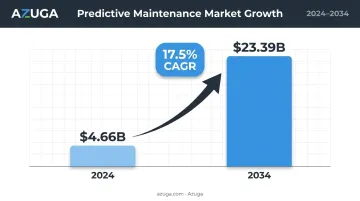
This isn't a niche technology anymore. The broader market for predictive maintenance across vehicles, including passenger and commercial applications, was valued at $4.66 billion in 2024 and is projected to reach $23.39 billion by 2034, growing at a 17.5% CAGR according to Global Market Insights. That kind of growth reflects sustained demand across the commercial fleet industry.
Why It Matters for Fleet-Based Businesses
For construction crews, HVAC contractors, trucking companies, and utility fleets, uptime isn't a nice-to-have. A single breakdown can push back a job site timeline, blow a service-level agreement, or leave a customer waiting on a repair that never shows up.
Predictive maintenance used to be something only large enterprises with dedicated fleet engineering teams could afford. That's changed.
- Plug-and-play OBD-II devices now cost a fraction of what custom telematics setups used to run
- Cloud-based platforms bundle sensor data, alerts, and reporting into a single monthly subscription
- Small fleets can access the same diagnostic capabilities that used to require a full IT department
A ten-vehicle HVAC company can now run the same predictive alerts as a 500-truck logistics operation, just at a smaller scale.
How Does Predictive Maintenance Work?
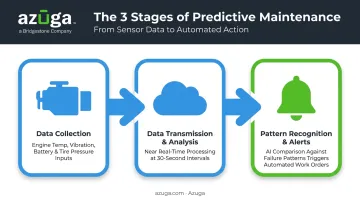
Predictive maintenance runs on three connected processes: collecting data, analyzing it, and acting on what it reveals.
Step 1: Data Collection via Sensors and Telematics
Sensors throughout the vehicle continuously capture
- Engine temperature
- Vibration patterns
- Battery health
- Tire pressure
- Braking performance
This isn't a one-time inspection. It's constant monitoring, every time the vehicle runs.
Getting this data flowing used to require a shop visit and hours of installation labor. Azuga's OBD-II device changes that math. Fleet operators can plug it into the vehicle's OBD port themselves in about 20 seconds, no mechanic, no appointment, no downtime. The device starts transmitting data immediately.
That matters when you're deploying across dozens or hundreds of vehicles. Self-installation means you're not waiting weeks for a rollout schedule.
Step 2: Data Transmission and Analysis
Once collected, sensor data flows to cloud or edge computing systems for near real-time processing. The frequency of that data transmission directly affects how accurate your predictions can be.
Higher-frequency tracking gives fleet managers more granular visibility into how a vehicle is actually performing between service intervals. Azuga's CompleteFleet plan, for example, tracks location and vehicle data at 30-second intervals, compared to the 1-minute cadence on lower tiers.
More frequent snapshots mean fewer blind spots between the moment a problem starts and the moment it's caught.
Step 3: Pattern Recognition and Alerts
This is where machine learning earns its keep. AI models compare live sensor data against historical failure patterns, looking for anomalies that suggest a part is drifting toward failure, not just running normally.
When the system spots something, it doesn't just log it. Fleet managers get an automated alert, often with a recommended repair and a suggested timeframe, before the vehicle is anywhere near the side of the road.
Azuga's platform delivers this through Diagnostic Trouble Code alerts and Check Engine Light notifications, which can be routed directly into a work order for the mechanic. Pest control fleets using this alert-driven approach have reported a 50% reduction in vehicle breakdowns, a meaningful shift from reactive firefighting to planned maintenance.
Predictive vs. Preventive vs. Reactive Maintenance
Each maintenance strategy answers a different question. Reactive asks, "what broke?" Preventive asks, "when is it due?" Predictive asks, "what does the data say it needs?"
- Reactive maintenance repairs vehicles after something fails. It requires no upfront investment in monitoring tools, but it comes with unplanned downtime and unpredictable repair bills, often at the worst possible moment.
- Preventive maintenance services components on a fixed schedule, based on mileage, engine hours, or elapsed time. It's more predictable than reactive repair but can lead to replacing parts that still had plenty of life left.
- Predictive maintenance uses live condition data, gathered through connected telematics devices like Azuga's OBD-II sensors, to determine actual need. It aims to convert unexpected failures into scheduled repairs while getting more usable life out of each component.
| Strategy | Cost Profile | Downtime | Component Life |
|---|---|---|---|
| Reactive | Unpredictable, often includes emergency labor rates | High, unplanned | Parts run until failure, sometimes causing secondary damage |
| Preventive | Predictable, but may include unnecessary part replacement | Planned, but frequent | Parts often replaced before end of useful life |
| Predictive | Higher setup cost, lower long-term repair spend | Minimal, scheduled around actual need | Parts used closer to their full service life |
No single strategy fits every vehicle. Many fleets run a hybrid approach: predictive monitoring on high-value assets, preventive schedules on lower-risk equipment.
Benefits of Predictive Maintenance for Fleets
The case for predictive maintenance comes down to five measurable outcomes.
Reduced downtime. Vendor data from Pitstop, reported by Fleet Maintenance, shows fleets using predictive tools average 25% less unscheduled downtime compared to reactive approaches.
Lower maintenance costs. That same Pitstop data points to roughly $2,000 less in maintenance and operating expense per asset annually.
Azuga customers running proactive alert-based maintenance have reported a 43% reduction in vehicle breakdowns, with home service fleets saving an average of $320 per month in maintenance costs across a ten-vehicle operation.
Improved fleet safety. Predictive alerts on brake wear and tire condition catch problems before they become road hazards. Azuga customers have seen accidents drop by 38% on average and speeding citations fall by 57%.
When incidents do happen, Azuga's SafetyCam AI Collision Reconstruction feature helps exonerate drivers, since data shows roughly 70% of accidents are not the fault of the fleet driver involved.
Extended vehicle and component lifespan. Catching a failing water pump or worn brake pad early prevents the cascading damage that happens when a small issue becomes a catastrophic one. That protects the resale value of every asset in your fleet.
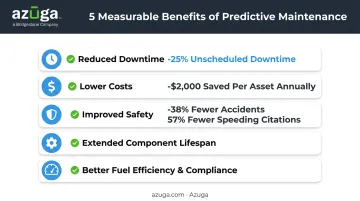
Better fuel efficiency and compliance. Monitoring tire pressure, alignment, and engine performance keeps vehicles running closer to factory efficiency, which also reduces the odds of a roadside inspection turning into a violation.
Common Challenges and How to Overcome Them
Predictive maintenance isn't without friction. Here's what trips fleets up, and how to work around it.
High upfront investment. Sensors, software, and integration work can feel expensive before you've proven the payoff.
Start small: run a focused pilot on your highest-value vehicles or your worst-performing components, then use that data to justify a wider rollout. Azuga's modular plan structure, from BasicFleet up to CompleteFleet, lets fleets add predictive capabilities incrementally instead of committing to a full deployment on day one.
Data quality and system integration. This is now the top barrier fleets report. Concerns about data integration jumped from 38.1% to 71.0% of surveyed fleets year over year, according to a Fleet Advantage survey on AI adoption.
Choose a telematics platform with strong API support and established data validation, so predictions rely on clean, reliable inputs rather than noisy or duplicate readings.
Training gaps for drivers and technicians. New alert systems mean nothing if your team doesn't know how to act on them. Structured onboarding matters here. Vendor support, like Azuga's 24/7 customer service, makes the transition smoother for teams that have never worked with predictive alerts before.
Frequently Asked Questions
What is the difference between preventive and predictive maintenance?
Preventive maintenance follows a fixed schedule based on mileage or time, regardless of actual part condition. Predictive maintenance uses real-time sensor data to determine when a component genuinely needs attention.
Why is predictive maintenance important for fleets?
It catches mechanical problems before they cause roadside breakdowns, cutting unplanned downtime and repair costs. It also helps fleets spend maintenance budgets on what vehicles actually need, not what a calendar assumes.
How much does it cost to implement predictive maintenance?
Costs vary based on fleet size and the depth of features you need. Plug-and-play telematics devices and subscription-based software have lowered the barrier to entry compared to custom enterprise systems.
Can small business fleets benefit from predictive maintenance?
Yes. Cloud-based, scalable packaging models mean a five-truck HVAC company can access the same diagnostic tools as a 500-vehicle logistics operation, without the enterprise price tag.
What kind of data do predictive maintenance systems use?
Systems rely on engine temperature, vibration patterns, battery health, tire pressure, and braking performance, all captured continuously through onboard sensors and telematics devices.
How quickly can fleets see ROI from predictive maintenance?
Industry telematics surveys show many fleets achieve positive ROI within a year. Actual results depend on fleet size, baseline breakdown rates, and how quickly the data pipeline is integrated.