
Most conversations about AI in waste management stay abstract — robots, algorithms, "the future of recycling." The real story is less glamorous and more useful: contamination rates dropping, fuel budgets shrinking, and fewer workers getting hurt on the sorting line.
This guide breaks down where AI actually delivers results, what it costs to adopt, where it falls short, and how waste businesses of any size can start using it without gambling their operating budget.
TL;DR
- AI improves waste operations through three core applications: computer vision sorting, predictive routing, and smart bin sensors
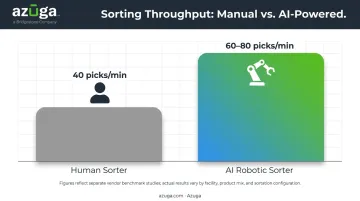
- Sorting robots reportedly hit 60-80 picks per minute versus 40 for human sorters, based on vendor benchmarks
- Benefits include lower contamination, less labor strain, and fuel savings — though hardware costs and data quality remain real hurdles
- Fleet-level GPS tracking is the often-overlooked layer that makes AI routing insights genuinely usable day-to-day
What Is AI in Waste Management?
AI in waste management means using machine learning, computer vision, robotics, and predictive analytics to automate and improve how waste gets collected, sorted, and processed.
You'll typically find it applied in three places
- Materials recovery facilities (MRFs): robotic arms and optical sensors sort recyclables by material type
- Municipal and commercial collection: smart bins and route-planning software replace fixed pickup schedules
- Waste-to-energy and composting operations: predictive analytics help forecast volumes and optimize processing
AI won't fix the broader waste crisis by itself, but it can produce cleaner recycling streams, lower operating costs, and safer working conditions when the underlying data is solid.
Key Advantages of AI in Waste Management
These advantages aren't theoretical. They're tracked by waste businesses in four categories: cost, throughput, safety, and material recovery. Each one below is backed by facility data or vendor-reported case results, not marketing copy.
Advantage 1: Automated Sorting and Contamination Reduction
AI-powered sorting robots use computer vision, hyperspectral imaging, and sensors to identify and separate recyclable materials by type, often faster and more consistently than a human crew.
Manual sorting is slow, error-prone, and increasingly hard to staff. Robotic systems address all three problems at once by handling the repetitive identification work while people focus on quality control and exception handling.
The throughput gap is significant. Manufacturer benchmarks reported by Waste Dive put newer recycling robots at 60-80 picks per minute, while EverestLabs' comparison of human versus robotic sorting places typical human sorter output at around 40 picks per minute.
These come from separate vendor benchmarks rather than a head-to-head trial, but the directional gap is hard to ignore.
Higher sorting accuracy means more clean, sellable recyclables recovered instead of landfilled. That translates to fewer rejected loads, higher revenue per ton, and lower tipping fees.
KPIs impacted:
- Contamination rate
- Material recovery rate
- Sorting throughput (items/hour)
- Revenue per ton processed
This matters most for high-volume MRFs dealing with mixed waste streams and chronic labor shortages, where a few percentage points of recovery improvement translate into real revenue.
Advantage 2: Predictive Analytics and AI-Powered Route Optimization
Instead of running fixed, calendar-based collection routes, AI analyzes bin fill levels, traffic patterns, and weather data to plan routes dynamically. Trucks go where the waste actually is, not where the schedule says it should be.
This shift from reactive to needs-based collection cuts unnecessary pickups, fuel burn, and vehicle wear. A peer-reviewed 2020 routing model found that variable routing based on real-time bin data produced 17.60% lower carbon emissions and 44.44% lower collection costs compared to fixed routing, at a 70% minimum fill threshold.
That's a modeled result, not a measured fleet outcome, but it shows the magnitude of what's possible when routing decisions are data-driven instead of calendar-driven.
Here's the catch: route intelligence is only as good as your fleet visibility. An AI system can recommend the optimal route, but if dispatchers can't see where trucks actually are, how long they're idling, or how drivers are behaving on the road, that intelligence sits unused.
This is where GPS fleet tracking platforms like Azuga come in. Azuga's telematics layer gives waste fleet managers real-time vehicle location, idle-time reporting, and driver safety scoring: the operational data needed to actually execute on AI-driven routing recommendations rather than just generate them.
KPIs impacted:
- Fuel cost per route
- Collection cost per ton
- On-time completion rate
- Vehicle utilization
This advantage matters most for fleets covering large service areas with variable bin fill rates or facing rising fuel costs, where a 10-15% routing efficiency gain adds up fast across dozens of vehicles.
Advantage 3: Enhanced Worker Safety and Reduced Labor Costs
Sorting lines are hazardous. Waste Dive reported an injury and illness rate of 4.9 per 100 full-time MRF workers, one of the highest among waste occupations. AI-powered robots absorb the repetitive, physically taxing tasks, like picking through mixed material streams, that historically caused strain injuries and repetitive motion issues.
At Alameda County Industries, EverestLabs reported a 59% reduction in manual-labor cost after installing its AI and robotics system, with the facility recovering its investment in the first unit within three months. That's a vendor-reported figure, but it's specific and grounded in an actual deployment rather than a projection.
Beyond the labor line item, automating dangerous tasks helps with
- Recruiting and retention: fewer workers quitting due to injury risk or physical demands
- Insurance and liability costs: fewer workplace incidents mean lower premiums over time
- Equipment uptime: predictive maintenance flags failures before they cause downtime or safety hazards
KPIs impacted:
- Worker injury rate
- Staff turnover
- Labor cost per ton processed
- Equipment downtime
This advantage is most valuable for facilities struggling to staff sorting lines or handling hazardous and e-waste streams where manual exposure carries higher risk.
What Happens When AI Adoption Is Missing or Ignored
Sticking with a fully manual, unoptimized system has predictable consequences
- Higher contamination rates and lost recyclable value from inconsistent manual sorting
- Wasteful, calendar-based routes that burn fuel and labor hours regardless of actual bin fill levels
- Reactive maintenance that leads to unplanned downtime and higher injury risk
- Scaling limits: adding volume without adding proportional labor becomes nearly impossible
That said, AI adoption isn't a free lunch either. Real barriers exist
- High upfront costs for robotics hardware and integration
- Data privacy concerns around smart bin and route data collection
- E-waste footprint: AI hardware itself eventually becomes electronic waste, a concern the UNEP has flagged for AI infrastructure broadly
Despite these hurdles, momentum keeps building. Grand View Research forecasts the market for AI-driven waste management growing at more than 20% annually through the early 2030s — a signal that the operational upside is outweighing the adoption friction for a growing number of businesses.
How to Get the Most Value from AI in Waste Management
AI delivers real ROI when it's paired with consistent, clean data collection — not a one-off pilot project that gets shelved after six months.
Follow this approach instead of trying to automate everything at once
- Identify your highest-friction pain point first. Is it contamination rates, route inefficiency, or safety incidents? Pick one and solve it before expanding.
- Build fleet-level visibility before chasing routing gains. AI routing recommendations only work if you know where every vehicle is in real time. Platforms like Azuga supply that visibility layer through GPS tracking and driver safety scoring.
- Use driver behavior data to prevent incidents, not just document them. Metrics like harsh braking and speeding against posted limits let fleet managers coach drivers before a pattern becomes a claim.
- Review outcomes on a schedule, not sporadically. Contamination rates, fuel costs per route, and injury reports should get reviewed weekly or monthly, then acted on rather than just logged in a dashboard nobody opens.
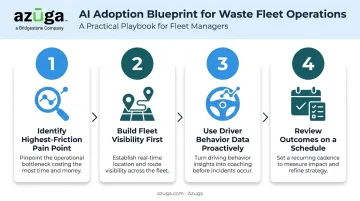
Beyond these four steps, waste fleets managing dense residential routes gain extra protection from dual-facing dashcam systems. These systems capture context around hard-braking or sudden-acceleration events, which supports coaching and helps defend against liability claims when pedestrians or parked vehicles are involved.
Conclusion
AI's real value in waste management shows up in daily operations: better sorting accuracy, smarter routing, and safer worksites, all built on what gets sorted, how trucks move, and how workers stay safe.
These gains compound. Sorting algorithms grow more accurate as they process additional material streams, while routing models sharpen as fill-level data accumulates. Safety scores rise once coaching becomes routine instead of reactive. Fleet telematics platforms like Azuga capture the vehicle and driver data behind these gains, from AI dashcams to real-time routing.
Treat AI adoption as an ongoing operational practice, not a one-time purchase, and the cost savings and recycling gains tend to follow.
Frequently Asked Questions
How is AI used in waste management?
AI is primarily used for automated sorting at recycling facilities, predictive route optimization for collection fleets, and smart bin sensors that monitor fill levels. These three applications cover most real-world deployments today.
What are the main benefits of AI for waste management businesses?
The core benefits are lower operating costs, higher recycling accuracy through reduced contamination, and improved worker safety by automating hazardous sorting tasks. Fuel savings from optimized routing add another layer of cost reduction.
Is AI waste management technology expensive to implement?
Hardware and robotics carry meaningful upfront costs, and integration takes planning. Most businesses recoup the investment over time through labor savings and higher material recovery rates.
Can small waste management companies benefit from AI, or is it only for large cities?
Smaller operators can access scaled versions of these tools, including smart bin sensors and GPS route optimization, without investing in full robotic sorting lines. Azuga's telematics platform, for instance, scales affordably from a few collection trucks to citywide fleets.
Will AI replace human workers in waste management?
AI automates the most hazardous and repetitive sorting tasks rather than eliminating the workforce entirely. It also creates new technical roles around system maintenance, data review, and quality control.
What does the future of AI in waste management look like?
Expect broader retrofit adoption at existing facilities, tighter integration with circular economy initiatives, and continued market growth as hardware costs come down and data quality improves industry-wide.