
But here's the catch: managing an EV fleet isn't the same as managing a gas or diesel fleet. Charging replaces refueling. Electricity rates replace fuel prices. Battery health replaces engine maintenance. Fleet managers who try to run EVs with old playbooks quickly hit walls.
This guide breaks down what EV fleet management actually involves, the core components you need to master, the benefits worth chasing, the challenges you'll likely face, and a practical roadmap for making the switch.
Key Takeaways
- EV fleet management spans charging, energy costs, driver behavior, and battery health
- Phased transitions prevent costly mistakes common in rushed electrification
- Centralized software delivers real-time visibility across mixed EV and ICE fleets
- Planning charging infrastructure early avoids expensive retrofits later
What Is Electric Vehicle Fleet Management?
Electric vehicle fleet management is the process of overseeing everything specific to running EVs commercially: acquisition, charging schedules, energy consumption, battery maintenance, and route planning built around vehicle range and duty cycles.
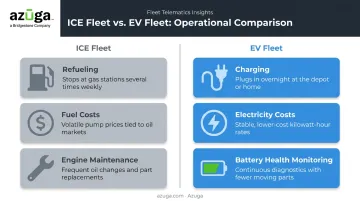
It's a different job than managing internal combustion engine (ICE) vehicles. Consider the core differences
- Refueling vs. charging - Filling a diesel tank takes minutes; charging an EV can take hours, depending on the charger level
- Fuel costs vs. electricity costs - Energy pricing fluctuates by time of day and location, unlike relatively stable fuel pricing
- Engine maintenance vs. battery health - EVs skip oil changes and transmission work but need battery monitoring and software updates
Momentum behind this shift is real. 87% of fleet decision-makers expect to have EVs in their fleets within the next five years, according to a 2024 Cox Automotive survey of 502 fleet operators ranging from small operations to fleets exceeding 500 vehicles.
Regulation is adding pressure too. California's Advanced Clean Fleets rule, for example, requires covered government agency fleets to make 50% of their annual vehicle purchases zero-emission between 2024 and 2026, scaling to 100% by 2027.
Private fleets aren't universally mandated yet, but similar rules are spreading state by state. Corporate sustainability targets are also pushing plenty of private companies to move early.
Successfully managing EVs comes down to five core pillars: charging infrastructure, energy optimization, driver behavior, maintenance, and data analytics. We'll walk through each one next.
Core Components of Electric Vehicle Fleet Management
Charging Infrastructure Planning
Before buying a single EV, figure out your charging setup. This means matching charger levels to your vehicles' duty cycles and dwell times
- Level 1 chargers are slow (think overnight only) but cheap to install
- Level 2 chargers work well for depots where vehicles sit for several hours
- DC fast charging suits vehicles that need a quick top-up between routes
Installation costs vary widely by level. Commercial Level 2 equipment and installation typically runs several thousand dollars per port, while DC fast charging setups can climb into six figures per port depending on power output and site conditions. These are planning estimates, not fixed quotes. Get a site assessment before locking in a vehicle purchase, not after.
Charging Schedule and Energy Optimization
Charging every vehicle at once, right when everyone returns to base, is a recipe for high electricity bills. Utilities often charge demand fees based on your highest usage spike, not just total consumption.
Smart charging and load balancing spread charging sessions across off-peak hours and stagger start times across the fleet. This flattens demand peaks and cuts monthly energy costs, especially for depots charging a dozen or more vehicles overnight.
Driver Behavior and Training
Driving habits affect EV range the same way they affect fuel economy in gas vehicles. Hard acceleration, aggressive braking, and excessive idling all drain battery charge faster than steady, moderate driving.
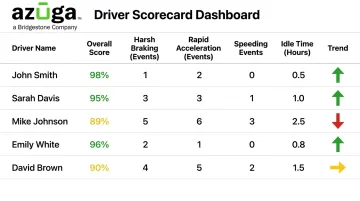
GPS fleet tracking platforms give fleet managers the data to coach these habits. Azuga's driver scorecards, for instance, track harsh braking, rapid acceleration, speeding, and idle time, behaviors that directly affect both safety outcomes and vehicle efficiency. Fleet managers can use that same data to identify drivers burning through EV range faster than expected and coach them accordingly, alongside standard safety metrics.
Maintenance and Battery Health Monitoring
EVs need far less mechanical upkeep. No oil changes, no transmission fluid, no exhaust system repairs. But they introduce a new priority: battery health.
The savings are measurable. The U.S. Department of Energy estimates scheduled maintenance for light-duty battery-electric vehicles costs 6.1 cents per mile, compared to 10.1 cents per mile for conventional ICE vehicles, according to DOE Fact of the Week #1190. That's a meaningful gap for fleets running thousands of miles a month.
Fleet management platforms with vehicle diagnostics, like Azuga's Diagnostic Trouble Code monitoring, help catch issues early across your fleet, though fleets should confirm with any vendor exactly which EV-specific data points, such as battery state of charge, are captured versus general vehicle data.
Data Analytics and Compliance Reporting
A centralized dashboard tracking vehicle location, utilization, and cost data supports two things at once: day-to-day operational decisions and long-term compliance or sustainability reporting.
That reporting side matters more than most fleets expect early on. Several states now require corporate and government fleets to report EV adoption rates or charging infrastructure investments as part of broader sustainability mandates. On the operational side, that same data answers questions fleet managers ask daily
- Which vehicles or routes carry the lowest cost per mile
- Where downtime or charging delays cluster by depot
- How EV energy costs compare to the ICE vehicles they replaced
Azuga's platform consolidates this location, utilization, and cost data into one dashboard, so when leadership asks how the EV rollout is performing, you have numbers ready, not guesses.
Benefits of Effective EV Fleet Management
Done right, EV fleet management pays off in three concrete ways
- Lower total cost of ownership. Argonne National Laboratory pegs battery-electric Class 4 trucks at roughly $0.70 per mile versus $0.90 for diesel, per the Argonne total cost of ownership study. That gap compounds fast across a multi-vehicle fleet.
- Stronger sustainability positioning. Measurable emissions reductions matter to customers, regulators, and increasingly to insurance underwriters and municipal contract bidders.
- Better uptime. Proactive charge scheduling and predictive maintenance replace reactive, break-fix routines, cutting surprise breakdowns and missed service calls. Fleet maintenance management tools like Azuga's make that scheduling easy to stay on top of.
Common EV Fleet Management Challenges (and How to Solve Them)
Every fleet electrification effort runs into friction. Here's what typically trips up fleet managers, and how to get ahead of it
- Range anxiety and route limitations - Solve this with route-planning tools that factor in vehicle range and charging stop locations before dispatching drivers
- High upfront infrastructure costs - Roll out chargers in phases rather than all at once, and research incentives like California's HVIP voucher program or utility make-ready pilots. Eligibility varies by location and funding status
- Energy demand management at depots - Smart charging and load management software prevents grid overload and avoids demand charge spikes from your utility
- Driver adaptation to new routines - Structured onboarding and refresher training reduce the friction drivers feel when switching from familiar gas-vehicle habits
- Limited visibility into total fleet costs - Consolidate GPS tracking, maintenance alerts, and cost data into one platform. Azuga's dashboard, for example, unifies GPS location, diagnostics, and maintenance scheduling for mixed ICE and EV fleets in a single view
How to Transition Your Fleet to Electric Vehicles
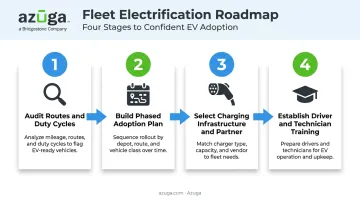
Jumping into full electrification overnight rarely works. A phased approach reduces risk and gives your team time to adjust.
Audit current routes, mileage, and duty cycles by identifying vehicles with predictable, return-to-base routes and shorter daily mileage. These are your best early candidates for electrification, not your long-haul or unpredictable-route vehicles.
Build a phased adoption plan by starting with light-duty vehicles before scaling up to medium- and heavy-duty applications. This limits your exposure while your team learns the operational differences.
Select charging infrastructure and a fleet management partner by choosing a platform, such as Azuga, that tracks vehicle performance, driver behavior, and ROI throughout the rollout. This visibility matters most in the first six months, when you're proving the business case to leadership.
Establish driver and technician training before vehicles go live, covering charging routines, range management basics, and any new maintenance procedures. Training upfront minimizes downtime and adoption friction once vehicles hit the road.
Frequently Asked Questions
What is electric vehicle fleet management?
It's the oversight of charging schedules, energy use, battery maintenance, and driver behavior specific to EVs operating in a commercial fleet. It goes beyond basic vehicle tracking to include energy and charging logistics.
How do I start managing an EV fleet?
Start by auditing your routes and duty cycles to find vehicles suited to electrification. Then plan your charging infrastructure and choose fleet management software that can track performance across your mixed fleet.
Is it more expensive to maintain an EV fleet than a gas fleet?
No. EVs have fewer moving parts and lower scheduled maintenance costs than comparable internal combustion engine (ICE) vehicles. The bigger upfront expense is charging infrastructure, not ongoing maintenance.
What is the biggest challenge in EV fleet management?
Charging infrastructure planning and energy demand management typically top the list. Getting the charger levels, installation timing, and load balancing right before scaling up prevents costly mistakes later.
Can fleet management software work for both EV and gas vehicles?
Yes. Platforms like Azuga Fleet support mixed fleets with unified GPS tracking, driver behavior scoring, and maintenance data across both vehicle types in one dashboard.
How much charging infrastructure does a fleet need?
It depends on your fleet size, vehicle duty cycles, and how long vehicles dwell at your depot. Assess these factors before purchasing vehicles to avoid under-building or overspending on chargers.