
Introduction
trucking is a $906 billion industry, moving 72.7% of all domestic freight tonnage in 2024 alone. That scale comes with brutal cost pressure.
Fleet managers juggle drivers, maintenance schedules, fuel spend, and multi-state compliance rules. Margins run thin enough that one bad month can wipe out a quarter's profit.
A single missed inspection or an unmonitored idling habit can drain thousands of dollars a year without anyone noticing.
This guide breaks down what truck fleet management actually involves, what a fleet manager does day-to-day, and how modern telematics technology has changed the job for the better.
Key Takeaways
- Truck fleet management unifies maintenance, safety, compliance, fuel, and routing in one system
- Fleet managers handle everything from service scheduling to HOS compliance and driver coaching
- GPS telematics and AI dashcams cut accidents by up to 38% while reducing fuel waste and violations
- Small inefficiencies add up fast, making data-driven decisions key to fleet profitability
What Is Truck Fleet Management?
Truck fleet management is the coordinated oversight of commercial vehicles, drivers, routes, maintenance, and regulatory compliance to move freight safely and profitably. It spans several overlapping functions, from dispatch to compliance, all running simultaneously.
Most industry definitions consider any operation with five or more vehicles a fleet. Below that threshold, one manager can usually keep track of everything on a spreadsheet. Above it, complexity multiplies fast.
Consider the difference in scale:
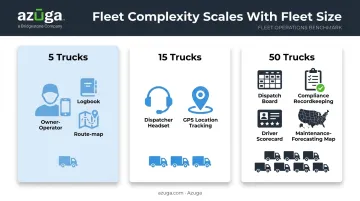
- A 5-truck operation might have one owner-operator handling maintenance calls, checking logs, and planning routes personally
- A 15-truck operation typically adds a part-time dispatcher and basic GPS tracking software to catch missed maintenance windows
- A 50-truck operation needs dedicated systems for dispatch, compliance recordkeeping, driver scorecards, and maintenance forecasting across multiple states
Why does this matter financially? Operating a truck cost the industry an average of $2.336 per mile in 2025, according to ATRI's Operational Costs of Trucking report. That's up 3.4% year over year, the highest figure in the organization's tracking history.
Strip out fuel, and that cost drops to $1.854 per mile, meaning fuel alone represents roughly 20.6% of total operating cost. That's a massive lever fleet managers can either control tightly or lose money on every single mile.
Core Responsibilities of Truck Fleet Management: What Does a Fleet Manager Do?
A fleet manager oversees vehicle maintenance, driver training and safety, fuel spend, regulatory compliance, and route planning, all with the same goal: keep trucks moving safely and profitably. Here's how those responsibilities break down in practice.
Vehicle Maintenance & Lifecycle Management
Fleet managers schedule preventive maintenance, track service history, and decide when a truck should be replaced rather than repaired. Get this wrong and downtime eats profit fast.
Key tasks include
- Building preventive maintenance schedules based on mileage or engine hours
- Tracking service history per vehicle to spot recurring issues
- Deciding when acquisition or replacement beats continued repair costs
- Monitoring diagnostic trouble codes before minor issues become major repairs
Driver Management & Safety
This covers recruiting, onboarding, training, and ongoing behavior monitoring, things like hard braking, speeding, and harsh acceleration. Turnover among large truckload carriers hit 91% back in 2019, according to ATA data. A precise current figure is harder to pin down, but retention has remained one of the industry's toughest and most expensive challenges ever since.
Coaching drivers using real behavior data, not just after-the-fact incident reports, is one of the few proven levers fleets have to reduce both turnover and accident risk. Azuga's AI dashcams and GPS telematics automate that coaching, flagging distraction, tailgating, and other risk indicators in real time rather than after an incident report lands on your desk.
Fuel Management
Fuel is the single largest variable cost most fleets face. Managers track consumption, fuel card usage, and idling time closely because small leaks here add up quickly across dozens of trucks.
Compliance & Regulatory Management
Trucking fleets operate under some of the heaviest regulatory oversight of any commercial sector. Fleet managers must maintain
- DOT regulations covering vehicle safety and driver qualification
- ELD compliance under the federal Electronic Logging Device rule, mandatory since December 2017
- Hours of Service tracking, including the 11-hour driving limit, 14-hour on-duty window, and mandatory 30-minute breaks
- IFTA reporting, keeping supporting records for four years per jurisdiction requirements
- Inspection documentation ready for roadside review at any time
Route Planning & Dispatch
Managers optimize routes for fuel savings, on-time delivery, and driver hours compliance simultaneously, a balancing act that gets harder as fleets scale across multiple states and time zones.
The Role of Technology & Telematics in Modern Fleet Management
Paper logs and manual spreadsheets used to be the norm. Now, real-time digital dashboards show vehicle location, maintenance alerts, and driver scores the moment something changes.
GPS telematics and OBD-II devices provide live tracking with update intervals as frequent as every 30 seconds on higher-tier plans, letting fleet managers respond to safety or maintenance issues in minutes instead of days.
AI Dashcams Are Changing Fault Determination
Accident liability disputes used to drag on for months. In a widely cited DOT/FHWA analysis of fatal car-truck crashes, car drivers were found solely responsible 70% of the time, versus 16% for the truck driver. AI-powered dashcams now give fleets a way to prove that in real time rather than relitigating it after the fact.
Azuga's SafetyCam AI, for example, pairs road-facing and driver-facing video with a neural learning network that tags distraction events automatically. When an accident happens, the system compiles video and telematics data into a collision reconstruction package that can settle a claim in days instead of months.
That protection starts with an equally simple setup. Azuga's OBD-II tracker plugs into a vehicle's standard diagnostic port and starts transmitting data in about 20 seconds, with no mechanic, no downtime, and no professional install needed.
Measurable Outcomes
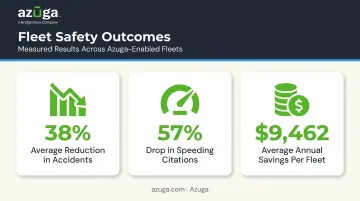
Fleets using Azuga's telematics platform report
- 38% average reduction in accidents
- 57% drop in speeding citations
- $9,462 in average annual savings per fleet
Backed by 24/7 support and a plug-and-play device, this kind of visibility is no longer reserved for large enterprise fleets. Small operations running five trucks can access the same tools as fleets running five hundred.
Key Performance Metrics (KPIs) to Track
Guessing doesn't scale. Tracking the right numbers does. Fleets that monitor KPIs consistently catch inefficiencies before they turn into five-figure problems.
Core KPIs every trucking fleet should watch:
| KPI | What It Reveals |
|---|---|
| Cost per mile | True operating cost, including fuel, maintenance, and labor |
| Fuel efficiency (MPG) | How driving behavior and route choices affect fuel spend |
| Vehicle utilization rate | Whether trucks are sitting idle or working at capacity |
| On-time delivery rate | Customer satisfaction and contract compliance |
| Driver safety scores | Accident risk and coaching priorities |
Platforms like Azuga pull these numbers directly from GPS and dashcam data, updating dashboards in real time.
Here's why the small stuff matters: a mid-size fleet of 50 trucks averaging 100,000 miles a year at 6.5 MPG burns roughly 770,000 gallons of diesel annually. Improve fuel efficiency by just 1 MPG, to 7.5 MPG, and that fleet saves over 100,000 gallons a year. At $4/gallon diesel pricing, that's a six-figure swing from a single-digit efficiency gain.
Common Fleet Management Challenges & Best Practices to Overcome Them
Rising Costs & Driver Shortages
Fuel, insurance, and labor costs keep climbing while driver retention remains a constant struggle. Operating costs hit a record $2.336 per mile in 2025, according to the American Transportation Research Institute, and that pressure isn't easing anytime soon. Long-haul driver turnover tops 90% annually at many large carriers, according to the American Trucking Associations, forcing dispatchers to recruit and train continuously just to stay staffed.
Best practices to offset it:
- Pair fuel monitoring with route optimization to cut waste at the pump
- Offer competitive, transparent pay structures tied to performance
- Build safety incentive programs that reward low-risk driving behavior, which also lowers insurance premiums
Downtime, Compliance Complexity & the Technology Fix
Beyond rising costs, unexpected breakdowns and inconsistent multi-state regulations rank among the biggest pain points for growing fleets. A truck sitting in a shop isn't earning, and a missed compliance deadline can trigger fines that erase a month's margin. Multi-state operations also mean juggling shifting IFTA and hours-of-service rules.
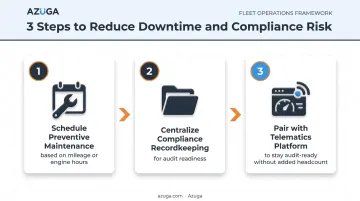
The fix is straightforward, even if it isn't always simple to implement
- Schedule preventive maintenance based on mileage and engine hour triggers, not guesswork
- Centralize compliance recordkeeping digitally so audits don't mean digging through file cabinets
- Pair both with an affordable telematics platform like Azuga to stay audit-ready without adding administrative headcount
Frequently Asked Questions
What does a fleet manager do in trucking?
A fleet manager oversees vehicle maintenance, driver safety and training, fuel management, regulatory compliance, and route planning. The goal is keeping trucks running safely and profitably across every mile driven.
How is truck fleet management different from general fleet management?
Trucking fleets face tighter delivery windows, heavier vehicle usage, and stricter DOT and ELD regulatory oversight compared to general commercial fleets like delivery vans or service vehicles.
What size fleet needs fleet management software?
Companies with five or more vehicles see the strongest cost savings. Platforms like Azuga scale from small five-truck operations to enterprise fleets running hundreds of vehicles.
How can GPS tracking reduce fleet costs?
GPS tracking cuts costs through route optimization, reduced idling time, safer driving behavior, and fewer accidents and citations. Fleets using this data report measurable savings within months, not years.
What KPIs should trucking fleets monitor most closely?
Cost per mile, fuel efficiency (MPG), on-time delivery rate, and driver safety scores are the top four metrics. Together, they reveal both cost drivers and operational risk.
Is fleet management software worth the investment for small trucking businesses?
Yes. Entry-level packaging is matched to fleet size and the features you select, and the ROI typically comes fast through reduced accidents, less fuel waste, and fewer compliance fines.