
Introduction
It's 2 p.m. and a service truck hasn't checked in since its 9 a.m. job. Is it stuck in traffic, sitting at a job site, or parked somewhere it shouldn't be? Meanwhile, the fuel card bill keeps creeping up, and nobody can explain why.
These are everyday headaches for fleet managers, and they're exactly what telematics was built to solve. Rising fuel costs, unclear vehicle whereabouts, risky driving habits, and mounting compliance paperwork drain time and money from businesses that run vehicles for a living.
This guide breaks down what telematics actually is and how the technology works under the hood. It also covers what data it can reveal about your fleet and the legal questions that come up most often around driver monitoring and consent.
Key Takeaways
- Telematics pairs GPS with OBD-II data to monitor vehicle location, health, and driver behavior.
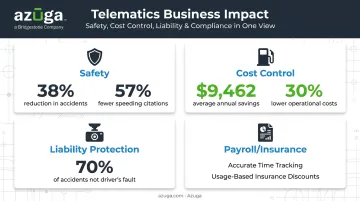
- Azuga customers report an average 38% drop in accidents and 57% fewer speeding citations.
- Tracking company vehicles is generally legal in the U.S., but several states require written employee disclosure
- Today's telematics platforms combine dash cams, AI coaching, and predictive maintenance, far beyond a simple map dot.
What Is Telematics?
Telematics is a blend of "telecommunications" and "informatics." French researchers Simon Nora and Alain Minc coined the term "télématique" in a 1978 government report on computerizing society. Decades later, the word found its true calling in vehicles.
Applied to fleets, telematics means combining a vehicle's location data with information pulled straight from its engine and sensors. GPS tells you where a truck is. Telematics tells you where it is, how it's being driven, and whether something under the hood needs attention.
Where Did Telematics Come From?
The roots go back further than most people expect
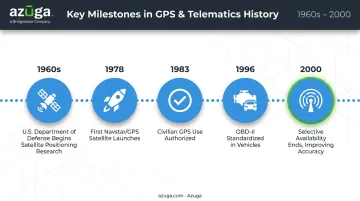
- 1960s: The U.S. Department of Defense begins developing satellite positioning technology for military use
- 1978: The first Block I Navstar/GPS satellite launches
- 1983: Civilian GPS use is authorized for the first time
- 1996 onward: Automakers standardize onboard diagnostics (OBD-II), setting the stage for modern connected vehicle devices
- 2000: Selective availability ends, sharply improving civilian GPS accuracy
What started as military-only positioning technology now runs on millions of commercial dashboards every day.
Telematics vs. Basic GPS Tracking
This is where a lot of buyers get confused, especially when comparing a basic consumer GPS tracker against a full telematics platform.
| Capability | Basic GPS Tracking | Full Telematics |
|---|---|---|
| Shows location | Yes | Yes |
| Tracks engine faults | No | Yes |
| Monitors driving behavior | No | Yes |
| Connects to vehicle diagnostics | Rarely | Typically via OBD-II or CAN-BUS |
| Feeds cloud-based reporting | Limited | Yes, with alerts and analytics |
A cheap GPS tracker answers "where is it?" A telematics platform like Azuga answers "where is it, how's it running, and is the driver behind the wheel doing anything risky?"
How Does Telematics Work?
At its simplest, telematics follows a straightforward path: a device in the vehicle captures data, sends it over a cellular network, and cloud software turns it into insights a fleet manager can actually use.
Hardware Inside a Telematics Device
A typical fleet telematics device packs several components into a small housing
- GPS receiver – pinpoints location, speed, and direction
- Accelerometer – detects hard braking, rapid acceleration, and sharp turns
- SIM card/cellular modem – transmits data to the cloud
- OBD-II or CAN-BUS connector – taps into the vehicle's diagnostic and network systems
- Engine interface – reads fault codes, idle time, and fuel data
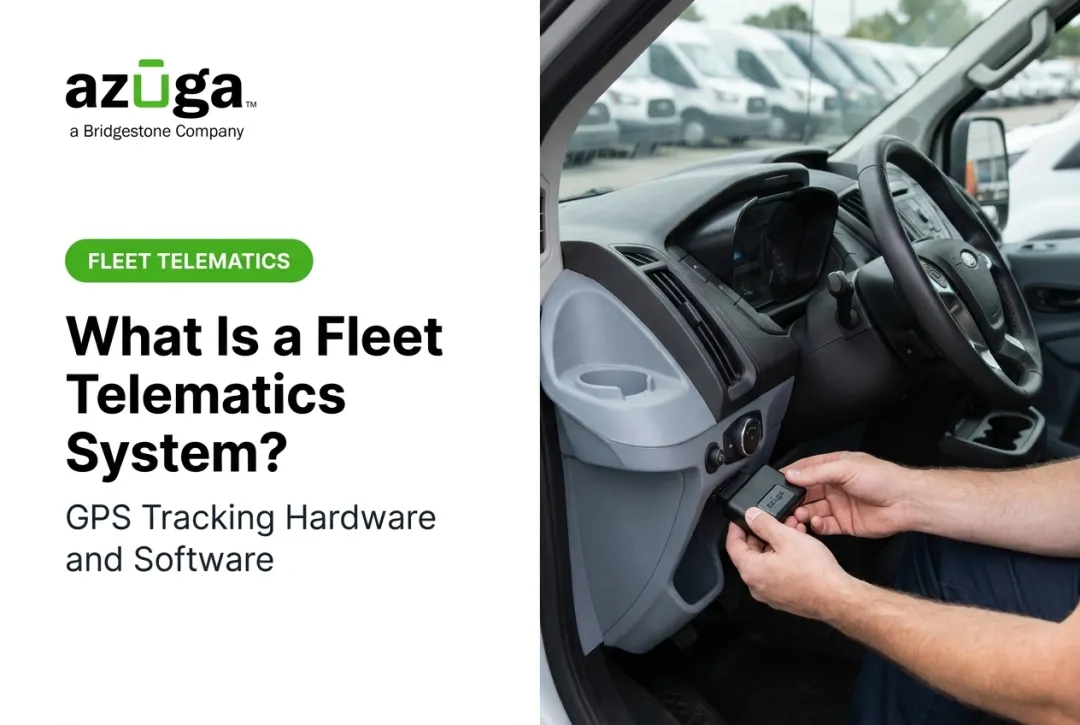
Most passenger vehicles and light trucks built since 1996 come with a standard OBD-II port, which is exactly why plug-and-play devices work across so many vehicle makes. Azuga's OBD-II tracker, for instance, plugs directly into that port and can be installed by a driver in minutes, without scheduling a technician visit.
From Vehicle to Dashboard: The Data Journey
Once the hardware is in place, here's what happens
- Sensors capture data – GPS coordinates, engine metrics, and motion events
- The device transmits that data over a cellular network
- Cloud software processes it, decoding raw signals into readable reports
- The dashboard displays it as maps, speeding alerts, idle-time summaries, and maintenance flags
Increasingly, that cloud layer includes AI and machine learning. Instead of just logging a hard-braking event, modern platforms cross-reference it with dash cam footage to figure out why it happened. Was it a distracted driver, or someone else cutting them off?
Azuga's SafetyCam pairs road-facing and driver-facing video with telematics data, so a risky event triggers footage review rather than a guess.
What Can Telematics Tell You? Data Points and Business Benefits
Telematics reveals a surprising amount about a vehicle and the person driving it, including
- Real-time location and route history
- Speed and speeding events
- Idling time
- Harsh braking and rapid acceleration
- Fuel consumption
- Engine fault codes
- Seatbelt use
None of that matters unless it changes something operationally. Here's where the payoff actually shows up.
Safety. Real-time coaching alerts and collision detection give managers a chance to correct risky habits before they turn into claims. Fleets on Azuga's platform report an average 38% reduction in accidents and a 57% drop in speeding citations.
Cost control. Idling burns fuel for nothing, and aggressive driving makes it worse. The Department of Energy notes that aggressive driving can cut fuel economy by 15% to 30% at highway speeds and up to 40% in stop-and-go traffic. Azuga customers report average annual savings of $9,462 and a 30% reduction in operational costs through better route planning and reduced idling.
Liability protection. Accidents happen, and drivers often get blamed unfairly. Azuga's SafetyCam AI with Collision Reconstruction found that 70% of accidents are not the fault of the covered driver, using synced video and telematics data to reconstruct what actually happened.
Payroll and insurance. Accurate location and time-stamped data support fair payroll calculations for field crews. Many insurers also offer usage-based insurance discounts tied to telematics data, rewarding safer fleets with lower premiums.
Types of Telematics Devices and Who Uses Them
Common Types of Telematics Devices
Not all telematics hardware works the same way
- Plug-in OBD-II / black box devices – the most common option, offering standardized data across most vehicle makes and models
- OEM-embedded systems – built into the vehicle at the factory, but data formatting varies widely by manufacturer, making cross-fleet comparisons harder
- Smartphone-based apps – low-cost and easy to deploy, but generally less accurate for engine diagnostics than dedicated hardware
For fleets managing mixed vehicle types, a dedicated OBD-II device tends to offer the most consistent, comparable data. Azuga's plug-and-play OBD-II device, for example, installs in minutes without professional help and immediately standardizes data across every vehicle in the fleet.
Industries That Rely on Telematics
Telematics adoption spans a wide range of vehicle-heavy industries
- Construction
- HVAC and plumbing
- Trucking and logistics
- Utilities and electrical
- Landscaping
- Pest control
- Waste management
- Towing and roadside assistance
The scale of adoption keeps growing. Berg Insight counted 19.2 million active commercial fleet management systems in North America as of Q4 2024, with that number projected to reach 33.2 million by 2029. Businesses running any number of vehicles, from a two-truck plumbing outfit to a regional trucking fleet, are increasingly treating telematics as standard equipment rather than a luxury add-on.
Is Telematics Legal? Privacy, Consent, and Control
Tracking a company-owned vehicle is generally legal in the United States. Employers own the asset, and courts have consistently upheld the right to monitor equipment used for business purposes.
That said, employee monitoring laws vary by state
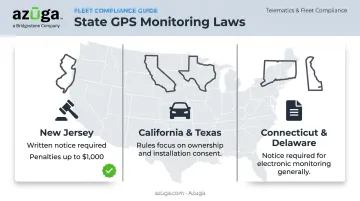
- New Jersey requires employers to give written notice before using a tracking device in a vehicle operated by an employee, with penalties up to $1,000 for a first violation
- California and Texas focus their statutes on vehicle ownership and installation consent rather than a blanket employee-notice rule
- Connecticut and Delaware require notice for certain types of electronic monitoring, though their statutes don't specifically name GPS tracking
Best practice regardless of state: put your monitoring policy in writing, notify drivers before rollout, and explain what data gets collected and why. Transparency builds trust and reduces the odds of a compliance headache later.
Can a device be switched off? Technically, yes, an OBD-II tracker can be unplugged. But doing so on a company vehicle almost always violates internal policy, and platforms like Azuga flag disconnection events automatically, so tampering rarely goes unnoticed for long.
Frequently Asked Questions
What can telematics tell you?
Telematics reveals vehicle location, speed, idling time, harsh braking, fuel use, and engine health. Combined, this data helps fleets improve driver safety, cut fuel costs, and catch maintenance issues early.
Are telematics devices legal?
Yes, tracking company-owned vehicles is generally legal in the U.S. Some states, like New Jersey, require written employee disclosure before monitoring begins.
Can telematics be turned off?
A device can technically be unplugged, but doing so on a work vehicle usually violates company policy. Most modern systems flag disconnection events, so tampering rarely goes unnoticed.
Is telematics the same as GPS tracking?
No. GPS tracking only shows location. Telematics combines GPS with engine diagnostics, driver behavior data, and cloud-based reporting for a fuller operational picture.
How much does a telematics system typically cost?
Azuga matches packaging to fleet size and selected features, making telematics accessible for small and large fleets alike.
Do I need a professional to install a telematics device?
Not usually. Most modern OBD-II devices, including Azuga's tracker, are plug-and-play and can be self-installed by a driver in minutes without a technician.