
Reactive repairs tend to cost more and disrupt more than planned service, especially for commercial fleets running tight delivery windows or service-level agreements. A truck sidelined on a Tuesday morning can mean missed appointments, frustrated customers, and a scramble to find backup capacity.
This guide breaks down what corrective maintenance actually means, how it differs from preventive maintenance, and how fleet telematics can help you catch problems before they turn into roadside emergencies.
Key Takeaways
- Corrective maintenance repairs a vehicle or asset after a fault is detected, not before
- Repairs can be planned (deferred to a convenient time) or unplanned (emergency, unscheduled)
- Preventive and predictive maintenance act before failures occur, unlike corrective repairs
- Most reliable fleets use a hybrid strategy, keeping corrective work as a backup, not a plan
- Telematics and diagnostic alerts help shift unplanned corrective work into scheduled repairs
What Is Corrective Maintenance? Definition and Examples
Corrective maintenance is work performed after a fault or failure has been identified, with the goal of restoring a vehicle or piece of equipment to normal operating condition.
The IEC's formal definition describes it as "maintenance carried out after fault detection to effect restoration." That's a useful anchor: the asset doesn't need to be completely broken down, just that a problem has been detected.
This is the key distinction from preventive maintenance. Preventive work happens on a fixed schedule regardless of condition, such as an oil change every 5,000 miles. Corrective maintenance is triggered by an actual, observed problem.
A common fleet example: a truck's brake warning light comes on. An inspection reveals worn pads. The vehicle needs immediate repair to stay roadworthy. That's corrective maintenance in its most recognizable form.
But it shows up across every vertical Azuga serves
- An HVAC service van with a failing alternator that's draining battery life faster than expected
- A construction vehicle with a hydraulic leak spotted during a pre-shift walkaround
- A waste management truck with a malfunctioning lift arm that needs repair before the next route
Corrective Work Often Surfaces During Routine Checks
Corrective maintenance needs aren't always discovered after a full breakdown. Many surface during routine inspections or scheduled preventive visits, when a technician doing an oil change notices a coolant leak, for example. That's still corrective work, just caught earlier and with less disruption.
Catching these issues early keeps fleets moving and prevents small problems from becoming expensive ones. A pre-trip inspection that flags a worn serpentine belt, or a maintenance alert triggered by an unusual sensor reading, both count as corrective triggers even though nothing has failed yet. Catching problems sooner usually means cheaper, faster repairs and less unplanned downtime for the fleet.
Corrective vs. Breakdown Maintenance
These terms get used interchangeably, but there's a practical difference. Corrective maintenance can happen while equipment is still partially functioning, like that HVAC van still driving with a dying alternator. Breakdown maintenance, in common fleet usage, refers to assets that are fully nonoperational. Every breakdown repair is corrective, but not every corrective repair starts from a full breakdown.
Types of Corrective Maintenance: Planned vs. Unplanned
Not all corrective work carries the same urgency. Once a fault is identified, fleets generally handle it one of two ways.
Planned (deferred) corrective maintenance happens when an issue is spotted but doesn't require an immediate stop. A minor fluid leak, for instance, might get logged and addressed at the vehicle's next scheduled service visit rather than pulling it off the road right away.
Unplanned (emergency) corrective maintenance happens when a failure demands immediate attention — often involving roadside assistance or towing to prevent further damage or a safety incident.
The tradeoff between the two shows up in cost, scheduling, and safety risk
| Factor | Planned Corrective | Unplanned Corrective |
|---|---|---|
| Cost | Lower, bundled with existing service | Higher, often includes towing/roadside fees |
| Scheduling | Fits existing shop capacity | Disrupts routes and delivery windows |
| Safety risk | Managed proactively | Elevated, especially for DOT-regulated fleets |
| Parts availability | Can be ordered in advance | May require rush shipping or substitutions |
The cost gap is real. A 2019 TMC and FleetNet America report found the average roadside mechanical repair cost $334 in Q4 2018, up from $317 the previous quarter. That's before accounting for the downtime, missed appointments, and driver hours lost while a truck sits on the shoulder.
The Corrective Maintenance Process for Fleets
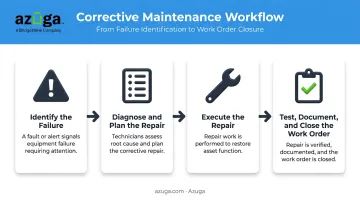
A well-run corrective maintenance workflow follows four steps, whether you're managing three vans or three hundred trucks.
Step 1: Identify the Failure
Issues surface in one of three ways
- A driver reports a concern during or after a route.
- A Driver Vehicle Inspection Report (DVIR) documents a defect.
- An automated fault alert comes through a telematics or OBD-II device.
The earlier a problem surfaces, the more options you have for scheduling the fix.
Step 2: Diagnose and Plan the Repair
A technician or fleet manager assesses severity, checks parts availability, and decides whether to handle the repair in-house or route it to an outside shop. This step determines whether the issue becomes planned or unplanned work.
Step 3: Execute the Repair
For commercial vehicles, this step needs to follow manufacturer specifications and DOT compliance standards. Cutting corners here risks safety violations and out-of-service designations down the line.
Step 4: Test, Document, and Close the Work Order
After the repair, check the vehicle for roadworthiness before returning it to service. Just as important, log the work order in your maintenance system.
Documenting recurring failures over time does more than satisfy recordkeeping requirements. It helps fleet managers spot patterns (say, three alternator failures on the same make and model within a year) and address root causes instead of chasing symptoms one repair at a time.
Corrective vs. Preventive vs. Predictive Maintenance: What's the Difference?
Three terms get thrown around in fleet maintenance conversations, and they're often confused with one another.
- Preventive maintenance is scheduled, time- or mileage-based servicing designed to head off failures before they occur: oil changes, tire rotations, filter swaps
- Predictive maintenance uses sensor and telematics data, like engine fault code trends, to anticipate failures before they happen
- Corrective maintenance reacts to a fault that's already been detected
The core distinction comes down to trigger and timing
| Maintenance Type | Trigger | Timing |
|---|---|---|
| Preventive | Calendar or mileage interval | Scheduled |
| Predictive | Sensor and telematics data | Data-driven |
| Corrective | Detected fault | Reactive |
In practice, these categories often overlap once a vehicle is in the shop.
FleetOwner has documented how predictive dashboards combine sensor and fault-code data, letting fleets address emerging issues while a vehicle is already in the shop for routine service. This approach catches corrective work before it becomes an emergency.
Most well-run fleets don't pick one strategy and stick to it exclusively. They lean on preventive schedules and predictive alerts to reduce emergencies, while keeping corrective maintenance in reserve for the failures that inevitably slip through. This blended approach isn't a system weakness. It reflects a realistic truth: no maintenance strategy eliminates every fault.
Benefits and Drawbacks of Corrective Maintenance
Corrective maintenance isn't inherently bad practice. For low-risk assets, it can be the most sensible approach.
Benefits:
- Lower upfront costs since there's no need for continuous monitoring on non-critical equipment
- Simple to execute when failure has minimal impact on safety or daily operations
- Works well for redundant equipment where a single failure won't halt operations
Drawbacks:
- Unpredictable downtime that disrupts delivery schedules and service commitments
- Higher emergency repair costs, plus DOT compliance risk when critical vehicles fail unexpectedly
- Over-reliance on reactive repairs tends to shorten asset lifespan and drive up total cost of ownership over time
The takeaway: corrective maintenance works fine as a fallback. It becomes a problem when it's the only strategy for vehicles your business depends on daily.
Reducing Corrective Maintenance with Fleet Telematics
GPS fleet tracking platforms can flag developing issues before they turn into a breakdown by capturing real-time vehicle diagnostics, engine fault codes, and driver behavior data. Instead of waiting for a dashboard warning light, fleet managers get visibility into vehicle health as it changes.
Azuga's plug-and-play OBD-II device makes this accessible without a complicated rollout. The device is ready to transmit data in about 20 seconds after plugging into a vehicle's OBD-II port, with no mechanic visit or scheduled downtime required.
Once connected, the platform gives fleet managers
- Live vehicle diagnostics through diagnostic trouble codes, viewable through the Azuga FleetMobile dashboard
- Maintenance alerts based on mileage or engine run time, so scheduled service doesn't get missed
- Ongoing diagnostic reports for tracking vehicle health trends over time, not just single incidents
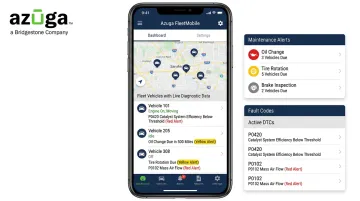
These alerts already prove valuable in daily operations. Smith & Solomon's Fleet Director, Chris Barbayanni, uses geofencing alongside DTC notifications to plan repairs before they escalate.
"When a flagged vehicle approaches the shop, I get notified and can have a mechanic ready," Barbayanni says. "It turns what could have been an unplanned repair into a coordinated, planned one."
That kind of proactive visibility supports the bottom line. Azuga customers have reported saving an average of $9,462 annually through more effective fleet cost management, alongside broader operational cost reductions.
Cost savings aren't limited to mechanical upkeep, though. For fleets dealing with collision-related repairs, Azuga SafetyCam AI with Collision Reconstruction adds critical context for diagnosis.
Because the system captures both road-facing and driver-facing footage, fleet managers can review what actually happened during an incident. This helps separate mechanical failure events from driver-caused ones, supporting more accurate root-cause diagnosis.
Frequently Asked Questions
What are the 7 types of maintenance?
Sources commonly list preventive, corrective, predictive, reactive/breakdown, condition-based, scheduled, and emergency maintenance. The exact list varies by industry source, since some terms describe timing while others describe the trigger.
What is the difference between corrective and preventive maintenance?
Corrective maintenance happens after detecting a fault, aiming to restore the vehicle to working condition. Preventive maintenance runs on a set schedule, based on time or mileage, to avoid failures altogether.
What is an example of corrective maintenance in fleet management?
Replacing a failed alternator after a dashboard warning light appears, or repairing a transmission once diagnostic data flags a fault. Both involve fixing an already identified problem, not preventing one.
Is corrective maintenance the same as reactive or breakdown maintenance?
The terms are closely related but not identical. Breakdown maintenance specifically refers to equipment that's fully nonoperational, while corrective maintenance can address a fault while the asset is still partially functioning.
What is the difference between planned and unplanned corrective maintenance?
Planned corrective maintenance defers a known issue to a scheduled service visit. Unplanned corrective maintenance requires immediate repair, often involving roadside assistance, because the failure can't wait.
How does GPS fleet tracking help reduce the need for corrective maintenance?
Real-time diagnostic alerts and vehicle health data catch developing issues, like fault codes or irregular engine data, before they become breakdowns. This shifts fleets from reacting to emergencies toward scheduling repairs on their own terms.