
Introduction
Every fleet owner hits the same fork in the road eventually: build an internal team to manage vehicles, or hand the keys to a third-party provider.
This decision shapes far more than a monthly budget line. It affects uptime, compliance exposure, and how quickly a business can add vehicles when demand spikes.
Get it wrong, and you're either overpaying for capacity you don't need, or losing control over vehicles that keep your business running.
The market is genuinely split on the answer. In Azuga's own survey data, 44.83% of companies still keep risk management in-house — proof that neither model has won outright.
This guide breaks down both paths, so you can pick the one that fits your fleet today, not the one that sounded right five years ago.
Key Takeaways
- In-house means owning your vehicles, staff, and processes outright
- Outsourcing shifts some or all of those functions to a provider
- Budget, fleet size, expertise, and growth stage decide the right fit — no universal winner
- Blending models is common: outsource specialty repairs, keep tracking and compliance in-house
- Fleet management software lets lean in-house teams operate at outsourced-level efficiency
In-House vs. Outsourced Fleet Management: Quick Comparison
Before we define each model, here's how the two models stack up across the factors that matter most to fleet managers.
| Factor | In-House | Outsourced |
|---|---|---|
| Cost | Higher upfront capital for vehicles, facilities, and staff; no contract lock-in | Lower upfront investment, predictable monthly fees, but risk of upselling and penalties |
| Control | Full say over prioritization, scheduling, and vendor choice | Limited day-to-day control; performance rides on the provider's SLA |
| Expertise & Tech | Requires investment in training and software to match provider capability | Instant access to specialists and mature tech stacks |
| Scalability | Scaling needs hiring, purchasing, and onboarding time | Vehicle count flexes faster, within contract terms |
| Compliance | Full accountability; needs dedicated DOT/ELD/safety tracking | Provider manages regulatory upkeep, but liability often still lands on you |
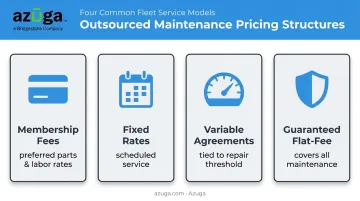
Cost structure deserves a closer look. Outsourced maintenance contracts typically use one of four pricing models, according to FleetOwner's breakdown of outsourcing options
- Membership fees with preferred parts and labor rates
- Fixed rates for scheduled service
- Variable agreements tied to a repair threshold
- Guaranteed flat-fee agreements covering all maintenance
None of these guarantee savings on their own. The right structure depends on your repair exposure and fleet age.
Understanding Your Two Options
What Is In-House Fleet Management?
In-house fleet management means your company owns and runs everything: vehicles, drivers, maintenance scheduling, and compliance tracking, all handled by internal staff.
The upside is direct oversight. You control costs, monitor driver behavior firsthand, and negotiate directly with parts suppliers and repair shops — no middleman markup.
There are two flavors of in-house management
- Traditional in-house: Spreadsheets, paper logs, and manual check-ins
- Tech-enabled in-house: GPS and telematics software providing outsourced-level visibility without outsourcing anything
The gap between these two is wide. Verizon Connect's 2024 survey of 657 U.S. fleets found 70% of fleets already use GPS tracking, climbing to 83% among medium-sized fleets running 50-499 vehicles.
Among those GPS users, nearly half reported improved maintenance outcomes, plus average reductions of 9% in fuel costs and 15% in accident costs.
In-house makes the most sense when your fleet is large enough to justify dedicated staff, or when vehicles are core to the business itself. Think construction, utilities, or trucking operations where the truck is the product.
What Is Outsourced Fleet Management?
Outsourced fleet management means contracting a third party, whether a dedicated fleet service, a 3PL, or a leasing partner, to handle some or all fleet functions on your behalf.
The appeal is straightforward: costs become predictable, the HR burden gets lighter, and you tap into expertise you don't have to build from scratch.
Outsourcing isn't all-or-nothing either
- Full outsourcing: vehicles, drivers, and maintenance all handled externally
- Partial outsourcing: only maintenance, only compliance, or only dispatch goes to a vendor
This model tends to fit smaller fleets, businesses scaling quickly without capital for vehicle ownership, or companies facing technician shortages. That last point is a real, growing pressure.
In a Fall 2023 survey of more than 400 fleet members, technician staffing ranked as the top maintenance concern among trucking fleets, ahead of roadside breakdowns and vendor reliability. When you can't hire enough wrenches, outsourcing maintenance stops being optional.
In-House vs. Outsourced: Which One Is Right for You?
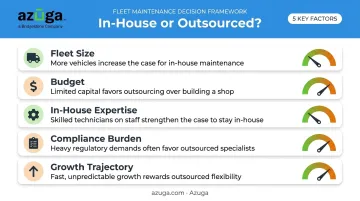
The right model comes down to five factors
- Fleet size: How many vehicles are you actually managing?
- Budget: Weigh whether you have capital for ownership or need predictable monthly costs.
- In-house expertise: Check if current staff can handle compliance and maintenance.
- Compliance burden: Consider how heavily regulated your industry is.
- Growth trajectory: Are you scaling fast, or holding steady?
Choose in-house if you have enough vehicles and staff to justify dedicated resources, and you want full ownership of your data and vendor relationships.
Choose outsourced if you're running a smaller fleet, short-staffed on technicians, or need to scale quickly without a major capital outlay.
The Hybrid Model Is Now the Default
Most fleets today don't pick one lane entirely. They outsource specialty repairs or dispatch while keeping GPS tracking, safety monitoring, and compliance management in-house.
This split makes sense. Tracking data is something you want direct access to at all times, while heavy engine repair is often best left to a specialist shop with the right lift and parts inventory.
Modern fleet management software is what makes this hybrid approach realistic for smaller teams. Platforms like Azuga give lean in-house teams
- Real-time visibility into vehicle location and driver behavior through live map tracking
- Predictive maintenance alerts that flag issues before they turn into expensive breakdowns
- AI-powered safety monitoring through dashcams that catch risky driving events as they happen
None of that required an outsourced provider a decade ago. Now it's a plug-in device and a subscription.
Quick Self-Assessment
Ask yourself
- Do I have more than 15-20 vehicles? (Favors in-house)
- Am I struggling to hire or retain maintenance technicians? (Favors outsourcing that function)
- Do I need real-time data ownership for insurance or compliance reasons? (Favors in-house tracking)
- Am I scaling by more than 20% annually? (Favors outsourced flexibility, at least short-term)
Real-World Example: Keeping Fleet Management In-House With the Right Technology
Kitsap Garage Door Company didn't outsource its fleet operations. Instead, the company switched from a traditional GPS provider to Azuga G2™, betting that better technology could match what a third-party provider offered.
The results, according to company President John Ramer, centered on fuel consumption and engine idling insights that weren't visible with their previous tracking setup. Once those numbers became clear, the payoff followed quickly
- Measurable per-vehicle ROI, seen almost immediately after switching
- Direct visibility into idling patterns that were previously invisible costs
- No need to add outsourced fleet management overhead to capture those savings
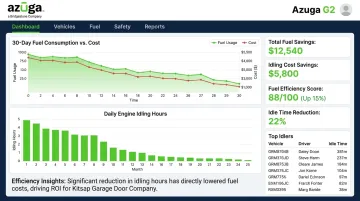
Read the full Kitsap Garage Door success story for more detail. This doesn't mean outsourcing is the wrong choice for every fleet. It shows that a lean in-house team, armed with the right platform, can hit efficiency numbers that once seemed to require an outside provider's specialized tech stack.
If you're weighing whether your in-house team could operate at that same level, explore Azuga's fleet tracking platform to see what's realistic for your vehicle count and budget.
Conclusion
There's no universal winner between in-house and outsourced fleet management. The right call depends on your fleet size, your team's existing expertise, and how fast you're growing.
Plenty of businesses land somewhere in the middle, outsourcing specialty work while keeping tracking and compliance close. Whichever path you choose, lower costs, less downtime, and tighter compliance are achievable when you pair the model with the right processes and technology, like Azuga's GPS tracking and AI dashcam platform, to back it up.
Frequently Asked Questions
Is it cheaper to outsource fleet management or keep it in-house?
It depends on fleet size and structure. Outsourcing lowers upfront investment but adds ongoing contract fees, while in-house costs more initially but gives you long-term cost control.
Can a small business benefit from outsourcing fleet management?
Yes. Small fleets can outsource specific functions like maintenance or compliance instead of the entire operation, making outsourcing accessible even without a large vehicle count.
What fleet tasks can be outsourced without losing full control of operations?
Maintenance scheduling, fuel management, and billing or collections can go to a vendor while core tracking and driver management stay in-house.
How does fleet management software help with in-house fleet management?
Software like GPS tracking, predictive maintenance alerts, and AI dashcams gives in-house teams the same visibility and efficiency tools that outsourced providers rely on.
What's the biggest risk of outsourcing fleet management?
Loss of day-to-day control, potential vendor upselling, and contract lock-in are the main risks, all of which can limit flexibility if your business needs change.
Can a business switch from outsourced to in-house fleet management, or vice versa?
Switching is common, and most transitions happen in phases, starting with tracking or compliance software before shifting other functions in-house or out.