
Introduction
A technician takes a two-hour "quick stop." A van burns fuel idling in a parking lot for 45 minutes. A driver takes the highway instead of the direct route.
Nobody notices until the fuel bill arrives. These small blind spots add up fast across a fleet, and most managers only catch them after the damage is done.
Fuel waste alone is staggering at scale. According to DOE's Argonne National Laboratory, long-haul truck rest-period idling burns up to 1 billion gallons of fuel annually in the US, a clear sign of how costly unmonitored vehicle behavior can become.
GPS fleet tracking has shifted from a competitive edge to a baseline expectation, though adoption still lags among smaller operations. This guide breaks down what fleet GPS tracking is, how it works, its core benefits, the legal rules to follow, and how to choose the right system for your operation.
Key Takeaways
- GPS fleet tracking combines satellite positioning with onboard hardware to monitor location, speed, and behavior live
- Fleets using behavior-based coaching have seen accident rates drop by an average of 38%
- Employers can track company-owned vehicles, but several states require written notice first
- Refresh frequency, installation ease, and integrations matter most when comparing systems
What Is GPS Tracking for Fleet Vehicles?
GPS fleet tracking uses satellite positioning combined with an onboard device and cloud software to monitor a vehicle's real-time location, speed, route history, and driving behavior. It applies to any business-owned or business-used vehicle, whether that's a single service van, a mixed fleet of pickups, or a line of heavy trucks.
In short, it's the system that turns a fleet of vehicles into a live, searchable map, backed by data on how each one is driven.
How GPS Fleet Tracking Works
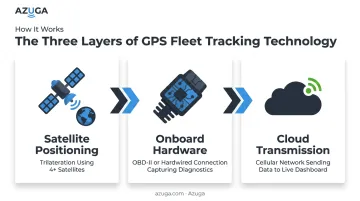
The process runs through three layers
- Satellite positioning. A receiver calculates position using trilateration, measuring distances to multiple satellites at once. According to GPS.gov, signals from at least four satellites let a device pinpoint latitude, longitude, altitude, and time.
- Onboard hardware. A device, either plugged into the OBD-II port or hardwired into the vehicle, captures that position data along with diagnostics like speed and engine status.
- Cloud transmission. The device sends this information over a cellular network to servers, which populate a live dashboard fleet managers can check from a phone or desktop.
Refresh intervals vary widely across providers, from every second to every two minutes or longer. This matters more than it sounds: a system updating every 15 minutes might place a vehicle at the wrong stop entirely, throwing off arrival times and route history. Faster refresh rates cost more in data, but they buy precision.
Types of GPS Tracking Devices
Not every fleet needs the same hardware. The three main categories
- OBD-II plug-in devices – Self-installable in minutes, no technician required. Best for small and mid-size fleets that want to get moving fast.
- Hardwired trackers – Installed by a technician directly into the vehicle's wiring. Harder to unplug or tamper with, which suits fleets managing driver accountability closely.
- Asset trackers – Separate battery-powered units for trailers, generators, and equipment that don't have their own OBD port.
Azuga's OBD-II device is a good example of the plug-and-play category. It connects to the OBD port and is functional in roughly 20 seconds, with no technician visit needed. That kind of self-install design shrinks onboarding time for fleets adding dozens of vehicles at once.
Core data points a GPS fleet tracking system typically collects
- Real-time location and speed
- Idle time and stop duration
- Harsh braking, rapid acceleration, and cornering events
- Engine diagnostic trouble codes
- Fuel level and consumption
- Geofence entry, exit, and dwell time
Key Benefits of GPS Tracking for Fleet Vehicles
The value of fleet tracking shows up in dispatch decisions, insurance conversations, and the fuel bill, often in that order.
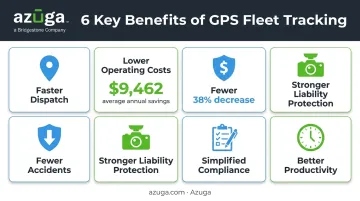
Faster, smarter dispatch. Real-time location lets managers assign the nearest available vehicle to a new job instead of guessing. That means fewer wasted miles and ETAs customers can actually trust.
Lower operating costs. Reduced fuel waste, tighter routing, and less after-hours vehicle use add up. Azuga customers report average annual savings of $9,462 from more effective fleet cost management, a figure that reflects fuel, maintenance, and administrative gains combined.
Fewer accidents. Driver behavior monitoring paired with coaching changes habits over time. Fleets using Azuga's behavior-based coaching have seen:
- 38% average decrease in accidents
- 57% reduction in speeding citations
Stronger liability protection. Dashcam footage and AI collision reconstruction give fleets evidence when it matters. Azuga's SafetyCam AI reflects a broader industry pattern: roughly 70% of commercial vehicle accidents involving a passing car are not the fault of the commercial driver, based on federal crash data. That evidence can mean the difference between a costly settlement and a dismissed claim.
Simplified compliance. Automated logging supports ELD requirements, DVIR submissions, and mileage documentation, cutting the paperwork burden during audits.
Better productivity. Idle time reports flag wasted hours immediately. One case study of a service fleet using Azuga found that flagging site visits over 45 minutes helped managers catch scheduling inefficiencies before they became a pattern.
Is GPS Tracking for Fleet Vehicles Legal? What Employers Need to Know
Can an employer track you with GPS? Yes, for company-owned vehicles used for business purposes. Employers have the right to monitor assets they own. But how you notify employees, and whether you need their consent, depends on the state.
Company Vehicles vs. Personal Vehicles
Tracking a company-owned vehicle is legally straightforward, but tracking an employee's personal vehicle, even for work purposes like mileage reimbursement, carries much higher risk. Without explicit, documented consent, personal vehicle tracking can expose employers to privacy claims. A handful of states add specific notice and consent requirements on top of these general rules.
State Requirements to Know
| State | Requirement | Penalty |
|---|---|---|
| New Jersey | Written notice required before using a tracking device in a vehicle used by an employee | Up to $1,000 first violation, $2,500 each subsequent (N.J.S.A. 34:6B-22) |
| Connecticut | Prior written notice required for electronic monitoring of employee activity on employer premises | ,000 depending on offense count |
| California | Tracking device use requires consent from the vehicle's registered owner, lessor, or lessee | Misdemeanor charge for violations |
Compliance Best Practices
- Provide written notice before activating any tracking device
- Get a signed acknowledgment from drivers
- Document a clear policy limiting data use to business purposes
- Avoid tracking outside scheduled work hours
- Never use tracking data punitively without a documented policy behind it
Frame tracking as an accountability and safety tool, not surveillance, since drivers who understand why it's there tend to push back far less.
Key Features to Look for in a GPS Fleet Tracking System
Not all tracking systems are built the same. A few features separate the useful ones from the frustrating ones.
- Update frequency. Longer refresh intervals mean stale location data. If dispatch decisions depend on real-time vehicle location, look for systems refreshing every 30 seconds to a minute, not every few minutes.
- Installation and packages matched to fleet needs. Plug-and-play devices with no-contract options reduce onboarding friction, especially for fleets under 20 vehicles that can't afford a lengthy rollout.
- Integrations. A system that doesn't talk to your fuel cards, maintenance software, or accounting platform creates duplicate work. Choose providers offering integrations with the service fleets or fuel card tools you already use.
How to Choose and Implement the Right GPS Fleet Tracking Solution
Start with a clear-eyed assessment before comparing vendors
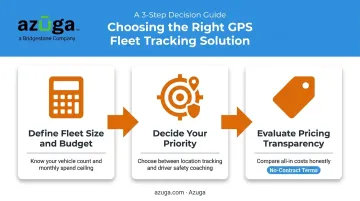
- Define your fleet's size and budget. A 5-vehicle landscaping crew has different needs than a 200-truck logistics operation.
- Decide your priority. Basic location tracking is one goal. Driver safety coaching with video evidence is another. Know which matters more before you shop.
- Evaluate total cost of ownership. Providers that publish pricing and offer month-to-month terms let you test the system without getting locked into a bad fit.
With those priorities set, compare how a real provider delivers on them. Azuga, for example, is built to scale across fleet sizes. Its self-install OBD-II device, packages matched to fleet needs, and 30-second high-frequency tracking on higher tiers remove friction from adoption. Add 24/7 unlimited support, and the platform works whether you're running 3 vehicles or 300.
Choosing the system is only half the job. Rollout tips that actually work:
- Communicate the purpose of tracking to drivers before installation, not after
- Put your policy in writing and have drivers sign off on it
- Start with a pilot group of 5 to 10 vehicles before rolling out fleet-wide
- Review the first month of data with your team to catch false alerts or miscalibrated thresholds early
Frequently Asked Questions
Can an employer track you with GPS?
Yes, employers can generally track company-owned vehicles used for business purposes. Best practice, and in some states a legal requirement, is providing written notice before tracking begins.
What is GPS tracking for company vehicles?
It's a system combining satellite positioning and an onboard device to monitor a business vehicle's real-time location, speed, and driving behavior. Data flows to a cloud dashboard fleet managers can access anytime.
Do employers have to notify employees about GPS tracking?
Notice isn't universally mandated, but it's strongly recommended everywhere. States like New Jersey legally require written notice before tracking employee-driven vehicles.
How much does GPS fleet tracking cost?
Packaging depends on features like dashcams or high-frequency tracking. Packages matched to fleet needs options exist for smaller fleets testing the technology.
What's the difference between GPS tracking and telematics?
GPS tracking answers where a vehicle is. Telematics is the broader term, combining location data with diagnostics, driver behavior, and fuel and maintenance reporting.
Can GPS fleet tracking help lower insurance costs?
Yes. Better driver behavior data and fewer accidents give insurers reason to offer discounts. Ask your provider about telematics-based programs like those from Progressive or The Hartford.