
This kind of breakdown usually traces back to a gap between two things fleets often confuse: fleet maintenance and fleet management. They sound similar, but they solve different problems. As fleets grow past a handful of vehicles, that confusion starts costing real money.
This guide breaks down both terms, shows how they work together, and explains how the right software connects them so breakdowns like the one above become far less common.
Key Takeaways
- Fleet maintenance keeps vehicles roadworthy; fleet management oversees the vehicle lifecycle, drivers, and costs.
- Four core maintenance types exist: preventive, predictive, reactive/corrective, and scheduled routine maintenance.
- A fleet maintenance manager handles vehicle upkeep, while a fleet manager owns broader operational strategy.
- Unified software that combines telematics, GPS tracking, and maintenance alerts cuts costs and downtime.
- The global fleet management market will grow from $32.76B in 2024 to $70.26B by 2030, per MarketsandMarkets.
What Is Fleet Maintenance?
Fleet maintenance is the hands-on work of inspecting, servicing, and repairing vehicles so they stay safe, compliant, and on the road. It's the wrench-turning side of fleet operations, not the strategy side.
Skipping it gets expensive fast. Unplanned downtime costs fleets an estimated $448 to $760 per vehicle per day, according to a Fleet Maintenance industry report. That's before factoring in missed jobs, towing fees, or a driver sitting idle waiting for a replacement vehicle.
Beyond cost, maintenance protects driver safety and preserves resale value. A neglected vehicle depreciates faster and poses a bigger risk on the road.
What Is Fleet Maintenance Management?
Fleet maintenance management is the coordination layer sitting on top of the physical repair work. It's the scheduling, the technician assignments, and the record-keeping that makes sure maintenance actually happens on time.
Platforms like Azuga's fleet maintenance management tools track service history, send automated reminders based on mileage or engine hours, and flag overdue work before it becomes a breakdown. This visibility helps fleet managers catch small issues before they turn into costly breakdowns or compliance failures.
A technician changing brake pads is fleet maintenance. Deciding when that brake job happens, who does it, and logging that it was completed is fleet maintenance management.
What Are the Four Types of Maintenance Management?
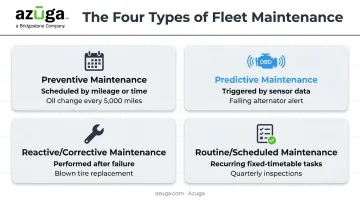
Fleets typically rely on four maintenance approaches, each triggered differently
- Preventive maintenance – Scheduled by mileage or time interval, regardless of vehicle condition. Example: an oil change every 5,000 miles.
- Predictive maintenance – Triggered by diagnostic data or sensor anomalies before a failure occurs. Example: a diagnostic trouble code flagging a failing alternator.
- Reactive/corrective maintenance – Performed after a problem is identified or a failure happens. Example: replacing a blown tire after a puncture.
- Routine/scheduled maintenance – Recurring tasks performed on a fixed timetable as part of a broader preventive strategy. Example: quarterly inspections.
Common fleet maintenance tasks include
- Oil and fluid changes
- Brake inspections and pad replacement
- Tire rotation and pressure checks
- Battery testing
- Fluid level checks (coolant, transmission, brake fluid)
What Is Fleet Management?
Fleet management is the broader discipline that oversees vehicle procurement, driver behavior, fuel spending, regulatory compliance, and cost control across a fleet's entire lifecycle. Maintenance is one piece of this puzzle, not the whole picture.
Fleet management typically covers five core pillars
- Vehicle lifecycle management – Acquisition, utilization, and eventual replacement or resale
- Telematics and tracking – GPS location, route history, and utilization data, often delivered through platforms like Azuga's connected hardware
- Driver management – Behavior monitoring, scorecards, and coaching
- Maintenance and fuel oversight – Service schedules and fuel spend tracking
- Regulatory compliance – DOT requirements, ELD logs, and inspection records
What Is the Role of a Fleet Maintenance Manager (vs. a Fleet Manager)?
These two roles get mixed up constantly, though their day-to-day responsibilities differ sharply.
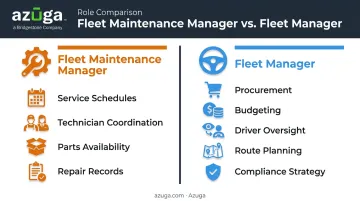
A fleet maintenance manager focuses on service schedules, technician coordination, parts availability, and repair records. Their world is the shop floor and the maintenance calendar.
A fleet manager handles procurement, budgeting, driver oversight, route planning, and compliance strategy. Their focus spans the entire operation, from budgets and routes to compliance strategy.
The primary goals of fleet management stay consistent across industries: reduce operational costs, improve safety, maintain compliance, and boost productivity. This holds true whether you're running plumbing vans, HVAC service trucks, construction equipment haulers, or long-haul trucking rigs.
Fleet Maintenance vs. Fleet management: Key Differences
Here's a side-by-side breakdown of how these disciplines differ in day-to-day practice
| Dimension | Fleet Maintenance | Fleet Management |
|---|---|---|
| Primary focus | Vehicle health and roadworthiness | Operational efficiency and cost control |
| Core data tracked | Service records, repair history | Vehicle utilization, driver behavior, costs |
| Daily users | Maintenance technicians, shop managers | Fleet managers, operations directors |
| Decision impact | Maintenance timing, part replacement | Resource planning, routing, budgeting |
Despite the differences, these two functions overlap in three key areas: cost visibility, asset performance data, and compliance/audit readiness, all feeding into the same bottom line.
In daily operations, the two disciplines constantly inform each other. Maintenance data influences dispatch decisions (you can't send a vehicle with a flagged brake issue to a job site). Inspection outcomes shape replacement planning years down the road.
This distinction matters when choosing software. Fleets with heavy service demands, like a shop running dozens of trucks through frequent repairs, benefit from maintenance-first platforms. Multi-vehicle, multi-driver operations need broader management-first platforms that cover routing, safety, and compliance too.
Most growing fleets eventually need both functions unified in a single dashboard, which is why platforms like Azuga combine maintenance tracking with GPS-based fleet management tools in one system. Splitting maintenance data from operational data creates blind spots in both areas.
Benefits of a Strong Fleet Maintenance & Management Program
A well-run program pays for itself in a few specific ways.
Cost savings. Preventive upkeep is cheaper than emergency repairs, full stop. Azuga's internal data shows fleets saved an average of $9,462 annually by managing maintenance and operational costs more effectively through a unified platform.
Safety improvements. Combining vehicle upkeep with driver behavior monitoring produces measurable results. Fleets using Azuga's telematics and maintenance tools together saw an average 38% decrease in accidents and a 57% reduction in speeding citations.
Compliance and uptime. Automated inspection records and service scheduling help fleets sidestep DOT fines and extend vehicle lifespan. This matters more than most fleets realize. During CVSA's May 2025 International Roadcheck, 10,148 of 56,178 inspected vehicles were placed out of service, an 18.1% out-of-service rate. Brake systems and tires topped the violation categories.
Fleets that stay ahead of these issues with documented maintenance records avoid becoming part of that statistic.
How Fleet Management Software Brings Maintenance and Management Together
Running separate systems for maintenance tracking, GPS location, and driver safety creates duplicate data entry and missed alerts. Modern platforms solve this by pulling everything into one dashboard.
Azuga's approach reflects this shift. The platform uses a plug-and-play OBD-II device that's self-installable in minutes, no technician visit required. Once installed, it delivers high-frequency tracking at 30-second intervals, alongside automated maintenance alerts that flag issues through real-time diagnostic trouble code monitoring.
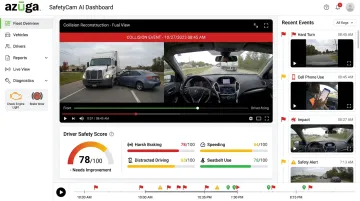
That diagnostic layer works alongside Azuga SafetyCam AI with Collision Reconstruction, which pairs driver safety monitoring with fleet oversight. Azuga's data shows 70% of accidents aren't the fault of the fleet driver. Collision reconstruction footage helps exonerate drivers and reduce litigation risk, turning a potential lawsuit into a closed claim.
These maintenance and safety tools only pay off if the software connecting them is built right. When evaluating fleet software, look for these features
- Automated maintenance reminders tied to mileage, time, or diagnostic triggers
- Real-time vehicle diagnostics for early problem detection
- Driver scorecards tracking speeding, hard braking, and idle time
- Integration with fuel cards and platforms like ServiceTitan for dispatch visibility
Companies like Triton Air, an HVAC service provider, chose Azuga specifically for its ServiceTitan integration, which overlays real-time vehicle location directly onto the dispatch board.
Frequently Asked Questions
What is fleet maintenance management?
Fleet maintenance management is the strategic coordination layer above physical repair work, scheduling services, assigning technician workload, and tracking maintenance records to keep vehicles operational.
What is the role of a fleet maintenance manager?
They schedule inspections, manage parts availability, track repair history, and work to minimize vehicle downtime across the fleet's service operations.
What are the four types of maintenance management?
Preventive (scheduled by time/mileage), predictive (data-triggered before failure), reactive/corrective (after a problem occurs), and routine/scheduled (recurring, fixed-interval tasks).
What is the difference between fleet maintenance and fleet management?
Maintenance focuses on vehicle condition and repairs. Management covers the broader operational, financial, and compliance oversight of the entire fleet.
How does fleet management software help reduce costs?
Platforms like Azuga automate maintenance scheduling, reduces breakdowns through early diagnostics, optimizes routing, and coaches drivers, lowering fuel and insurance costs over time.
Which industries benefit most from fleet maintenance and management systems?
Construction, HVAC, plumbing, trucking, utilities, and other vehicle-dependent service industries that rely heavily on uptime and regulatory compliance see the biggest gains.